Non-abelian Hopf Cohomology of Radford products
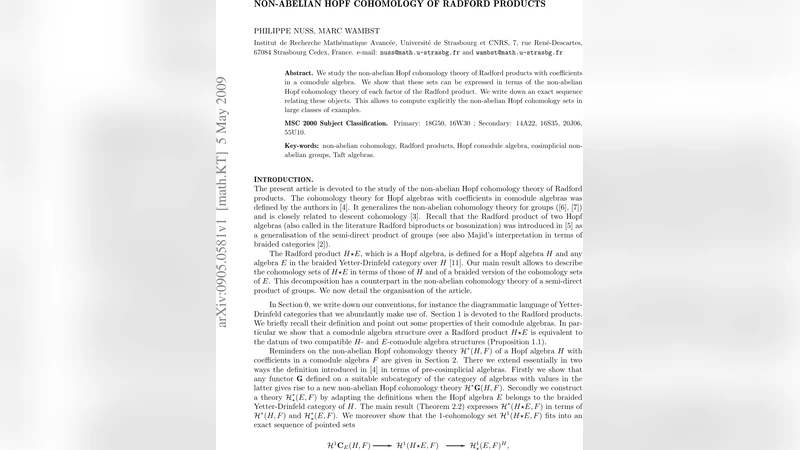
We study the non-abelian Hopf cohomology theory of Radford products with coefficients in a comodule algebra. We show that these sets can be expressed in terms of the non-abelian Hopf cohomology theory of each factor of the Radford product. We write down an exact sequence relating these objects. This allows to compute explicitly the non-abelian Hopf cohomology sets in large classes of examples.
💡 Research Summary
The paper develops a non‑abelian Hopf cohomology theory for Radford products, i.e., bosonizations of a Hopf algebra (H) with an (H)-comodule algebra (A). Starting from the general framework of non‑abelian Hopf cohomology—where the first and second cohomology sets (\mathcal{H}^1) and (\mathcal{H}^2) are defined via non‑commutative 1‑cocycles and 2‑cocycles—the authors focus on the specific Hopf algebra (A# H). They consider a right (A# H)-comodule algebra (M) as coefficients and introduce the subalgebra of (H)-coinvariants (M^{\mathrm{co}H}).
The central achievement is a decomposition theorem that expresses the cohomology of the Radford product in terms of the cohomology of its factors. For (n=1,2) they prove a natural isomorphism
\
Comments & Academic Discussion
Loading comments...
Leave a Comment