A theory for viral capsid assembly around electrostatic cores
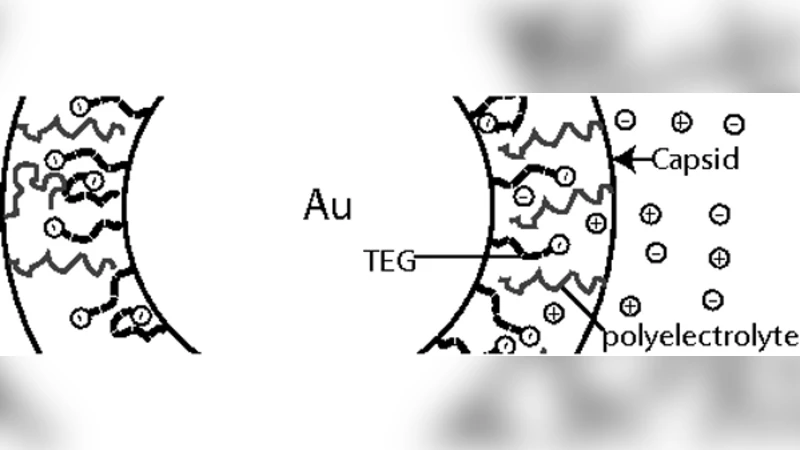
We develop equilibrium and kinetic theories that describe the assembly of viral capsid proteins on a charged central core, as seen in recent experiments in which brome mosaic virus (BMV) capsids assemble around nanoparticles functionalized with polyelectrolyte. We model interactions between capsid proteins and nanoparticle surfaces as the interaction of polyelectrolyte brushes with opposite charge, using the nonlinear Poisson Boltzmann equation. The models predict that there is a threshold density of functionalized charge, above which capsids efficiently assemble around nanoparticles, and that light scatter intensity increases rapidly at early times, without the lag phase characteristic of empty capsid assembly. These predictions are consistent with, and enable interpretation of, preliminary experimental data. However, the models predict a stronger dependence of nanoparticle incorporation efficiency on functionalized charge density than measured in experiments, and do not completely capture a logarithmic growth phase seen in experimental light scatter. These discrepancies may suggest the presence of metastable disordered states in the experimental system. In addition to discussing future experiments for nanoparticle-capsid systems, we discuss broader implications for understanding assembly around charged cores such as nucleic acids.
💡 Research Summary
This paper presents a combined equilibrium and kinetic theoretical framework to describe how viral capsid proteins self‑assemble around a charged central core, a situation that has recently been realized experimentally by coating nanoparticles with polyelectrolytes and allowing Brome Mosaic Virus (BMV) capsid proteins to encapsulate them.
Equilibrium model. The authors treat the functionalized nanoparticle as a charged brush of polyelectrolyte chains grafted to a spherical surface. Using the nonlinear Poisson‑Boltzmann (PB) equation they compute the electrostatic potential and ion distribution surrounding the brush and derive a free‑energy functional ΔG(σ,R) that depends on the surface charge density σ (set by the density of grafted polyelectrolyte) and the particle radius R. The free‑energy landscape exhibits a sharp transition: when σ exceeds a critical value σ_c (which decreases for smaller R), the global minimum corresponds to a fully wrapped capsid–core complex. Below σ_c the partially wrapped or unbound states are favored. This predicts an “electrostatic threshold” for efficient encapsulation.
Kinetic model. Building on the equilibrium picture, the authors formulate a master‑equation description of the assembly pathway. Free capsid subunits bind to the core with an on‑rate k_on that is enhanced by the attractive electrostatic energy (∝ exp
Comments & Academic Discussion
Loading comments...
Leave a Comment