On the Classification of Topological Field Theories
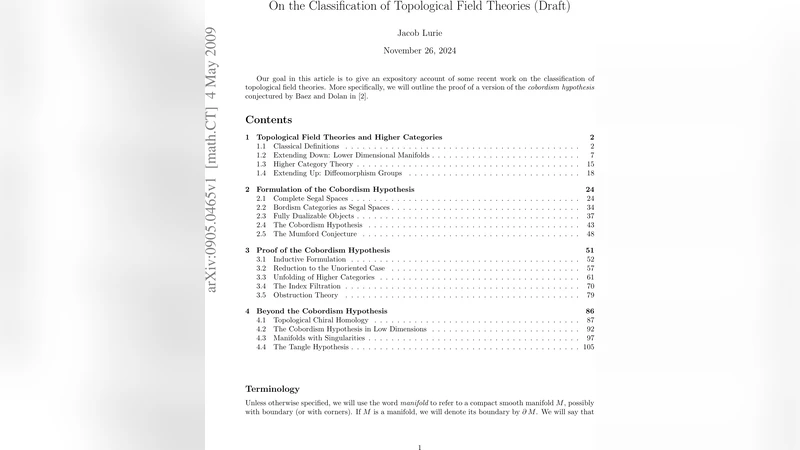
This paper provides an informal sketch of a proof of the Baez-Dolan cobordism hypothesis, which provides a classification for extended topological quantum field theories.
💡 Research Summary
The paper “On the Classification of Topological Field Theories” offers an informal but detailed sketch of a proof of the Baez‑Dolan cobordism hypothesis, which asserts that fully extended topological quantum field theories (TQFTs) are completely classified by fully dualizable objects in a symmetric monoidal higher category. The authors begin by motivating the need for an extended framework: while 2‑dimensional TQFTs are classified by Frobenius algebras, higher‑dimensional theories involve manifolds with corners, and their algebraic data must be organized in an (∞, n)‑category.
In the background sections the paper reviews the language of symmetric monoidal (∞, n)‑categories, the notion of full dualizability (the existence of left and right duals in every dimension together with coherent evaluation and coevaluation morphisms), and Lurie’s theorem that such objects give rise to fully extended TQFTs. The authors then construct the cobordism n‑category Cobₙ as a free symmetric monoidal (∞, n)‑category generated by a single point. Objects are (n‑1)‑dimensional closed manifolds, 1‑morphisms are n‑dimensional cobordisms with boundary, and higher morphisms are diffeomorphisms and isotopies between them. By describing Cobₙ via cellular decomposition and handle attachment, they show that every higher‑dimensional cobordism can be built recursively from the point and its dual data.
A fully extended TQFT is defined as a symmetric monoidal functor Z : Cobₙ → 𝒞, where 𝒞 is a target (∞, n)‑category. The central claim—the cobordism hypothesis—states that such a functor is uniquely determined (up to contractible choice) by the image of the point, provided that image is a fully dualizable object X∈𝒞. The proof sketch proceeds in two main steps. First, the freeness of Cobₙ implies that any object or morphism can be expressed in terms of the point together with the evaluation and coevaluation maps of X; this is the categorical analogue of Morse theory, where each handle corresponds to a dual pair. Second, the coherence conditions for the higher evaluation/coevaluation maps in 𝒞 are shown to match exactly the coherence data required for the higher morphisms in Cobₙ. The authors invoke Lurie’s adjointability results to argue that all higher isotopies automatically satisfy the necessary commutative diagrams, thereby guaranteeing that Z respects the full (∞, n)‑categorical structure.
To illustrate the hypothesis, the paper discusses three emblematic examples. In two dimensions, the fully dualizable object is a commutative Frobenius algebra, reproducing the classic classification of 2‑D TQFTs. In three dimensions, a modular tensor category serves as the fully dualizable object, and the associated TQFT recovers the Reshetikhin‑Turaev construction of Chern‑Simons theory. In four dimensions, the authors point to a suitable 2‑category (often built from braided monoidal categories) whose fully dualizable objects encode the data of Donaldson‑Witten theory. Each example demonstrates how the abstract hypothesis translates into concrete algebraic structures that physicists already use.
The conclusion emphasizes that the cobordism hypothesis provides a universal classification scheme for all fully extended TQFTs, turning the problem of constructing such theories into the problem of finding fully dualizable objects in suitable higher categories. The authors acknowledge that their proof remains informal; they outline future work needed to formalize the higher‑categorical coherence, to develop computational tools for identifying dualizable objects, and to explore connections with factorization homology and the classification of invertible field theories. Overall, the paper serves as a bridge between the abstract homotopy‑theoretic formulation of the cobordism hypothesis and the concrete models used in mathematical physics, offering both a conceptual roadmap and a set of illustrative cases that underscore the hypothesis’s power and breadth.