Derived Algebraic Geometry V: Structured Spaces
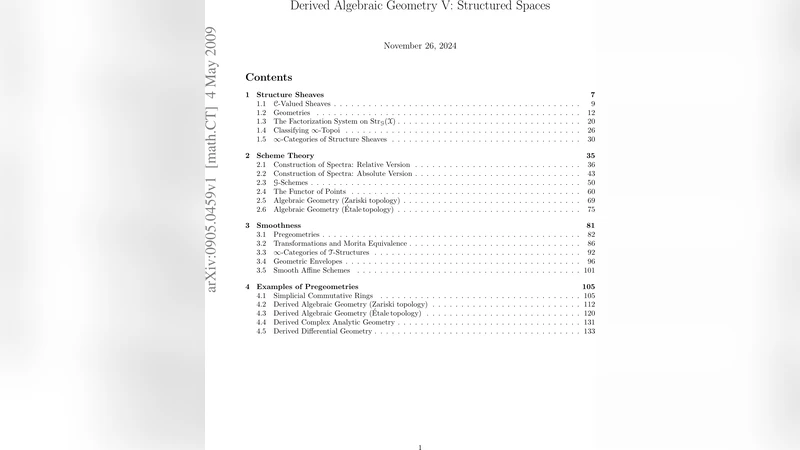
In this paper, we describe a general theory of “spaces with structure sheaves.” Specializations of this theory include the classical theory of schemes, the theory of Deligne-Mumford stacks, and their derived generalizations.
💡 Research Summary
The paper “Derived Algebraic Geometry V: Structured Spaces” develops a unified categorical framework for spaces equipped with sheaves of derived algebraic structures. Starting from an ∞‑topos, the authors introduce the notion of a “structured sheaf” – a sheaf of simplicial commutative rings or, more generally, an E∞‑algebra – which endows the underlying ∞‑topos with derived algebraic data. A pair consisting of an ∞‑topos together with such a sheaf is called a “structured space”.
A model structure on the category of structured spaces is constructed by declaring morphisms to be weak equivalences when they induce equivalences on the underlying sheaves. This makes the category of structured spaces a complete ∞‑category, allowing one to treat classical schemes, Deligne–Mumford stacks, and their derived analogues uniformly. The authors then define two central subclasses: derived schemes and derived stacks. A derived scheme is a structured space that is locally equivalent to a derived affine space Spec R, where R is a simplicial commutative ring. Derived stacks are obtained by gluing derived schemes along étale or fppf covers, thus providing the derived counterpart of Deligne–Mumford stacks. The paper proves that these definitions recover the classical notions when the sheaves are discrete, while simultaneously preserving higher homotopical information.
A key technical contribution is the derived “affinization” functor, which assigns to any structured space its universal map to a derived affine space. This functor is shown to be left adjoint to the inclusion of derived affines, and it respects the ∞‑categorical structure, ensuring that push‑forwards and pull‑backs of sheaves behave correctly in the derived setting. The authors also develop a theory of affine morphisms between structured spaces, characterizing them by the preservation of the derived algebraic structure under base change.
The final section applies the framework to moduli problems. By working in the internal Hom of the ∞‑category of structured spaces, the authors construct derived moduli stacks that parametrize objects such as perfect complexes, derived Poisson structures, and derived smooth maps. They introduce derived notions of dimension and smoothness, showing how these invariants can be read off from the cotangent complex of the underlying structured sheaf. This yields a robust derived deformation theory that unifies classical deformation theory with modern homotopical methods.
Overall, the paper provides a comprehensive theory of structured spaces that subsumes schemes, stacks, and their derived versions. It offers a powerful language for formulating and solving derived moduli problems, and it lays the groundwork for future developments in derived algebraic geometry, higher categorical geometry, and homotopical algebraic structures.
Comments & Academic Discussion
Loading comments...
Leave a Comment