Derived Algebraic Geometry IV: Deformation Theory
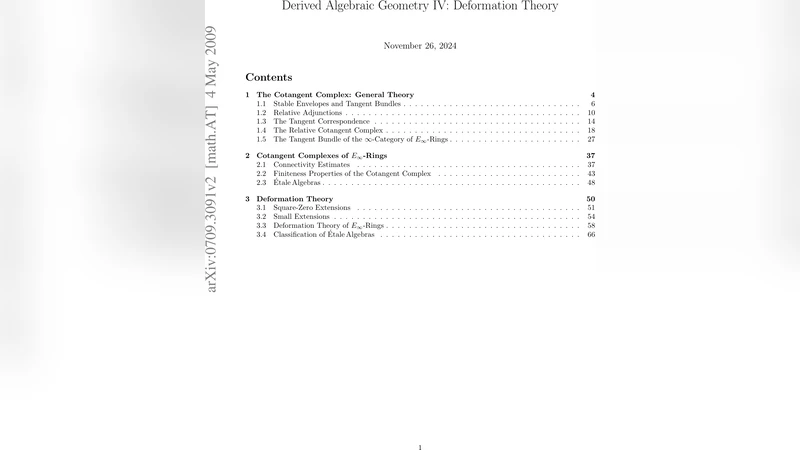
In this paper, we prove some foundational results on the deformation theory of E-infinity ring spectra.
💡 Research Summary
The paper establishes a foundational framework for the deformation theory of E∞‑ring spectra within derived algebraic geometry. After a concise review of Lurie’s ∞‑categorical approach to commutative ring spectra, the author introduces the cotangent complex L_{A/A₀} for a base spectrum A₀ and a deformation A, and shows that this complex serves as the universal controlling object for infinitesimal extensions. By adapting Lurie’s formal moduli problems to the setting of Alg_{E∞}, the work proves that small extensions are classified by obstruction classes living in H²(L_{A/A₀}), and that a Postnikov tower provides a step‑by‑step construction of higher deformations. Each stage is governed by a differential map d : πₙ(A) → π_{n‑1}(L_{A/A₀}), which transmits obstructions to the next level, guaranteeing convergence under appropriate completeness hypotheses (a‑adic, p‑adic, etc.).
A central theorem asserts that any complete E∞‑ring spectrum gives rise to a complete formal moduli stack; the proof relies on a weakened commutativity condition that allows non‑strictly commutative spectra to fit into the same deformation picture. The paper further establishes a “homological completeness” principle: all higher obstructions are detected in the higher cohomology H^{>1}(L_{A/A₀}), so the deformation problem reduces entirely to the homology of the cotangent complex.
Concrete calculations are carried out for the complex K‑theory spectrum KU and the complex cobordism spectrum MU. For each, the author computes the homotopy groups, identifies the cotangent complex, and explicitly shows how obstruction classes vanish, thereby producing unobstructed deformations. These examples illustrate how the abstract theory translates into tangible spectral data.
In the concluding section, the author outlines future directions, including extending formal moduli theory to derived algebraic stacks, investigating interactions between higher operations (e.g., power operations) and deformation classes, and applying the framework to higher categorical dualities in homotopy theory and mathematical physics. Overall, the paper provides a rigorous ∞‑categorical foundation for deformations of E∞‑ring spectra, bridges abstract derived geometry with explicit spectral computations, and opens pathways for further exploration in higher algebra and its applications.
Comments & Academic Discussion
Loading comments...
Leave a Comment