Characterizations of Stable Model Semantics for Logic Programs with Arbitrary Constraint Atoms
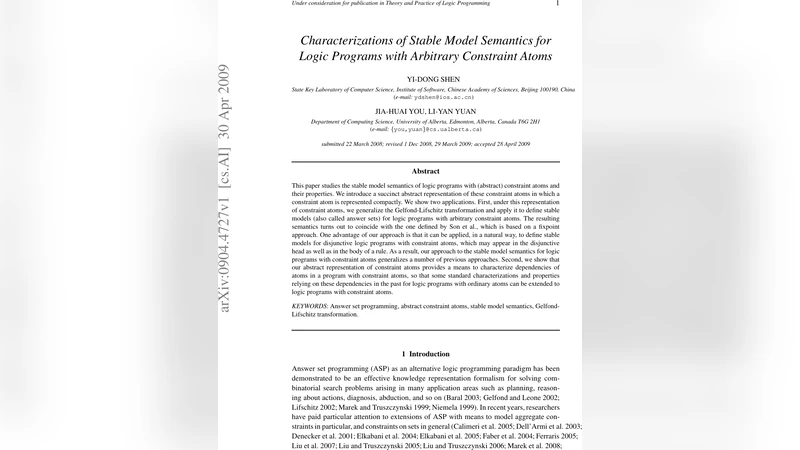
This paper studies the stable model semantics of logic programs with (abstract) constraint atoms and their properties. We introduce a succinct abstract representation of these constraint atoms in which a constraint atom is represented compactly. We show two applications. First, under this representation of constraint atoms, we generalize the Gelfond-Lifschitz transformation and apply it to define stable models (also called answer sets) for logic programs with arbitrary constraint atoms. The resulting semantics turns out to coincide with the one defined by Son et al., which is based on a fixpoint approach. One advantage of our approach is that it can be applied, in a natural way, to define stable models for disjunctive logic programs with constraint atoms, which may appear in the disjunctive head as well as in the body of a rule. As a result, our approach to the stable model semantics for logic programs with constraint atoms generalizes a number of previous approaches. Second, we show that our abstract representation of constraint atoms provides a means to characterize dependencies of atoms in a program with constraint atoms, so that some standard characterizations and properties relying on these dependencies in the past for logic programs with ordinary atoms can be extended to logic programs with constraint atoms.
💡 Research Summary
The paper addresses a fundamental limitation of Answer Set Programming (ASP) – the lack of a unified treatment for various kinds of constraints such as weight, cardinality, and aggregates. To overcome this, the authors introduce an abstract representation of constraint atoms (c‑atoms). A c‑atom is denoted as a pair (D, C) where D is a finite set of ordinary atoms (the domain) and C ⊆ 2^D is a collection of admissible subsets of D. This compact notation can encode any previously studied constraint and also allows the definition of new ones without changing the underlying formalism.
Having fixed a uniform syntax, the authors turn to semantics. They generalize the classic Gelfond‑Lifschitz (GL) transformation, which is the cornerstone of the stable‑model (answer‑set) semantics for normal logic programs. For a given interpretation I, the generalized GL transformation proceeds as follows: (i) all negative literals “not b” are removed exactly as in the original GL step; (ii) each c‑atom A = (D, C) appearing in the body is evaluated with respect to I by checking whether the projection I∩D belongs to C. If the c‑atom evaluates to true, it is simply dropped from the rule; if it evaluates to false, the whole rule is discarded. The result is a positive program P^I that may still contain c‑atoms but no negation‑as‑failure.
A stable model is then defined in the usual way: an interpretation I is a stable model of the original program P if I coincides with the minimal model of P^I. The authors prove that this definition is equivalent to the fixpoint‑based semantics introduced by Son, Pontelli, and Tu (2006). Consequently, the new approach inherits all the desirable properties of the Son et al. semantics while offering a more operational perspective that aligns with existing GL‑based implementations.
A major contribution of the work is the seamless extension to disjunctive logic programs. In the generalized framework, c‑atoms may appear both in the body and in the disjunctive head of a rule. When a c‑atom occurs in the head, its satisfaction restricts which disjuncts can be chosen in a stable model. The transformation handles this uniformly: after evaluating the body c‑atoms, the head is treated as a set of ordinary atoms whose selection is conditioned on the truth of the head c‑atom. This yields a natural definition of stable models for disjunctive programs with arbitrary c‑atoms, something that earlier approaches could not accommodate without ad‑hoc modifications.
Beyond semantics, the abstract representation enables a systematic analysis of dependencies among atoms. The authors construct a dependency graph that treats each c‑atom as a virtual node connected to all atoms in its domain D. Positive edges are added from a rule’s head atom to each domain atom when the c‑atom appears positively; negative edges are added when the c‑atom occurs under negation‑as‑failure. This graph generalizes the classic positive/negative dependency notions and allows the transfer of well‑known results such as acyclicity, tightness, and loop formulas to programs containing c‑atoms. For instance, a program is tight if every cycle in the graph contains at least one negative edge, a condition that now also accounts for cycles introduced by c‑atoms. Consequently, existence guarantees, complexity bounds, and modularity results that rely on these graph properties remain valid in the richer setting.
The paper also discusses practical implications. Since the generalized GL transformation differs from the original only by an additional evaluation step for c‑atoms, existing ASP solvers can be extended with minimal engineering effort. The abstract c‑atom format can be compiled into standard ASP constraints or handled by dedicated propagators, enabling efficient grounding and solving. Moreover, the dependency analysis can be employed for program optimization, dead‑code elimination, and modular compilation, mirroring techniques already used in conventional ASP systems.
In summary, the authors provide a comprehensive theoretical framework that (1) unifies the representation of arbitrary constraints, (2) extends the GL‑based stable‑model semantics to both normal and disjunctive programs with c‑atoms, (3) proves equivalence with the established fixpoint semantics, and (4) generalizes dependency‑based characterizations to the new setting. This work not only consolidates several previously fragmented approaches but also opens the door for more expressive and analytically tractable ASP applications.