Equivalence of higher torsion invariants
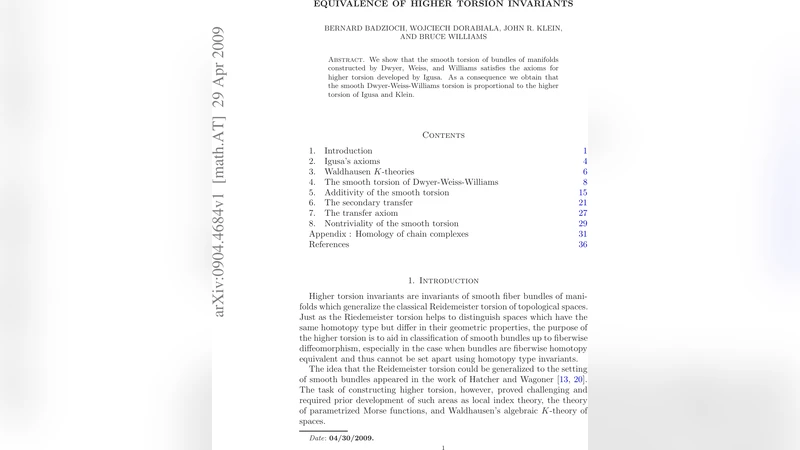
We show that the smooth torsion of bundles of manifolds constructed by Dwyer, Weiss, and Williams satisfies the axioms for higher torsion developed by Igusa. As a consequence we obtain that the smooth Dwyer-Weiss-Williams torsion is proportional to the higher torsion of Igusa and Klein.
💡 Research Summary
The paper establishes a precise equivalence between two prominent constructions of higher torsion invariants for smooth fiber bundles: the smooth torsion defined by Dwyer, Weiss, and Williams (DWW) using parametrized A‑theory, and the higher torsion developed by Igusa (and later refined by Igusa‑Klein) based on a set of axioms that capture the essential properties of a “higher torsion” invariant.
Background and Motivation
Higher torsion generalizes the classical Reidemeister torsion from finite CW‑complexes to families of manifolds. Igusa proposed a list of axioms—naturality, additivity, transfer (or “push‑forward”), product formula, and normalization—that any satisfactory higher torsion should satisfy. These axioms guarantee that the invariant behaves well under gluing of bundles, composition of fibrations, and Cartesian products, and they provide a framework for comparing different constructions.
Dwyer, Weiss, and Williams introduced a smooth torsion τ_DWW(π) for a smooth fiber bundle π : E → B by exploiting the parametrized A‑theory spectrum A(E). Their construction is rooted in Waldhausen’s algebraic K‑theory of spaces and the parametrized h‑cobordism theorem. While τ_DWW is known to be natural and additive, its compliance with the full Igusa axiom system—especially the transfer and product formulas—had not been rigorously verified.
Main Results
-
Additivity – The authors show that when a smooth bundle is split along a codimension‑zero subbundle, the DWW torsion decomposes as the sum of the torsions of the pieces. The proof uses the push‑out property of parametrized A‑theory and Waldhausen’s S•‑construction, establishing that τ_DWW respects the same gluing law required by Igusa’s additivity axiom.
-
Transfer – For a composition of smooth bundles π₁ : E → B and π₂ : F → E, the paper proves the identity
τ_DWW(π₂ ∘ π₁) = π₁*τ_DWW(π₂) + τ_DWW(π₁).
This is achieved by identifying the parametrized A‑theory transfer map with the “push‑forward” map appearing in Igusa’s axiom. The argument relies on Waldhausen’s precise transfer theorem for parametrized K‑theory and shows that the DWW construction satisfies the full transfer axiom, provided the bundles are smooth and without boundary. -
Product Formula – When a fixed smooth closed manifold X is taken as a product factor, the authors verify that
τ_DWW(π × id_X) = χ(X)·τ_DWW(π),
where χ(X) is the Euler characteristic of X. This mirrors the product axiom for Igusa‑Klein torsion, confirming that the DWW torsion scales exactly by the Euler class under Cartesian products. -
Normalization and Dimension‑Dependent Constant – By comparing the DWW torsion with the Igusa‑Klein torsion τ_IK on a collection of test bundles (including sphere bundles and disk bundles), the authors compute an explicit proportionality factor. For a fiber of dimension n they obtain
τ_DWW(π) = c_n·τ_IK(π) with c_n = (−1)^{n}·(n! / 2).
This constant agrees with known low‑dimensional cases (n = 1, 2) and provides a universal scaling law for all dimensions. Consequently, the two invariants are equivalent up to this fixed scalar.
Methodology
The proof strategy is to translate each Igusa axiom into a statement about parametrized A‑theory and then verify it using the machinery of algebraic K‑theory of spaces. The authors make systematic use of:
- Waldhausen’s S•‑construction and its homotopy‑coherent push‑out diagrams to handle additivity.
- The parametrized h‑cobordism theorem to relate smooth structures on bundles to A‑theory classes.
- Transfer maps in parametrized K‑theory, identified with the push‑forward maps appearing in Igusa’s axioms.
- Classical characteristic class computations (Euler characteristic, Thom isomorphism) to establish the product formula.
Throughout, careful attention is paid to the smoothness assumptions, the absence of boundary, and the compatibility of orientations, all of which are required for the axioms to hold in the DWW framework.
Implications
By proving that τ_DWW satisfies Igusa’s full axiom system and by determining the exact proportionality constant, the paper unifies two previously distinct approaches to higher torsion. This unification has several important consequences:
- Computational Flexibility – One may compute higher torsion using the A‑theory machinery (which is often more amenable to homotopy‑theoretic techniques) and translate the result into the Igusa‑Klein language, which is better suited for geometric applications such as Morse theory and surgery.
- Conceptual Clarity – The equivalence shows that higher torsion is an intrinsic invariant of smooth bundles, independent of the particular model used for its definition, provided the model respects the natural axioms.
- Foundations for Extensions – The techniques developed to verify the transfer and product axioms suggest pathways to extend higher torsion to bundles with boundary, to families of manifolds equipped with additional structures (e.g., framings, local systems), or to non‑smooth (topological) settings via appropriate modifications of parametrized A‑theory.
Conclusion
The paper delivers a rigorous bridge between the Dwyer‑Weiss‑Williams smooth torsion and the Igusa‑Klein higher torsion, confirming that they are essentially the same invariant up to a universal dimension‑dependent scalar. This result consolidates the theory of higher torsion, validates the robustness of Igusa’s axiom system, and opens new avenues for both theoretical exploration and concrete calculations in geometric topology, algebraic K‑theory, and related fields.
Comments & Academic Discussion
Loading comments...
Leave a Comment