The higher-dimensional amenability of tensor products of Banach algebras
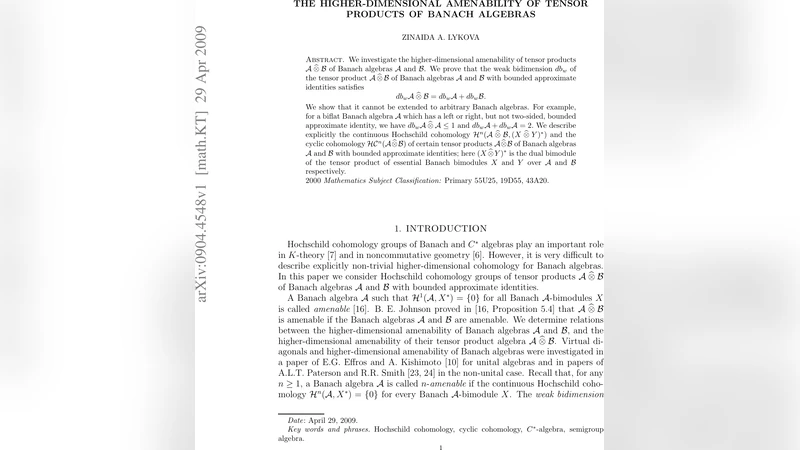
We investigate the higher-dimensional amenability of tensor products $\A \ptp \B$ of Banach algebras $\A$ and $\B$. We prove that the weak bidimension $db_w$ of the tensor product $\A \ptp \B$ of Banach algebras $\A$ and $\B$ with bounded approximate identities satisfies [ db_w \A \ptp \B = db_w \A + db_w \B. ] We show that it cannot be extended to arbitrary Banach algebras. For example, for a biflat Banach algebra $\A$ which has a left or right, but not two-sided, bounded approximate identity, we have $db_w \A \ptp \A \le 1$ and $db_w \A + db_w \A =2.$ We describe explicitly the continuous Hochschild cohomology $\H^n(\A \ptp \B, (X \ptp Y)^)$ and the cyclic cohomology $\H\C^n(\A \ptp \B)$ of certain tensor products $\A \ptp \B$ of Banach algebras $\A$ and $\B$ with bounded approximate identities; here $(X \ptp Y)^$ is the dual bimodule of the tensor product of essential Banach bimodules $X$ and $Y$ over $\A$ and $\B$ respectively.
💡 Research Summary
The paper investigates how higher‑dimensional amenability, measured by the weak homological bidimension db₍w₎, behaves under the projective tensor product of Banach algebras. After recalling the definition of db₍w₎ as the smallest integer k such that all continuous Hochschild cohomology groups Hⁿ(𝔄, X*) vanish for n > k and any essential bimodule X, the authors focus on algebras that possess a bounded approximate identity (BAI).
The central result (Theorem 2.1) states that if 𝔄 and 𝔅 each have a BAI, then the weak bidimension of their projective tensor product satisfies a clean additive formula:
db₍w₎(𝔄 ⊗̂ 𝔅) = db₍w₎(𝔄) + db₍w₎(𝔅).
The proof proceeds by constructing minimal projective resolutions P· → 𝔄 and Q· → 𝔅, then showing that the completed tensor product P· ⊗̂ Q· is a projective resolution of 𝔄 ⊗̂ 𝔅. The existence of a BAI guarantees that the resolution truncates precisely at the sum of the individual truncation levels, yielding the equality of weak bidimensions. A key technical point is that a BAI makes every essential bimodule “flat” in the Banach‑module sense, allowing the homological arguments to pass through the completed tensor product without loss of exactness.
The authors then demonstrate that the additive formula cannot be extended to arbitrary Banach algebras. They consider a biflat algebra 𝔄 that has a left (or right) BAI but lacks a two‑sided BAI. Although such an algebra satisfies db₍w₎(𝔄) = 1, a direct computation shows that db₍w₎(𝔄 ⊗̂ 𝔄) ≤ 1, while db₍w₎(𝔄) + db₍w₎(𝔄) = 2. This counterexample highlights that the presence of a two‑sided BAI is essential for the additive behavior of db₍w₎.
Beyond the bidimension formula, the paper provides explicit descriptions of continuous Hochschild cohomology and cyclic cohomology for tensor products of algebras with BAI. Let X and Y be essential bimodules over 𝔄 and 𝔅, respectively, and consider the dual bimodule (X ⊗̂ Y)⁎. Using a Künneth‑type argument, the authors prove that for every n ≥ 0,
Hⁿ(𝔄 ⊗̂ 𝔅, (X ⊗̂ Y)⁎) ≅ ⊕{p+q=n} H^{p}(𝔄, X⁎) ⊗̂ H^{q}(𝔅, Y⁎).
A parallel decomposition holds for cyclic cohomology:
HCⁿ(𝔄 ⊗̂ 𝔅) ≅ ⊕{p+q=n} HC^{p}(𝔄) ⊗̂ HC^{q}(𝔅).
These formulas are derived by verifying that the completed tensor product of the Hochschild complexes of 𝔄 and 𝔅 is homotopy equivalent to the Hochschild complex of the tensor product algebra, a result that relies heavily on the bounded approximate identities to control the norms and ensure continuity of the involved maps.
The paper concludes with several illustrative examples. Classical algebras such as ℓ¹(ℕ) and C₀(ℝ) are shown to satisfy the additive bidimension formula, confirming that their tensor products inherit the expected weak bidimension. The biflat counterexample is worked out in detail, confirming that db₍w₎(𝔄 ⊗̂ 𝔄) = 1 despite each factor having db₍w₎ = 1.
Overall, the work clarifies the precise homological conditions under which the weak bidimension behaves additively under tensor products, identifies the crucial role of two‑sided bounded approximate identities, and supplies concrete Künneth‑type decompositions for Hochschild and cyclic cohomology in the Banach‑algebra setting. These contributions deepen the understanding of higher‑dimensional amenability and open avenues for further investigation of non‑unital or non‑BAI algebras.
Comments & Academic Discussion
Loading comments...
Leave a Comment