Ionization and charge migration through strong internal fields in clusters exposed to intense X-ray pulses
A general scenario for electronic charge migration in finite samples illuminated by an intense laser pulse is given. Microscopic calculations for neon clusters under strong short pulses as produced by X-ray free-electron laser sources confirm this scenario and point to the prominent role of field ionization by strong internal fields. The latter leads to the fast formation of a core-shell system with an almost static core of screened ions while the outer shell explodes. Substituting the shell ions with a different material such as helium as a sacrificial layer leads to a substantial improvement of the diffraction image for the embedded cluster thus reducing the consequences of radiation damage for coherent diffractive imaging.
💡 Research Summary
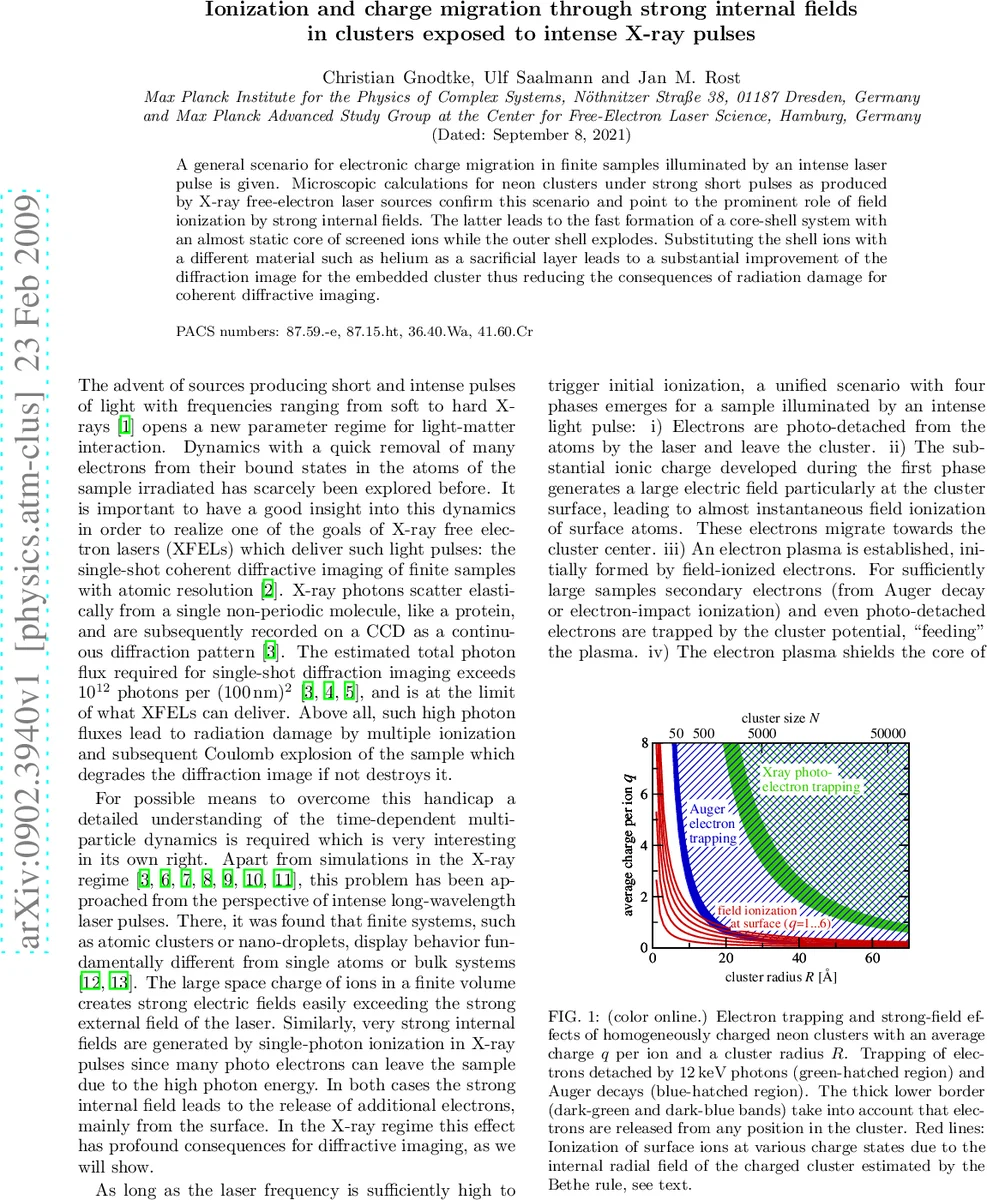
The paper presents a comprehensive theoretical and computational study of charge migration and ionization dynamics in finite neon clusters exposed to intense, short‑duration X‑ray free‑electron‑laser (XFEL) pulses. The authors identify a unified four‑phase scenario that applies across a wide range of sample sizes, pulse lengths, and photon energies. First, photo‑electrons are stripped from atoms by the incoming 12 keV photons and leave the cluster. The resulting positive charge creates a strong internal electric field, especially at the cluster surface, which immediately triggers field ionization of surface atoms. The electrons released by this field ionization migrate toward the cluster center, forming a dense electron plasma that screens the interior ions. Consequently, the cluster evolves into a core‑shell configuration: a quasi‑neutral core with negligible internal field and an outer positively charged shell that undergoes rapid Coulomb explosion. This mechanism operates on sub‑femtosecond timescales, preceding the Auger decay (≈ 2.5 fs) that supplies additional electrons in conventional models.
To quantify these effects, the authors perform classical molecular dynamics simulations augmented with quantum‑mechanical photo‑ionization and Auger rates. They incorporate field ionization by propagating the least‑bound electron of each atom/ion in the full Coulomb field of all particles, using a fast‑multipole method to keep the computational cost manageable for clusters up to 15 000 atoms. Two sets of simulations are compared: one including field ionization and one where it is artificially suppressed. The results show that field ionization dramatically reduces the average ionic displacement ⟨Δr⟩—by up to 20 % for the whole cluster and by as much as 75 % for the inner half (the core)—even though the total charge of the cluster is comparable. Larger clusters experience stronger Coulomb forces and thus larger displacements, but the core‑shell separation persists, with the core remaining essentially static while the shell explodes.
Recognizing that the exploding shell is the primary source of radiation damage in coherent diffractive imaging, the authors propose using a sacrificial layer of a different material. They embed a Ne₁₅₀₀ cluster in a He₁₅₀₀₀ droplet and repeat the simulations. The positive charge rapidly migrates into the helium, which then explodes, leaving the neon core largely intact. To assess imaging performance, they calculate diffraction patterns at 2 Å resolution, define an R‑factor that measures deviation from an ideal undamaged pattern, and compare the embedded and bare clusters. The helium‑capped system exhibits a substantially lower R‑factor, indicating higher fidelity. Moreover, the embedded system tolerates pulse durations more than five times longer (from 2.5 fs to ≈ 14 fs) before reaching comparable damage levels, effectively extending the usable parameter space of XFEL imaging.
In summary, the study demonstrates that internal field ionization is a fast, efficient driver of charge migration that creates a protective neutral core and a destructive charged shell. By surrounding the sample with a sacrificial material such as helium, one can channel the destructive dynamics into the outer layer, preserving the structural integrity of the target during the XFEL exposure. This insight provides a practical pathway to mitigate radiation damage in single‑shot, high‑resolution coherent diffractive imaging, potentially enabling longer pulses or higher photon fluxes without compromising image quality.
Comments & Academic Discussion
Loading comments...
Leave a Comment