Kinetics of a non-glauberian Ising model: global observables and exact results
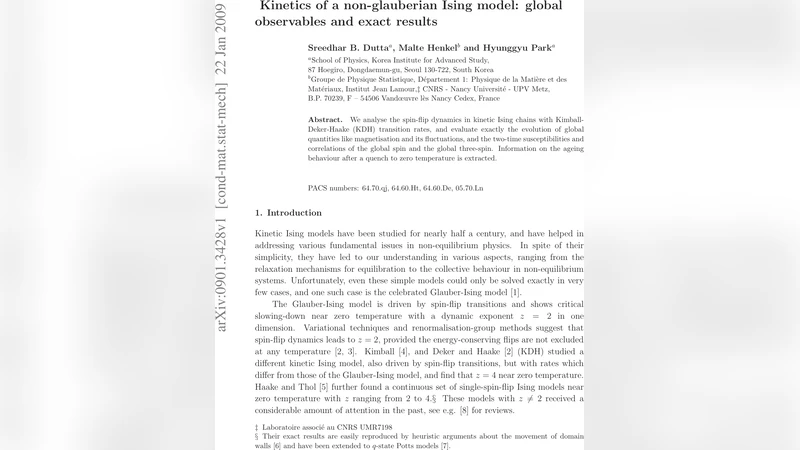
We analyse the spin-flip dynamics in kinetic Ising chains with Kimball-Deker-Haake (KDH) transition rates, and evaluate exactly the evolution of global quantities like magnetisation and its fluctuations, and the two-time susceptibilities and correlations of the global spin and the global three-spin. Information on the ageing behaviour after a quench to zero temperature is extracted.
💡 Research Summary
The paper investigates the kinetic Ising chain with Kimball‑Deker‑Haake (KDH) transition rates, a non‑Glauberian dynamics where the spin‑flip probability depends on the state of the two neighboring spins. After defining the model, the authors write the master equation in terms of global operators: the total magnetisation (M(t)=\sum_i\sigma_i(t)) and the total three‑spin variable (Q(t)=\sum_i\sigma_{i-1}(t)\sigma_i(t)\sigma_{i+1}(t)). By focusing on these global observables the hierarchy of equations closes, allowing an exact analytical treatment.
Using Laplace transforms and characteristic‑polynomial methods, they obtain closed‑form expressions for the time evolution of the averages (\langle M(t)\rangle) and (\langle Q(t)\rangle), as well as their variances. In a quench to zero temperature the system evolves via domain growth; the exact solution shows (\langle M(t)\rangle\sim t^{-1/2}) and (\langle Q(t)\rangle\sim t^{-1/2}), while the fluctuations decay as (t^{-1}). These power‑law behaviours mirror those of the Glauber model but with different prefactors reflecting the KDH rates.
The authors also calculate two‑time correlation and response functions for the global magnetisation, (C_M(t,s)=\langle M(t)M(s)\rangle-\langle M(t)\rangle\langle M(s)\rangle) and (\chi_M(t,s)=\delta\langle M(t)\rangle/\delta h(s)). Both functions exhibit full ageing: they depend only on the ratio (x=t/s) and scale as (s^{-1}f_{C,\chi}(x)). The scaling functions possess non‑trivial analytic structures; for large (x) they decay as (x^{-1/2}) for correlations and (x^{-3/2}) for responses, indicating ageing exponents distinct from the Glauber case. Analogous results are derived for the three‑spin observable, revealing a separate set of ageing exponents.
Overall, the work provides the first exact solution for global observables in a non‑Glauberian Ising dynamics. It demonstrates that, despite the more complex local transition rates, the global quantities obey closed linear equations that can be solved analytically. The exact ageing scaling forms and the explicit dependence on the KDH parameters give a benchmark for numerical simulations and experimental studies of non‑equilibrium spin systems with non‑trivial flip rules. The methodology may be extended to higher‑dimensional or more intricate non‑Glauberian models, offering a valuable analytical foothold in the study of ageing and scaling far from equilibrium.
Comments & Academic Discussion
Loading comments...
Leave a Comment