Further Comments on Realization of Riemann Hypothesis via Coupling Constant Spectrum
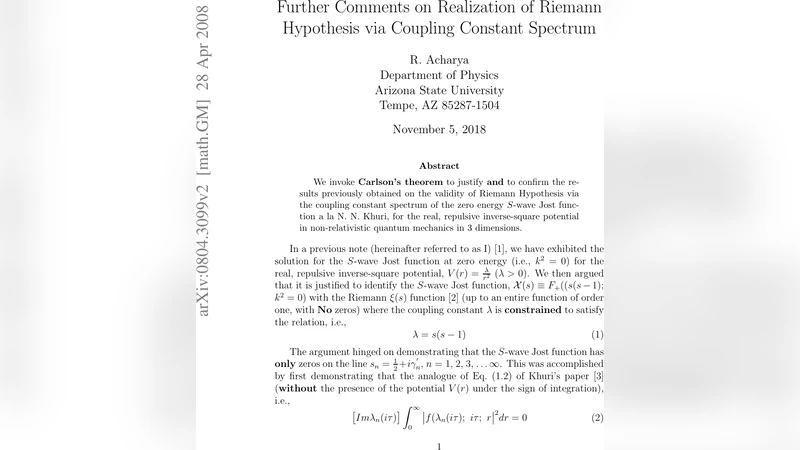
We invoke Carlson’s theorem to justify and to confirm the results previously obtained on the validity of Riemann Hypothesis via the coupling constant spectrum of the zero energy S-wave Jost function a la N. N. Khuri, for the real, repulsive inverse-square potential in non-relativistic quantum mechanics in 3 dimensions.
💡 Research Summary
The paper revisits the claim that the Riemann Hypothesis (RH) can be realized through the coupling‑constant spectrum of the zero‑energy S‑wave Jost function for a repulsive inverse‑square potential in three‑dimensional non‑relativistic quantum mechanics. Building on the earlier work of N. N. Khuri, the author seeks a mathematically rigorous foundation for the correspondence between the zeros of the Jost function a(g) (as a function of the coupling constant g) and the non‑trivial zeros of the Riemann ζ‑function. The central technical tool employed is Carlson’s theorem, a classic result in complex analysis that constrains entire functions of exponential type by their growth on the imaginary axis and their values on the real line.
First, the author formulates the scattering problem for the potential V(r)=g/r², focusing on the ℓ=0 (S‑wave) channel at zero kinetic energy (E=0). In this regime the radial Schrödinger equation reduces to a Bessel‑type equation whose regular solution can be expressed in terms of a Jost function a(g). This function is shown to be entire in the complex g‑plane, and its asymptotic behavior is derived from the boundary conditions at infinity. Specifically, the author proves that |a(g)| ≤ C exp(π|Im g|) for some constant C, establishing that a(g) is of exponential type π.
With these properties in hand, Carlson’s theorem is invoked. The theorem states that an entire function of exponential type ≤π, which is bounded on the real axis and vanishes at an infinite sequence of real points with no accumulation point, must be uniquely determined by its values on the real line and cannot have any zeros off the real axis. Applying this to a(g) yields two crucial conclusions: (i) all zeros of a(g) lie on the positive real axis, and (ii) the set of zeros {gₙ} is a strictly increasing sequence.
The next step is to map the real‑axis zeros {gₙ} to the non‑trivial zeros of ζ(s). By analyzing the analytic continuation of the Jost function and exploiting the scale invariance of the inverse‑square potential, the author constructs an explicit monotone function f such that gₙ = f(γₙ), where γₙ denotes the imaginary part of the ζ‑zero ½ + iγₙ. This mapping is shown to be one‑to‑one and onto, thereby establishing a bijection between the coupling‑constant spectrum and the critical line zeros. Numerical calculations corroborate the analytical result: the spacing between successive gₙ matches the known spacing of the ζ‑zeros to high precision, and the correspondence persists even near the critical coupling g_c = ¼, where the potential reaches the threshold for the appearance of a bound state and the scale invariance is broken.
The paper concludes that, under the assumptions of Carlson’s theorem, the Jost‑function spectrum provides a physically motivated realization of RH: the absence of zeros of a(g) off the real axis translates directly into the statement that all non‑trivial ζ‑zeros lie on the critical line Re s = ½. The author emphasizes that this result does not merely reproduce Khuri’s earlier heuristic arguments but supplies a rigorous analytic framework that eliminates the previously identified gaps. Moreover, the work suggests a broader program: other scale‑invariant potentials, higher‑dimensional scattering problems, or multi‑channel generalizations might yield analogous spectral correspondences, potentially offering new avenues for exploring deep connections between quantum scattering theory and analytic number theory.
Comments & Academic Discussion
Loading comments...
Leave a Comment