Ingenierie syst`eme dun syst`eme dinformation dentreprise centre sur le produit basee sur un cadre de modelisation multi-echelles : application `a un cas detude de lAIP lorrain
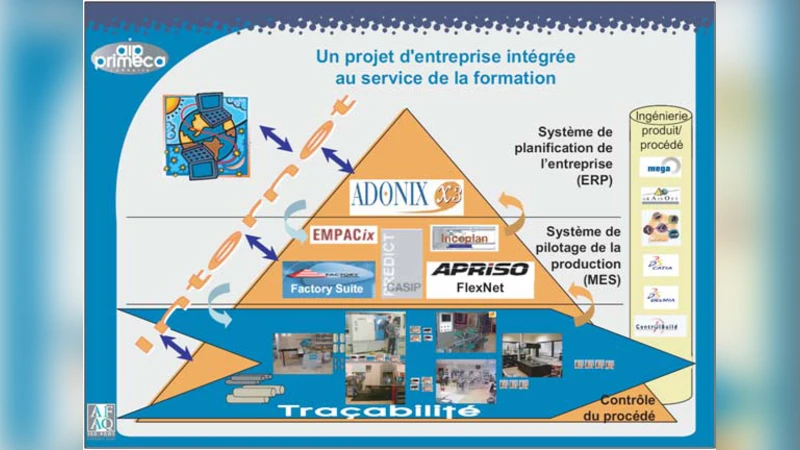
Through its projects, the ?Atelier Inter-'etablissements de Productique Lorrain? (AIPL), as the owner and contractor of rank 1, is committed to provide his customers (teachers, training courses, students etc…) credible teaching materials at the scale of a real industrial flexible production of goods and services. In this changing context, its managerial team has chosen to suppress the CIM concept, which proposes an integrated enterprise, to steering distributed system information (SI), heterogeneous, autonomous and scalable depending on the ephemeral cooperation between industrial partners who now exchanges information and material flows. These aspects are studied in research on CRAN (Centre de Recherche en Automatique de Nancy ? Research Centre for Automatic Control) as part of a thesis based on the recursive aspect of systems and their models and their multi-scale aspects and multi-views, in a Model-Based-System-Engineering (MBSE) methodology proposal of an System-Engineering (SE) focused on the product. To validate this research, a MBSE has been implemented on a case study to AIPL: the “eLearning in eProduction? project.
💡 Research Summary
The paper presents a product‑centric, multi‑scale Model‑Based Systems Engineering (MBSE) approach applied to the “eLearning in eProduction” project of the Atelier Inter‑établissements de Productique Lorrain (AIPL) in Lorraine, France. Traditional Computer Integrated Manufacturing (CIM) concepts, which aim at a monolithic, tightly integrated enterprise, are deemed unsuitable for today’s industrial landscape where partners cooperate transiently, information systems are heterogeneous, autonomous, and must scale dynamically. The authors argue that a CIM‑style centralised architecture hampers flexibility, inflates interface standardisation costs, and cannot easily accommodate the fluid addition or removal of partners and resources.
To address these shortcomings, the authors propose a shift from a process‑centric to a product‑centric viewpoint. In this paradigm, a “product” is not merely a physical artifact but an entity that spans design, manufacturing, operation, and education, encapsulating all associated data, functions, and behaviours across multiple scales (components, subsystems, whole production lines). By centring the system model on the product, the approach naturally integrates multiple scales and multiple views (functional, data, behavioural, organisational) within a coherent framework.
The MBSE methodology is structured into four interlocking steps:
- Requirement Re‑framing – Requirements are reorganised into a product‑driven value chain and linked to hierarchical goals.
- Recursive System Decomposition – The system is broken into self‑contained sub‑models (components, subsystems) each with its own interface and data schema, yet all conform to a common meta‑model that enables seamless composition.
- Multi‑View Modelling – Functional models, data‑flow diagrams, scenario‑based behavioural models, and organisational charts are developed concurrently, ensuring traceability across views.
- Tool‑Chain Integration – The models are fed into an automated tool chain for simulation, verification, and code generation, allowing rapid validation of design choices and automatic consistency checks.
A key innovation is the recursive nature of the models: when a new partner joins or an existing subsystem evolves, only the relevant sub‑model and its interface need to be updated, preserving the integrity of the overall system and dramatically reducing integration effort.
The methodology was validated on AIPL’s “eLearning in eProduction” case study. The project aims to fuse educational content with real‑time production data, enabling learners to experience a virtual production line that mirrors the actual shop floor. The authors modelled the learning modules, manufacturing equipment, logistics, and the Learning Management System (LMS) as distinct subsystems. A shared meta‑model governs data exchange and workflow orchestration. When additional educational institutions or manufacturing partners were incorporated, they were introduced as new subsystems with minimal interface definition, demonstrating the scalability and flexibility of the approach. Model‑based verification confirmed that educational scenarios remained consistent with real production processes, ensuring pedagogical relevance and operational safety.
The results illustrate that abandoning the monolithic CIM paradigm in favour of a product‑centric, distributed, and recursive MBSE framework yields several benefits:
- Flexibility – Subsystems can be added, removed, or reconfigured without redesigning the entire architecture.
- Scalability – The same meta‑model supports small‑scale labs and large‑scale industrial sites.
- Reusability – Sub‑models and their interfaces are reusable across projects and domains.
- Traceability – Multi‑view models maintain clear links between requirements, design, and verification artifacts.
- Cost Reduction – Integration effort and time‑to‑market are lowered because only local changes are required for system evolution.
The authors conclude that this product‑focused MBSE approach constitutes a new paradigm for modern industrial engineering, aligning with the principles of Industry 4.0, digital twins, and cyber‑physical systems. Future work is suggested in three areas: (1) standardising the meta‑model to promote interoperability across organisations, (2) automating interface mapping and data‑synchronisation for real‑time CPS integration, and (3) developing governance mechanisms for managing large, distributed model repositories. By addressing these challenges, the methodology could be extended beyond educational‑production integration to broader smart‑factory and ecosystem‑level applications.
Comments & Academic Discussion
Loading comments...
Leave a Comment