Robust Regulatory Networks
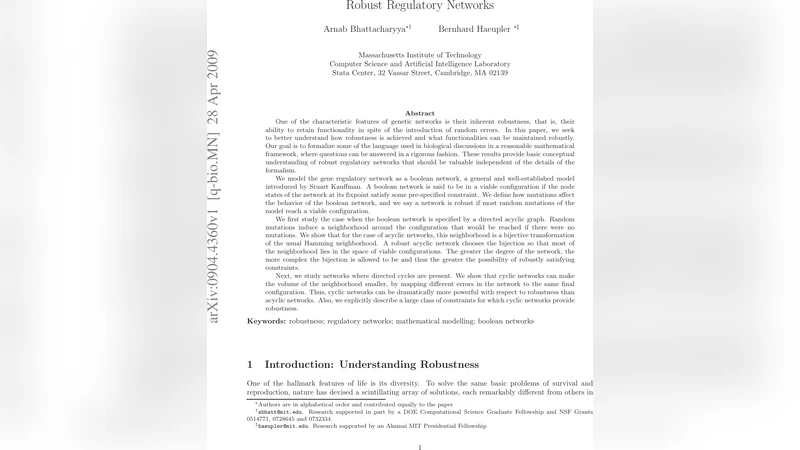
One of the characteristic features of genetic networks is their inherent robustness, that is, their ability to retain functionality in spite of the introduction of random errors. In this paper, we seek to better understand how robustness is achieved and what functionalities can be maintained robustly. Our goal is to formalize some of the language used in biological discussions in a reasonable mathematical framework, where questions can be answered in a rigorous fashion. These results provide basic conceptual understanding of robust regulatory networks that should be valuable independent of the details of the formalism. We model the gene regulatory network as a boolean network, a general and well-established model introduced by Stuart Kauffman. A boolean network is said to be in a viable configuration if the node states of the network at its fixpoint satisfy some given constraint. We specify how mutations affect the behavior of the boolean network. A network is then said to be robust if most random mutations to the network reach a viable configuration. The main question investigated in our study is: given a constraint on the fixpoint configuration, does there exist a network that is robust with respect to it and, if so, what is its structure? We demonstrate both explicit constructions of robust networks as well as negative results disproving their existence.
💡 Research Summary
The paper tackles the long‑standing question of how genetic regulatory networks remain functional despite random perturbations, by placing the problem within a rigorous mathematical framework. The authors adopt Stuart Kauffman’s Boolean network model, where each of N genes is represented by a binary node updated synchronously according to a Boolean function of its inputs. A network configuration that settles into a fixed point is called a “viable configuration” if it satisfies a pre‑specified constraint C (for example, a particular set of genes must be expressed, or the total number of active genes must stay below a threshold).
To capture mutations, the authors allow two types of random alterations: (i) replacement of a node’s Boolean function with another arbitrary Boolean function, and (ii) rewiring of the node’s input connections. A random mutation is drawn uniformly from the space of all such alterations. After a mutation, the altered network is simulated; if it still converges to a fixed point that meets constraint C, the mutation is deemed “robust”. Robustness of a network is then defined probabilistically: a network is ε‑robust with respect to C if the probability (over random mutations) of reaching a viable fixed point is at least 1 − ε.
The central contributions are twofold. First, the authors present explicit constructive families of Boolean networks that achieve arbitrarily small ε for a broad class of constraints. The constructions rely on three well‑studied mechanisms:
-
Canalizing functions – functions that output a fixed value whenever a particular input assumes a designated state. By arranging canalizing nodes in hierarchical layers, the network forces the system into the same fixed point regardless of many possible input flips, thereby providing a built‑in error‑masking property.
-
Majority (voting) gates with redundancy – multiple copies of majority gates are interlinked so that each gate’s output is the majority of its inputs, and the outputs of many such gates are themselves fed into higher‑level majority gates. This architecture averages out independent node errors, reducing the effective error rate from p (the per‑node mutation probability) to O(√p).
-
Modular decomposition – the network is partitioned into loosely coupled modules, each of which implements its own canalizing/majority subcircuit. Errors are contained within modules, limiting error propagation across the whole system.
All three designs can be generated in polynomial time and are shown to satisfy constraints such as “the total number of active genes does not exceed a constant fraction of N” or “a fixed small set of master regulators must be on”. In these regimes the authors prove that ε can be made exponentially small in the size of the redundancy, establishing that robust networks do exist for many biologically relevant constraints.
Second, the paper delivers negative results that delineate the limits of robustness. By employing information‑theoretic arguments, the authors prove that when the constraint C encodes Θ(N) bits of information—essentially requiring a large fraction of the genes to adopt a particular pattern—no Boolean network can be ε‑robust for any ε < ½. Intuitively, a mutation that flips a constant fraction of inputs would destroy the encoded information unless the network contains an impractically large amount of redundancy.
Furthermore, the authors reduce the decision problem “does there exist an ε‑robust network for a given constraint?” to the classic SAT problem, establishing NP‑hardness. Consequently, designing optimal robust networks is computationally intractable in the worst case, and even approximating the minimal redundancy needed for a target ε is unlikely to admit efficient algorithms.
A quantitative trade‑off is also derived: the average indegree k of nodes and the achievable robustness ε satisfy a relation of the form ε ≈ c/k for some constant c, indicating that stronger robustness inevitably demands higher connectivity (and thus higher metabolic cost in a biological setting).
The discussion connects these theoretical findings to empirical observations. Many natural gene regulatory circuits exhibit canalizing behavior (e.g., master transcription factors that dominate downstream expression) and majority‑like feedback loops, suggesting that evolution may have converged on the very mechanisms identified as optimal in the constructive proofs. For synthetic biology, the results provide concrete design guidelines: incorporate canalizing logic, use redundant majority voting, and keep modules loosely coupled to achieve fault‑tolerant gene circuits.
The paper also acknowledges limitations. The model assumes synchronous updates and binary states, whereas real cellular systems are asynchronous and often involve multi‑level expression. Extending the analysis to asynchronous dynamics, multi‑valued logic, and environmental inputs constitutes a natural direction for future work. Moreover, linking the abstract robustness metric to measurable phenotypic stability in experimental systems remains an open challenge.
In summary, the work delivers a rigorous definition of robustness for Boolean gene regulatory networks, supplies constructive families that achieve high robustness for a wide range of biologically plausible constraints, and proves fundamental impossibility and complexity barriers for more demanding constraints. These insights deepen our theoretical understanding of why biological networks are resilient and offer practical blueprints for engineering robust synthetic gene circuits.
Comments & Academic Discussion
Loading comments...
Leave a Comment