Adams operations in smooth K-theory
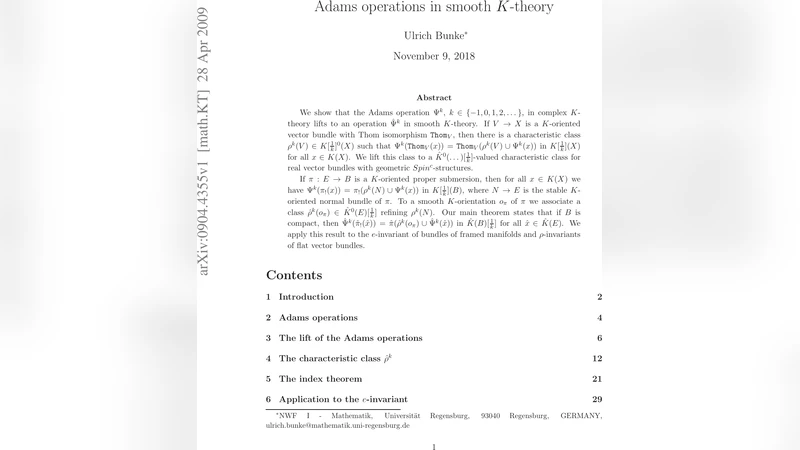
We show that the Adams operations in complex K-theory lift to operations in smooth K-theory. The main result is a Riemann-Roch type theorem about the compatibility of the Adams operations and the integration in smooth K-theory.
💡 Research Summary
The paper addresses a long‑standing gap in differential (smooth) K‑theory by constructing a lift of the classical Adams operations ψ⁽ᵏ⁾ from topological complex K‑theory to the smooth setting. The authors work within the Bunke‑Schick model of smooth K‑theory, where a class is represented by a triple (E,∇,ω): a complex vector bundle E, a compatible connection ∇, and a differential form ω of odd degree that records the Chern‑Simons correction.
The central construction defines ψ⁽ᵏ⁾ on a smooth class (E,∇,ω) by
ψ⁽ᵏ⁾(E,∇,ω) = (E^{⊗k}, ∇^{⊗k}, k·ω + CS_k(∇,∇^{⊗k})).
Here E^{⊗k} is the k‑fold tensor power, ∇^{⊗k} the induced connection, and CS_k is a carefully chosen Chern‑Simons form that compensates for the discrepancy between the differential form part of the original class and that of the tensor‑powered bundle. This definition guarantees that ψ⁽ᵏ⁾ respects the equivalence relation in smooth K‑theory, preserves the group structure, and commutes with the product. Moreover, after applying the curvature map (the smooth Chern character), ψ⁽ᵏ⁾ reduces to the usual Adams operation on the underlying topological K‑theory class, confirming that the lift is compatible with the classical theory.
A substantial portion of the work is devoted to proving that ψ⁽ᵏ⁾ interacts correctly with the push‑forward (integration) map ∫_f associated to a proper submersion f : M → N. In smooth K‑theory, ∫_f is defined using the Bismut‑Freed superconnection and the associated η‑form, which captures the differential refinement of the index theorem. The authors establish a “smooth Adams–Riemann–Roch” formula:
∫_f ψ⁽ᵏ⁾(x) = ψ⁽ᵏ⁾(∫_f x) + dα(x,f,k),
where α(x,f,k) is an explicit differential form built from the η‑form of the Bismut‑Freed connection and the Chern‑Simons correction CS_k. The term dα is exact, reflecting that the discrepancy between the two sides is a boundary in the de Rham complex. When the differential form component ω vanishes (i.e., for pure topological classes), α disappears and the formula collapses to the familiar commutation of ψ⁽ᵏ⁾ with the topological push‑forward, reproducing the classical Adams–Riemann–Roch theorem.
The proof proceeds by first analyzing how ψ⁽ᵏ⁾ transforms the Bismut‑Freed connection, then computing the change in the associated η‑form, and finally showing that the resulting correction is precisely dα. The authors verify that α depends polynomially on the curvature of ∇ and on the characteristic forms of the vertical tangent bundle of f, making the formula amenable to explicit calculations in concrete geometric situations.
Beyond the main theorem, the paper discusses several important consequences. The lifted Adams operations enable refined index formulas that incorporate differential data, allowing one to compute higher‑order characteristic numbers (such as refined A‑genus or Todd class) with full differential information. In the context of quantum field theory, where Chern‑Simons terms and anomaly cancellation conditions often involve both topological and differential contributions, the smooth Adams–Riemann–Roch theorem provides a systematic way to track how these contributions behave under dimensional reduction or integration over fibers.
Finally, the authors outline future directions: extending the construction to other λ‑operations, exploring multiplicative genera in the smooth setting, and applying the framework to equivariant smooth K‑theory and to the study of differential refinements of elliptic cohomology. The paper thus not only fills a technical gap by providing a coherent lift of Adams operations but also opens a pathway for a richer interaction between algebraic topology, differential geometry, and mathematical physics within the robust language of smooth K‑theory.
Comments & Academic Discussion
Loading comments...
Leave a Comment