Linear operators with compact supports, probability measures and Milyutin maps
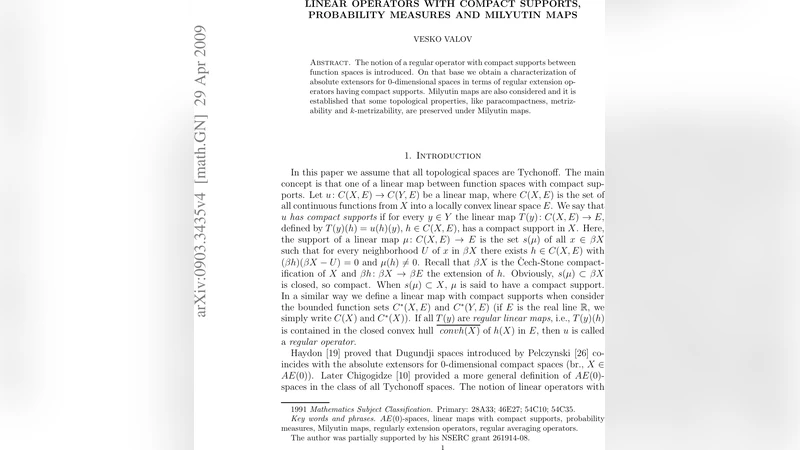
The notion of a regular operator with compact supports between function spaces is introduced. On that base we obtain a characterization of absolute extensors for zero-dimensional spaces in terms of regular extension operators having compact supports. Milyutin maps are also considered and it is established that some topological properties, like paracompactness, metrizability and k-metrizability, are preserved under Milyutin maps.
💡 Research Summary
The paper introduces a new class of linear operators between spaces of real‑valued continuous functions, called regular operators with compact supports. A linear operator (T:C(X)\to C(Y)) is regular if it preserves positivity and the lattice operations (suprema and infima). The compact‑support condition requires that for each point (y\in Y) the set of points of (X) that influence the value (T(f)(y)) is a compact subset of (X) and varies continuously with (y). This notion generalises the classical ideas of finite or bounded support and fits naturally with probability measures, because for a probability measure (\mu) on (X) the operator (T_\mu(f)=\int_X f,d\mu) is regular and has compact support (the support of (\mu)).
Using this framework the authors obtain a new characterisation of absolute extensors for zero‑dimensional spaces (AE(0)). They prove that a zero‑dimensional space (Z) is an AE(0) if and only if for every closed subspace (A\subset Z) there exists a regular extension operator (E:C(A)\to C(Z)) that possesses a compact support. In other words, the existence of such operators is equivalent to the classical extension property, but now the extension is controlled by a compact set in the domain. This operator‑theoretic viewpoint links the extension problem with the geometry of supports and with the theory of probability measures.
The second major theme is the study of Milyutin maps. A Milyutin map is a continuous map (\phi:X\to P(Y)) into the space (P(Y)) of probability measures on (Y) that is induced by a regular operator with compact support. The paper shows that if (\phi) is a Milyutin map, then several important topological properties are preserved from the domain to the codomain:
- Paracompactness – if (X) is paracompact, then so is (Y);
- Metrizability – if (X) is metrizable, then (Y) is metrizable;
- (k)-metrizability – if (X) is (k)-metrizable, then (Y) is (k)-metrizable.
The proofs rely on the compact‑support condition: the support of the measure (\phi(x)) is a compact subset of (Y) that varies continuously with (x). This ensures that locally finite refinements, countable bases, and (k)-networks can be transferred along (\phi). The results extend the classical theory, which usually treats Milyutin maps only between complete metric spaces, to a much broader class of topological spaces.
Finally, the authors discuss how the introduced operators unify the extension theory for zero‑dimensional spaces with the measure‑theoretic perspective of Milyutin maps. By viewing both phenomena through the lens of regular operators with compact supports, they obtain a coherent picture in which extension operators, absolute extensors, and measure‑induced maps are all manifestations of the same underlying structure. The paper suggests further research directions, such as extending the compact‑support framework to non‑zero‑dimensional spaces, to non‑abelian function algebras, or to operator‑valued measures, thereby opening new pathways between functional analysis, topology, and probability theory.
Comments & Academic Discussion
Loading comments...
Leave a Comment