Light scattering from an isotropic layer between uniaxial crystals
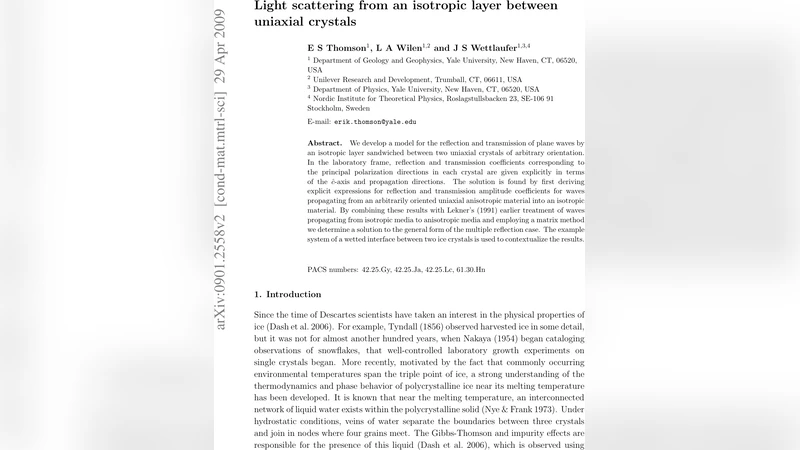
We develop a model for the reflection and transmission of plane waves by an isotropic layer sandwiched between two uniaxial crystals of arbitrary orientation. In the laboratory frame, reflection and transmission coefficients corresponding to the principal polarization directions in each crystal are given explicitly in terms of the c-axis and propagation directions. The solution is found by first deriving explicit expressions for reflection and transmission amplitude coefficients for waves propagating from an arbitrarily oriented uniaxial anisotropic material into an isotropic material. By combining these results with Lekner’s (1991) earlier treatment of waves propagating from isotropic media to anisotropic media and employing a matrix method we determine a solution to the general form of the multiple reflection case. The example system of a wetted interface between two ice crystals is used to contextualize the results.
💡 Research Summary
The paper presents a comprehensive analytical framework for the reflection and transmission of plane electromagnetic waves by a three‑layer system consisting of an isotropic slab sandwiched between two arbitrarily oriented uniaxial crystals. The authors begin by deriving explicit amplitude reflection and transmission coefficients for a wave incident from a uniaxial anisotropic medium into an isotropic medium. This derivation is performed in the laboratory coordinate system, where the crystal’s optic axis (c‑axis) may point in any direction relative to the incident wave vector. By decomposing the electric field into ordinary and extraordinary components with respect to the crystal’s principal axes, and applying the standard boundary conditions (continuity of the tangential components of E and H), they obtain closed‑form expressions that involve the direction cosines of the c‑axis, the incident angle, and the complex propagation constants for each polarization.
Next, the authors revisit Lekner’s 1991 treatment of the inverse problem—waves propagating from an isotropic medium into a uniaxial crystal. They rewrite Lekner’s results in the same matrix notation used for the forward problem, thereby creating a unified description for both directions of wave transfer across an anisotropic–isotropic interface.
The core of the methodology is a transfer‑matrix approach. The two interface matrices (denoted B₁ for the first crystal–isotropic interface and B₂ for the second isotropic–crystal interface) are multiplied by a propagation matrix M that accounts for phase accumulation and amplitude scaling within the isotropic layer of thickness d. The overall system matrix S = B₂·M·B₁ encapsulates all single‑pass interactions. To incorporate multiple internal reflections, the authors sum the resulting geometric series analytically, yielding compact formulas for the total reflected and transmitted fields as functions of the elementary matrix elements.
To demonstrate the practical relevance of the theory, the paper examines a “wetted ice” configuration: two ice crystals with different c‑axis orientations separated by a thin water film. Using realistic optical constants (ice ordinary and extraordinary refractive indices, water refractive index ≈ 1.33) and a visible wavelength (λ ≈ 550 nm), they compute the dependence of reflectance, transmittance, and polarization conversion on the water‑film thickness (from tens of nanometers to several micrometers) and on the incidence angle. The results reveal several notable phenomena. When the water layer thickness approaches a quarter‑wave (≈ λ/4), destructive interference suppresses overall reflection, and a pronounced conversion from extraordinary to ordinary polarization occurs at moderate incidence angles (≈ 30°). As the film becomes thicker, Fabry‑Pérot‑like resonances appear due to multiple internal reflections, leading to oscillatory variations in reflectance. The analysis also shows that the relative orientation of the two c‑axes strongly influences the polarization mixing, offering a mechanism for engineered polarization control that is unavailable in single‑interface designs.
The authors discuss the limitations of their model, which assumes linear, lossless media and neglects magnetic anisotropy. They outline straightforward extensions to include complex refractive indices (absorption) and nonlinear effects, as well as generalizations to multilayer stacks of alternating isotropic and anisotropic layers. The work thus provides a versatile analytical tool for designing advanced optical components such as polarization‑selective coatings, photonic crystals with embedded anisotropic layers, and remote‑sensing models of ice‑water interfaces in glaciology.
In summary, the paper delivers a rigorous, closed‑form solution for wave propagation through an isotropic layer bounded by arbitrarily oriented uniaxial crystals, validates the theory with a realistic ice‑water example, and highlights its potential impact on both fundamental optics research and applied photonic engineering.
Comments & Academic Discussion
Loading comments...
Leave a Comment