Structural Evolution of the Brazilian Airport Network
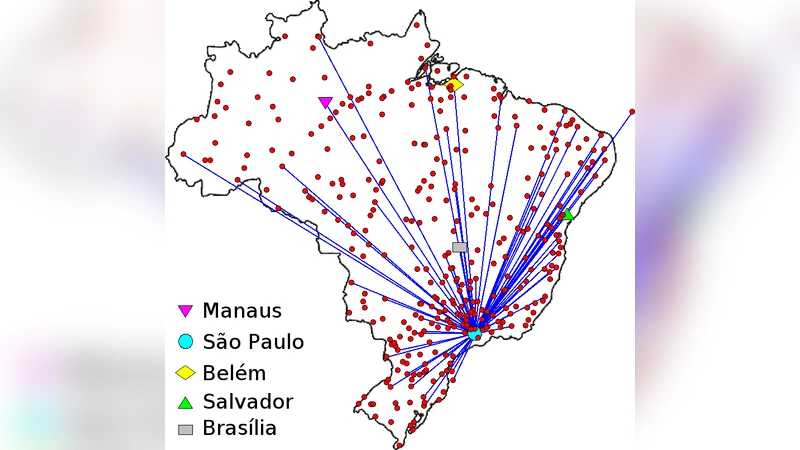
The aviation sector is profitable, but sensitive to economic fluctuations, geopolitical constraints and governmental regulations. As for other means of transportation, the relation between origin and destination results in a complex map of routes, which can be complemented by information associated to the routes themselves, for instance, frequency, traffic load or distance. The theory of networks provides a natural framework to investigate dynamics on the resulting structure. Here, we investigate the structure and evolution of the Brazilian Airport Network (BAN) for several quantities: routes, connections, passengers and cargo. Some structural features are in accordance with previous results of other airport networks. The analysis of the evolution of the BAN shows that its structure is dynamic, with changes in the relative relevance of some airports and routes. The results indicate that the connections converge to specific routes. The network shrinks at the route level but grows in number of passengers and amount of cargo, which more than doubled during the period studied.
💡 Research Summary
The paper presents a comprehensive longitudinal study of the Brazilian Airport Network (BAN) covering the years 1995‑2006. Using publicly available data from Brazil’s National Civil Aviation Agency, the authors construct a directed, multi‑layered network in which each node represents a Brazilian city (or its main airport) and each directed edge corresponds to a regular, non‑stop flight route. Three layers encode distinct weights: the number of flights per year (L₁), the total number of passengers (L₂), and the total cargo tonnage (L₃). Self‑loops, duplicate entries, and private or military flights are removed; airports within the same metropolitan area are merged into a single node, yielding a clean representation of the commercial domestic air transport system.
Structural analysis shows that the network is dynamic: the number of nodes declines from 211 in 1995 to 142 in 2006, while the average degree ⟨k⟩ falls from 13.19 to 10.28 (≈28 % reduction). Despite this contraction, the clustering coefficient remains high (0.61–0.66) and the average shortest‑path length stays low (≈2.4), confirming a small‑world topology similar to other national airport networks. Reciprocity, measured as the proportion of bidirectional links, is relatively high (R≈0.84–0.89) but not unity, indicating a substantial fraction of one‑way routes—reflecting airline scheduling practices that prioritize demand‑driven asymmetries.
The in‑degree distribution is best described by a stretched exponential form P(k > k) = C exp(−βk − αk). Parameter values evolve over time (β increases, α decreases), suggesting a gradual homogenization of node degrees. Correspondingly, the degree entropy Sₖ declines, implying that the network becomes less heterogeneous and potentially more vulnerable to random failures, while still retaining hub‑centric vulnerability due to the persistence of high‑degree airports.
A detailed rewiring analysis reveals that each year roughly 18 % of all routes are newly created between existing airports (aOO), while about 20 % of existing routes disappear (dOO). New‑airport–old‑airport connections constitute only 6–8 % of the total, highlighting airlines’ preference for optimizing existing hub infrastructure rather than expanding to new locations. Over the twelve‑year span, 395 distinct airports appear in the data, but only 100 are present throughout; the rest enter and exit the network intermittently, reflecting regional demand fluctuations, temporary service trials, or infrastructure changes.
Weighted layer analysis shows divergent trends: the number of flights per route (L₁) remains relatively stable, whereas passenger traffic (L₂) and cargo volume (L₃) more than double between 1995 and 2006. This decoupling indicates that while the physical network shrinks, traffic concentrates on a core set of routes, increasing overall efficiency but also stressing capacity at major hubs such as São Paulo, Rio de Janeiro, and Brasília.
The authors conclude that the BAN exhibits a paradoxical evolution: a reduction in topological size coupled with a substantial growth in traffic demand. The network retains small‑world characteristics and high clustering, yet its degree distribution becomes more uniform and its reciprocity, though high, signals persistent asymmetries. These structural shifts have implications for robustness: hub failures remain catastrophic, while the growing homogeneity may reduce resilience to random disruptions. The study suggests that policymakers and airline operators should balance hub capacity expansion with strategies to maintain connectivity for smaller regional airports, thereby safeguarding both efficiency and systemic robustness.
Comments & Academic Discussion
Loading comments...
Leave a Comment