Characterizing synaptic conductance fluctuations in cortical neurons and their influence on spike generation
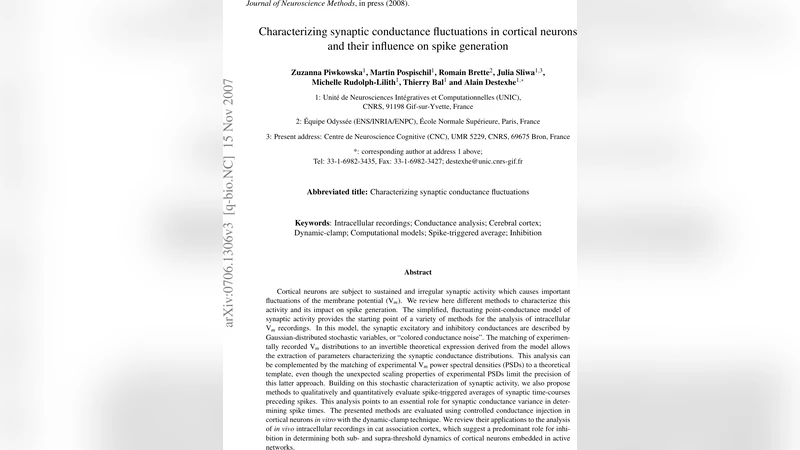
Cortical neurons are subject to sustained and irregular synaptic activity which causes important fluctuations of the membrane potential (Vm). We review here different methods to characterize this activity and its impact on spike generation. The simplified, fluctuating point-conductance model of synaptic activity provides the starting point of a variety of methods for the analysis of intracellular Vm recordings. In this model, the synaptic excitatory and inhibitory conductances are described by Gaussian-distributed stochastic variables, or colored conductance noise. The matching of experimentally recorded Vm distributions to an invertible theoretical expression derived from the model allows the extraction of parameters characterizing the synaptic conductance distributions. This analysis can be complemented by the matching of experimental Vm power spectral densities (PSDs) to a theoretical template, even though the unexpected scaling properties of experimental PSDs limit the precision of this latter approach. Building on this stochastic characterization of synaptic activity, we also propose methods to qualitatively and quantitatively evaluate spike-triggered averages of synaptic time-courses preceding spikes. This analysis points to an essential role for synaptic conductance variance in determining spike times. The presented methods are evaluated using controlled conductance injection in cortical neurons in vitro with the dynamic-clamp technique. We review their applications to the analysis of in vivo intracellular recordings in cat association cortex, which suggest a predominant role for inhibition in determining both sub- and supra-threshold dynamics of cortical neurons embedded in active networks.
💡 Research Summary
This paper addresses how ongoing, irregular synaptic activity shapes membrane‑potential (Vm) fluctuations in cortical neurons and how those fluctuations influence spike generation. The authors adopt the simplified “point‑conductance” model, in which excitatory (g_e) and inhibitory (g_i) synaptic conductances are treated as independent Ornstein‑Uhlenbeck processes with Gaussian statistics. Each conductance is characterized by a mean (μ_e, μ_i) and a standard deviation (σ_e, σ_i), and the resulting Vm distribution can be expressed analytically in an invertible form. By fitting experimentally recorded Vm histograms to this theoretical expression, the four conductance parameters can be extracted without the need for voltage‑clamp techniques.
Because the histogram alone does not provide information about the temporal correlation (τ_e, τ_i) of the conductance fluctuations, the authors complement the analysis with a power‑spectral‑density (PSD) fitting procedure. The PSD of Vm reflects both the colour of the conductance noise and the passive filtering properties of the membrane. In practice, however, in‑vivo PSDs display a 1/f^α scaling that deviates from the idealised model, limiting the precision of τ estimates. Consequently, PSD fitting is presented as a supplementary rather than a primary tool.
To link synaptic fluctuations to spike timing, the study introduces spike‑triggered averages (STA) of the underlying conductances, termed spike‑triggered conductance averages (STGA). Using dynamic‑clamp, the authors inject artificial conductance noise into cortical slices while recording spikes. They find that spikes tend to occur when the instantaneous conductance variance, especially the inhibitory variance σ_i, pushes the total synaptic drive across threshold. In other words, variance—not merely mean conductance—plays a decisive role in determining when a neuron fires.
The methodology is validated in two ways. First, in vitro dynamic‑clamp experiments with known conductance parameters confirm that both histogram fitting and PSD fitting recover the injected values accurately, and that STGA correctly identifies the conductance trajectories leading to spikes. Second, intracellular recordings from cat association cortex in vivo are analysed. The results reveal a predominance of inhibitory conductance: μ_i exceeds μ_e, and σ_i contributes substantially to Vm variance. This suggests that, within active cortical networks, inhibition largely governs both sub‑threshold fluctuations and the timing of suprathreshold events.
The discussion situates these findings within the broader “balanced excitation‑inhibition” framework, emphasizing that balance must be considered not only in terms of mean conductances but also in terms of their variances. The authors argue that models of cortical processing, brain‑machine interfaces, and pathophysiological studies (e.g., epilepsy, schizophrenia) should incorporate conductance variance, particularly inhibitory variance, as a key determinant of neuronal excitability.
In summary, the paper provides a coherent analytical pipeline—Vm histogram fitting, PSD matching, and spike‑triggered conductance averaging—grounded in a tractable stochastic model. This pipeline enables researchers to extract quantitative descriptors of synaptic conductance fluctuations from intracellular data and to assess how those fluctuations shape spike generation, highlighting the central role of inhibitory variance in cortical dynamics.
Comments & Academic Discussion
Loading comments...
Leave a Comment