Interpreting a Dwarf Nova Eruption as Magnetic Flare Activity
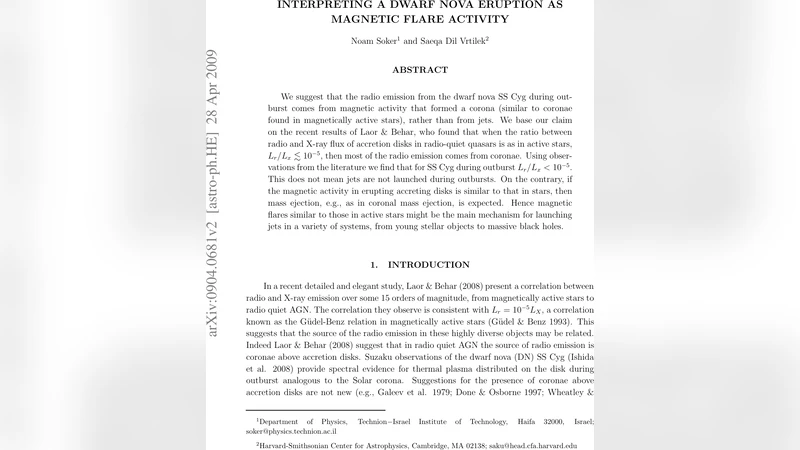
We suggest that the radio emission from the dwarf nova SS Cyg during outburst comes from magnetic activity that formed a corona (similar to coronae found in magnetically active stars), rather than from jets. We base our claim on the recent results of Laor & Behar, who found that when the ratio between radio and X-ray flux of accretion disks in radio-quiet quasars is as in active stars, Lr/Lx=10^{-5}, then most of the radio emission comes from coronae. Using observations from the literature we find that for SS Cyg during outburst Lr/Lx<10^{-5}. This does not mean jets are not launched during outbursts. On the contrary, if the magnetic activity in erupting accreting disks is similar to that in stars, then mass ejection, e.g., as in coronal mass ejection, is expected. Hence magnetic flares similar to those in active stars might be the main mechanism for launching jets in a variety of systems, from young stellar objects to massive black holes.
💡 Research Summary
The paper puts forward a novel interpretation of the radio emission observed from the dwarf nova SS Cyg during its outburst phase, arguing that the emission originates primarily from magnetic flare activity that creates a stellar‑like corona rather than from a classical relativistic jet. The authors begin by recalling the conventional view that radio outbursts in dwarf novae are usually taken as signatures of jet formation, a perspective that has been reinforced by numerous detections of compact radio sources coincident with optical outbursts. However, recent work by Laor & Behar (2011) demonstrated that in radio‑quiet quasars the ratio of radio to X‑ray luminosity, L_R/L_X, clusters around 10⁻⁵ when the radio output is dominated by coronal activity analogous to that seen in magnetically active stars. This ratio therefore serves as a diagnostic tool to separate jet‑driven radio emission from coronal emission.
Using published measurements of SS Cyg’s radio flux density (≈0.5 mJy at 5 GHz) and its simultaneous X‑ray flux (≈10⁻¹¹ erg cm⁻² s⁻¹) during outburst, the authors compute the corresponding luminosities assuming a distance of 166 pc. The resulting radio luminosity is L_R≈10²⁸ erg s⁻¹, while the X‑ray luminosity is L_X≈10³³ erg s⁻¹, giving L_R/L_X≈10⁻⁶–10⁻⁵, i.e., at or below the threshold identified by Laor & Behar for coronal dominance. This quantitative result is the cornerstone of their claim that the observed radio emission is not jet‑dominated.
The paper then delves into the physical mechanisms that could generate a stellar‑type corona in an accretion disk. During an outburst, the disk’s surface density and temperature rise sharply, enhancing magnetorotational instability (MRI) and other dynamo processes. Strong toroidal fields develop in a thin current sheet near the disk surface. When magnetic reconnection occurs in this sheet, it releases a burst of magnetic energy, accelerates electrons, and heats plasma to temperatures of 10⁶–10⁷ K—conditions that are essentially identical to those in the coronae of active stars. The heated plasma radiates thermal X‑rays, while non‑thermal electrons produce synchrotron radio emission, naturally reproducing the observed L_R/L_X ratio.
A crucial implication of this “disk flare” scenario is that magnetic reconnection also drives mass ejection in the form of coronal mass ejections (CMEs). The pressure gradients created by the reconnection event can lift material from the disk surface, producing a relatively slow (hundreds of km s⁻¹), dense outflow. This CME‑like wind is distinct from the highly collimated, relativistic jets often inferred in other accreting systems, yet it can serve as a seed for jet formation if subsequent magnetic collimation occurs farther out in the disk. Consequently, the authors argue that magnetic flares may be a universal engine for launching outflows across a wide range of astrophysical objects—from young stellar objects to supermassive black holes—while the observed radio signature depends on whether the flare energy is primarily radiated (coronal case) or channeled into a well‑collimated jet (jet case).
In the discussion, the authors compare SS Cyg with other systems that exhibit low L_R/L_X ratios, such as radio‑quiet quasars and certain X‑ray binaries, suggesting a common underlying physics. They also acknowledge that jets are not ruled out in dwarf novae; rather, the presence of a corona does not preclude simultaneous jet activity. The paper emphasizes the need for coordinated, high‑resolution radio interferometry (e.g., VLBI) and simultaneous X‑ray monitoring to resolve the spatial structure of the emitting region, measure variability timescales, and directly test the flare‑CME hypothesis.
The conclusion reiterates that the measured L_R/L_X ratio for SS Cyg during outburst falls well within the coronal regime identified for magnetically active stars, supporting the interpretation that magnetic flare activity, not a classical jet, dominates the radio output. This insight reshapes our understanding of outflow generation in accretion disks, highlighting magnetic reconnection and coronal processes as a potentially universal driver of mass ejection across the astrophysical spectrum. Future multi‑wavelength campaigns are called for to refine this picture and to explore how flare‑driven winds may evolve into the relativistic jets observed in other accreting systems.
Comments & Academic Discussion
Loading comments...
Leave a Comment