On a nonlinear integrable difference equation on the square 3D-inconsistent
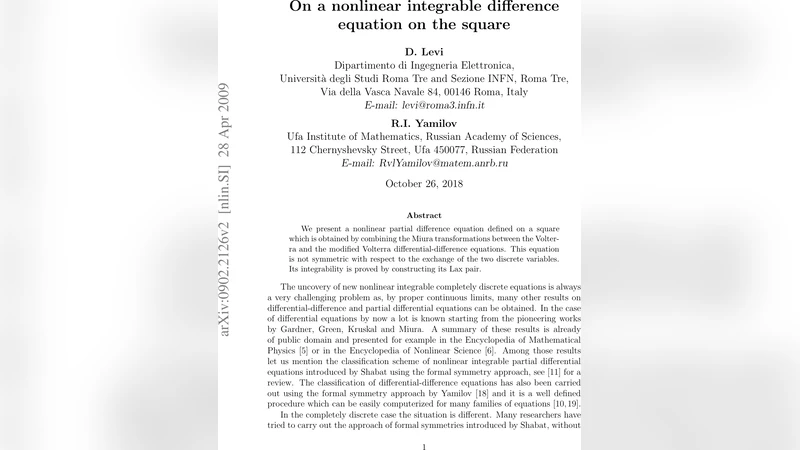
We present a nonlinear partial difference equation defined on a square which is obtained by combining the Miura transformations between the Volterra and the modified Volterra differential-difference equations. This equation is not symmetric with respect to the exchange of the two discrete variables and does not satisfy the 3D-consistency condition necessary to belong to the Adler-Bobenko-Suris classification. Its integrability is proved by constructing its Lax pair.
💡 Research Summary
The paper introduces a novel nonlinear partial difference equation defined on a square lattice that arises from the combination of Miura transformations linking the Volterra and modified Volterra differential‑difference equations. By applying the two Miura maps
(u = v,v_{n+1}) and (u = v_{n-1},v)
simultaneously, the authors obtain a relation that couples the evolution in the two discrete directions (n) (horizontal) and (m) (vertical). The resulting equation is intrinsically non‑symmetric: the update rule in the (n)‑direction differs from that in the (m)‑direction, and swapping the two lattice indices changes the functional form. Consequently, the equation fails the three‑dimensional consistency (3D‑consistency) test that underlies the Adler‑Bobenko‑Suris (ABS) classification of integrable quad‑equations. The authors explicitly demonstrate the failure by extending the equation to a three‑dimensional cube and showing that the values obtained along different paths do not coincide.
Despite this failure, integrability is established through the construction of a Lax pair. Two (2\times2) matrices (L(\lambda)) and (M(\lambda)) are introduced, each depending on a spectral parameter (\lambda) and on the lattice fields at a given site. The matrix (L) governs the shift in the (n)‑direction, while (M) governs the shift in the (m)‑direction. The compatibility condition
(L_{n,m+1}(\lambda),M_{n,m}(\lambda)=M_{n+1,m}(\lambda),L_{n,m}(\lambda))
is shown to be exactly equivalent to the proposed non‑symmetric quad‑equation. This equivalence proves that the equation possesses an infinite hierarchy of conserved quantities, a hallmark of integrable systems.
From the Lax representation the authors further derive a Bäcklund transformation that coincides with the original Miura maps, providing an explicit mechanism to generate new solutions from known ones. They also extract conserved densities from the trace and determinant of the Lax matrices, confirming that these quantities remain invariant under the lattice evolution.
The paper’s contribution is twofold. First, it expands the landscape of integrable discrete equations beyond the ABS class by presenting a concrete example that is integrable without satisfying 3D‑consistency. Second, it demonstrates that the existence of a Lax pair remains a robust criterion for integrability even when the more geometric 3D‑consistency condition fails. The authors suggest several avenues for future work, including the extension of the non‑symmetric construction to higher‑dimensional lattices, the development of explicit analytic solutions, and the exploration of physical models (e.g., discrete nonlinear wave propagation) where such asymmetric interactions may naturally arise.
Comments & Academic Discussion
Loading comments...
Leave a Comment