Active Galactic Nuclei and their role in Galaxy Formation and Evolution
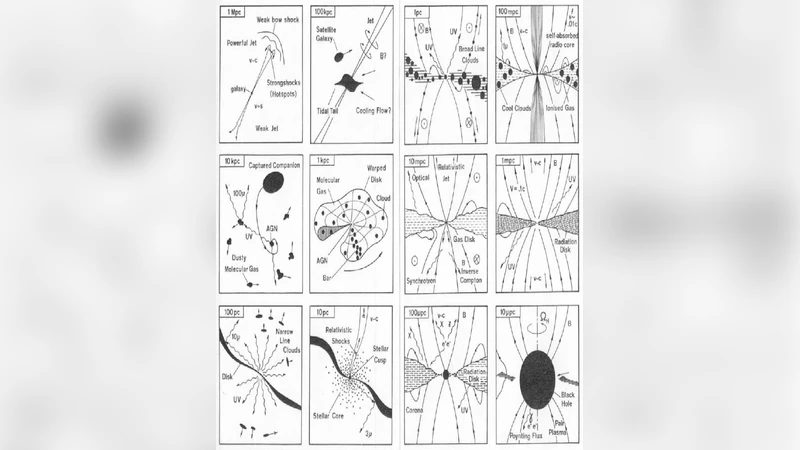
There are several key open questions as to the nature and origin of AGN including: 1) what initiates the active phase, 2) the duration of the active phase, and 3) the effect of the AGN on the host galaxy. Critical new insights to these can be achieved by probing the central regions of AGN with sub-mas angular resolution at UV/optical wavelengths. In particular, such observations would enable us to constrain the energetics of the AGN “feedback” mechanism, which is critical for understanding the role of AGN in galaxy formation and evolution. These observations can only be obtained by long-baseline interferometers or sparse aperture telescopes in space, since the aperture diameters required are in excess of 500 m - a regime in which monolithic or segmented designs are not and will not be feasible and because these observations require the detection of faint emission near the bright unresolved continuum source, which is impossible from the ground, even with adaptive optics. Two mission concepts which could provide these invaluable observations are NASA’s Stellar Imager (SI; Carpenter et al. 2008 & http://hires.gsfc.nasa.gov/si/) interferometer and ESA’s Luciola (Labeyrie 2008) sparse aperture hypertelescope.
💡 Research Summary
The paper addresses three fundamental, yet unresolved, questions concerning active galactic nuclei (AGN): what triggers the onset of nuclear activity, how long an active episode lasts, and how the energetic output of an AGN influences its host galaxy. While X‑ray, radio, and infrared observations have revealed much about the large‑scale impact of AGN, they lack the angular resolution needed to directly probe the innermost optical/ultraviolet (UV) regions where the feedback processes are launched. The authors argue that sub‑milliarcsecond (sub‑mas) imaging at UV/optical wavelengths is essential for measuring the energetics, geometry, and kinematics of the gas and radiation fields within a few parsecs of the supermassive black hole (SMBH).
Achieving a resolution better than 0.1 mas at λ≈200–500 nm requires an effective aperture exceeding 500 m. Conventional monolithic or segmented mirrors of this size are beyond current engineering and budgetary capabilities, prompting the authors to explore two space‑based interferometric concepts that can synthesize such an aperture: NASA’s Stellar Imager (SI) and ESA’s Luciola hypertelescope.
Stellar Imager envisions a formation‑flying array of dozens of 1‑meter collector telescopes spaced 100–500 m apart. Laser metrology and fiber‑optic beam transport would maintain phase coherence across the array, enabling coherent combination of the collected light. The design targets a baseline of up to 500 m, delivering 0.05–0.1 mas resolution across a broad UV/optical bandpass. Critical technology drivers include ultra‑precise formation control (nanometer‑level distance stability), high‑speed phase‑locking algorithms, and detectors capable of extracting faint line emission in the glare of a bright, unresolved continuum source.
Luciola follows the sparse‑aperture “hypertelescope” principle first articulated by Labeyrie. Rather than a dense interferometric mesh, a non‑redundant set of small sub‑apertures is arranged in a pseudo‑random pattern that, after pupil densification, produces a high‑contrast point‑spread function with a narrow central peak. This approach dramatically reduces structural complexity while still achieving 0.05 mas resolution with a total collecting area comparable to a 30‑meter class telescope. The primary challenges lie in accurate optical path‑difference compensation, wavefront sensing across a highly diluted pupil, and sophisticated image‑reconstruction techniques to separate the weak AGN‑host signatures from the dominant nuclear point source.
Both concepts aim to directly image the optical/UV broad‑line region, the inner edge of the dusty torus, and, crucially, the putative “optical shadow” of the SMBH itself. By mapping the spatial distribution of high‑ionization lines (e.g., C IV λ1549, Mg II λ2800) and measuring their velocity fields at sub‑parsec scales, astronomers can quantify the kinetic power of outflows, the momentum flux imparted to the interstellar medium, and the timescales over which AGN feedback operates. These measurements will provide the empirical anchor needed to calibrate cosmological simulations that currently rely on phenomenological feedback prescriptions.
The paper also outlines a realistic development pathway. Early technology demonstrations would involve ground‑based testbeds for formation‑flying metrology and laboratory hypertelescope prototypes. A small‑scale precursor mission (e.g., a 10‑meter baseline interferometer) could validate phase‑control algorithms and high‑contrast imaging pipelines before committing to the full‑scale arrays. Cost estimates place the Stellar Imager at roughly $1 billion and Luciola at $500 million, suggesting that an international partnership could share the financial burden while leveraging complementary expertise in formation flying (NASA) and sparse‑aperture optics (ESA).
In summary, the authors make a compelling case that only a space‑based interferometer or hypertelescope with an effective aperture of several hundred meters can deliver the sub‑mas UV/optical imaging required to answer the three key AGN questions. Stellar Imager and Luciola represent two viable, technically distinct routes to this capability. Their successful deployment would open a new observational window on the physics of SMBH accretion, the launch of AGN‑driven winds, and the consequent regulation of star formation in galaxies across cosmic time, thereby transforming our understanding of galaxy formation and evolution.
Comments & Academic Discussion
Loading comments...
Leave a Comment