Automated Epilepsy Diagnosis Using Interictal Scalp EEG
Approximately over 50 million people worldwide suffer from epilepsy. Traditional diagnosis of epilepsy relies on tedious visual screening by highly trained clinicians from lengthy EEG recording that contains the presence of seizure (ictal) activities. Nowadays, there are many automatic systems that can recognize seizure-related EEG signals to help the diagnosis. However, it is very costly and inconvenient to obtain long-term EEG data with seizure activities, especially in areas short of medical resources. We demonstrate in this paper that we can use the interictal scalp EEG data, which is much easier to collect than the ictal data, to automatically diagnose whether a person is epileptic. In our automated EEG recognition system, we extract three classes of features from the EEG data and build Probabilistic Neural Networks (PNNs) fed with these features. We optimize the feature extraction parameters and combine these PNNs through a voting mechanism. As a result, our system achieves an impressive 94.07% accuracy, which is very close to reported human recognition accuracy by experienced medical professionals.
💡 Research Summary
The paper addresses the challenge of diagnosing epilepsy without the need for long recordings that contain seizure (ictal) activity, which are costly and difficult to obtain, especially in resource‑limited settings. The authors propose an automated system that relies solely on interictal scalp electroencephalogram (EEG) data, which are much easier to acquire. A dataset was built from 22‑channel routine scalp EEG recordings of six healthy volunteers and six patients with epilepsy, recorded at 200 Hz using the international 10‑20 system. The recordings were segmented into either 4096‑sample or 8192‑sample windows, yielding a total of 491,766 segments.
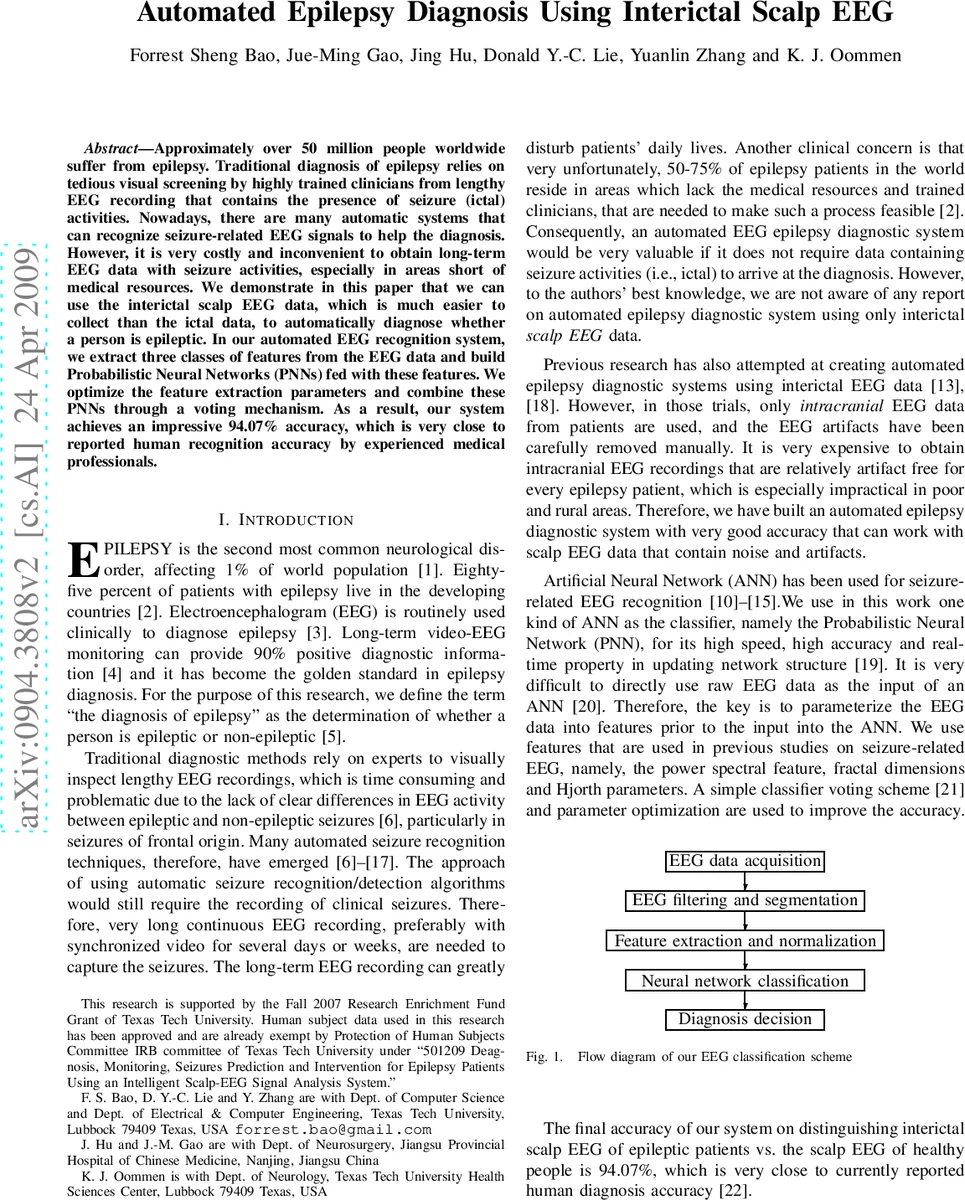
Feature extraction is performed in three complementary domains: (1) Power spectral features – the Fast Fourier Transform (FFT) of each segment is computed, and the power in predefined frequency bins is summed to obtain Power Spectral Intensity (PSI). These values are normalized to Relative Intensity Ratios (RIR) to capture the distribution of energy across bands. (2) Fractal dimensions – both Petrosian Fractal Dimension (PFD) and Higuchi Fractal Dimension (HFD) are calculated to quantify the signal’s self‑similarity and complexity. (3) Hjorth parameters – activity, mobility, and complexity are derived from first‑order differences of the time series, providing a compact description of its chaotic behavior.
The extracted features are fed into Probabilistic Neural Networks (PNNs). A PNN is a distance‑based classifier that uses Gaussian radial basis functions to estimate class‑conditional probability densities and makes decisions via Bayesian inference. In this work, the spread constant is set to 0.1, and the bias term in the radial basis layer is fixed at √ln 0.5, ensuring that the activation crosses 0.5 at the weighted input. Each EEG channel has its own PNN trained on the corresponding feature vectors.
To improve robustness, the authors employ a simple majority‑vote scheme across the 22 channel‑specific classifiers. For a given time instant, each channel’s PNN outputs a binary decision (epileptic vs. healthy). The final diagnosis is the class receiving the most votes. This ensemble approach mitigates the impact of noisy or artifact‑contaminated channels.
Experiments use Leave‑One‑Out Cross‑Validation (LOOCV). With default parameters (segment length = 4096, filter cut‑off = 40 Hz, frequency band = 2‑32 Hz, bin = 1 Hz), single‑channel accuracies range from about 70 % to 85 %, and the combined classifier reaches 84.27 % accuracy. Parameter optimization—extending segment length to 8192 samples, raising the filter cut‑off to 56 Hz, and adjusting the frequency band to 2‑34.5 Hz with a 2.5 Hz bin—boosts performance dramatically. Under this configuration, the ensemble classifier achieves 94.07 % accuracy, with sensitivity 83.33 % and specificity 84.69 %, essentially matching the diagnostic accuracy reported for experienced clinicians.
The analysis shows that increasing the filter cut‑off beyond 46 Hz yields diminishing returns, likely because most interictal spikes reside in the 15‑50 Hz range, while higher cut‑offs introduce line‑noise without adding useful information. Longer segments also improve accuracy, probably by providing more stable spectral estimates.
In conclusion, the study demonstrates that interictal scalp EEG, when processed with a combination of spectral, fractal, and Hjorth features and classified by PNNs, can reliably differentiate epileptic patients from healthy subjects. The system’s reliance on non‑ictal data, low‑cost scalp electrodes, and a classifier that can be updated in real time makes it attractive for deployment in underserved regions. Limitations include the small sample size (12 subjects) and the manual artifact handling; future work should involve larger, multi‑center datasets and automated artifact rejection to validate generalizability.
Comments & Academic Discussion
Loading comments...
Leave a Comment