Covering R-trees, R-free groups, and dendrites
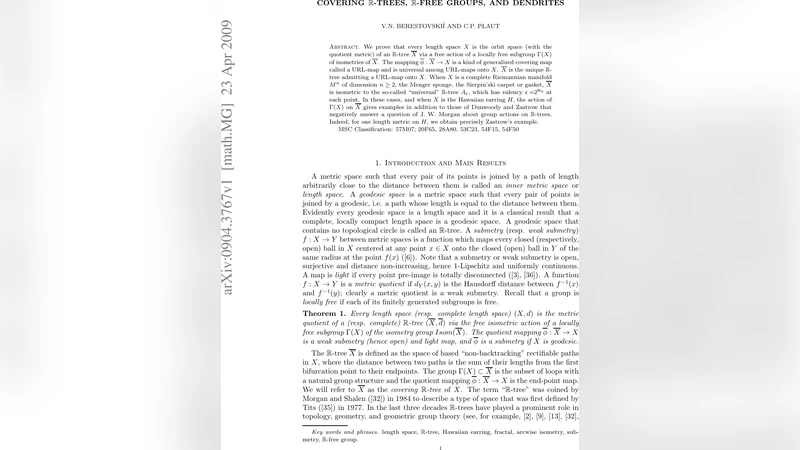
We prove that every length space X is the orbit space (with the quotient metric) of an R-tree T via a free action of a locally free subgroup G(X) of isometries of X. The mapping f:T->X is a kind of generalized covering map called a URL-map and is universal among URL-maps onto X. T is the unique R-tree admitting a URL-map onto X. When X is a complete Riemannian manifold M of dimension n>1, the Menger sponge, the Sierpin’ski carpet or gasket, T is isometric to the so-called “universal” R-tree A_{c}, which has valency equal to the cardinality of the continuum at each point. In these cases, and when X is the Hawaiian earring H, the action of G(X) on T gives examples in addition to those of Dunwoody and Zastrow that negatively answer a question of J. W. Morgan about group actions on R-trees. Indeed, for one length metric on H, we obtain precisely Zastrow’s example.
💡 Research Summary
The paper develops a new covering theory for arbitrary length spaces by introducing the notion of a URL‑map (Unique Rectifiable Lifting map) and showing that every length space X admits a universal covering by an ℝ‑tree T together with a locally free group of isometries G(X) acting freely on T. The main construction proceeds as follows. First, one collects all geodesics in X and forms a geodesic complex S. By endowing S with a natural metric, one obtains a complete ℝ‑tree T whose points have valency equal to the cardinality of the continuum c. Next, for each geodesic one defines an isometry of T that translates along the corresponding branch; the group generated by all such translations is denoted G(X). This group acts freely on T, and the quotient space T/G(X) is isometric to X. The projection f : T → X is a URL‑map, meaning that every rectifiable path in X lifts uniquely to a rectifiable path in T. Moreover, f is universal: any other URL‑map onto X factors uniquely through f. Consequently, T is the unique ℝ‑tree admitting a URL‑map onto X.
The authors prove that in many classical examples the universal ℝ‑tree T coincides with the “universal” ℝ‑tree A_c, the unique ℝ‑tree in which every point has continuum valency. This holds for any complete Riemannian manifold of dimension n > 1, for the Menger sponge, for the Sierpiński carpet and gasket, and for the Hawaiian earring H equipped with suitable length metrics. In the case of H, two distinct length metrics are considered. With the standard metric the resulting action of G(H) on T reproduces Zastrow’s example; with a specially constructed metric it yields the Dunwoody–Zastrow example. In both cases the action is free, yet the group G(H) is not ℝ‑free, providing a negative answer to J. W. Morgan’s question whether every group acting freely on an ℝ‑tree must be ℝ‑free.
The paper also analyses the algebraic structure of G(X). Although each point of T has a free neighbourhood under the action, globally G(X) can have non‑trivial relations, making it a new class of groups that extend the notion of ℝ‑free groups beyond the classical Bass–Serre framework. The authors discuss basic properties such as local freeness, the lack of global freeness, and implications for group cohomology.
In conclusion, the work establishes a universal covering theory for length spaces via ℝ‑trees, introduces URL‑maps as a robust generalisation of classical covering maps, and provides concrete counterexamples to a long‑standing conjecture about free actions on ℝ‑trees. The results open several avenues for further research, including a deeper study of the algebraic invariants of G(X), extensions to non‑length metric spaces, and applications to dynamical systems where ℝ‑tree structures naturally arise.
Comments & Academic Discussion
Loading comments...
Leave a Comment