On the tidal evolution of Hot Jupiters on inclined orbits
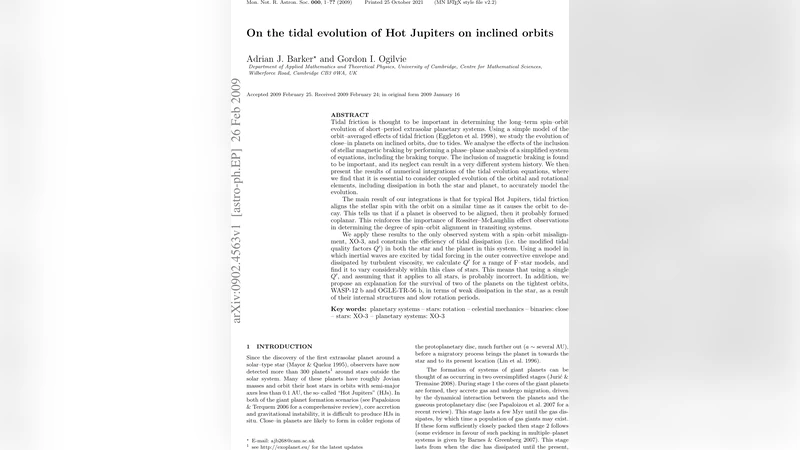
Tidal friction is thought to be important in determining the long-term spin-orbit evolution of short-period extrasolar planetary systems. Using a simple model of the orbit-averaged effects of tidal friction, we study the evolution of close-in planets on inclined orbits, due to tides. We analyse the effects of the inclusion of stellar magnetic braking by performing a phase-plane analysis of a simplified system of equations, including the braking torque. The inclusion of magnetic braking is found to be important, and its neglect can result in a very different system history. We then present the results of numerical integrations of the tidal evolution equations, where we find that it is essential to consider coupled evolution of the orbital and rotational elements, including dissipation in both the star and planet, to accurately model the evolution. The main result of our integrations is that for typical Hot Jupiters, tidal friction aligns the stellar spin with the orbit on a similar time as it causes the orbit to decay. This means that if a planet is observed to be aligned, then it probably formed coplanar. This reinforces the importance of Rossiter-McLaughlin effect observations in determining the degree of spin-orbit alignment in transiting systems. We apply these results to the XO-3 system, and constrain the tidal quality factors Q’ in both the star and planet in this system. Using a model in which inertial waves are excited by tidal forcing in the outer convective envelope and dissipated by turbulent viscosity, we calculate Q’ for a range of F-star models, and find it to vary considerably within this class of stars. This means that assuming a single Q’ applies to all stars is probably incorrect. We propose an explanation for the survival of WASP-12 b & OGLE-TR-56 b, in terms of weak dissipation in the star.
💡 Research Summary
This paper investigates the long‑term spin‑orbit evolution of short‑period exoplanets, focusing on hot Jupiters that occupy inclined orbits. The authors adopt a simple, orbit‑averaged tidal model that incorporates dissipation in both the star and the planet, and they extend it by adding a magnetic braking torque to represent the stellar wind‑driven spin‑down that real stars experience.
First, a phase‑plane analysis of a reduced two‑dimensional system (stellar spin rate versus orbital angular momentum) shows that magnetic braking dramatically alters the trajectories. Without braking, the star retains a rapid rotation, suppressing tidal synchronization and leading to a qualitatively different evolutionary history. When braking is included, the stellar spin decays on a timescale of a few hundred Myr, allowing the tidal torque to bring the stellar spin axis into alignment with the orbital plane while simultaneously draining orbital angular momentum.
Next, the authors perform full numerical integrations of the coupled tidal equations for a wide range of initial conditions: different initial inclinations, stellar spin‑to‑orbital‑frequency ratios, and tidal quality factors Q′ for both bodies. The integrations reveal that, for typical hot Jupiters (≈1 M_J, a≈0.05 AU), the timescale for orbital decay (τ_a) is comparable to the timescale for spin‑orbit alignment (τ_obl). In other words, the orbit shrinks at roughly the same rate that the stellar spin axis is forced to align with the orbital plane. Consequently, an observed alignment strongly suggests that the planet formed in a near‑coplanar configuration rather than having been realigned after formation.
A key part of the study is the estimation of the stellar tidal quality factor Q′* for F‑type stars. Using a model in which inertial waves are excited in the outer convective envelope and dissipated by turbulent viscosity, the authors compute Q′* for a grid of stellar models. The results show a large spread, with Q′* ranging from 10^5 to 10^8 depending on convective depth, rotation rate, and stellar mass. This variability implies that a single, universal Q′* value cannot be applied across different host stars.
The paper applies the framework to the XO‑3 system, which exhibits a large projected spin‑orbit misalignment (~70°). By matching the observed orbital decay and misalignment evolution, the authors constrain Q′_≈10^6–10^7 and Q′p≈10^5–10^6 for this system, indicating that both stellar and planetary tides are moderately efficient. They also discuss the puzzling survival of ultra‑close hot Jupiters such as WASP‑12 b and OGLE‑TR‑56 b. The authors argue that weak stellar dissipation (i.e., a large Q′) can significantly prolong the orbital lifetime, reconciling the observed existence of these planets with theoretical expectations of rapid inspiral.
Overall, the study demonstrates that (1) magnetic braking must be included to obtain realistic spin‑orbit histories, (2) coupled evolution of orbital and rotational elements is essential for accurate modeling, (3) the similarity of alignment and decay timescales makes the Rossiter‑McLaughlin effect a powerful diagnostic of formation pathways, and (4) stellar tidal quality factors are highly star‑dependent, cautioning against the use of a single Q′_* in population‑level studies. The work thus provides a comprehensive theoretical framework that links tidal physics, stellar spin‑down, and observational diagnostics to improve our understanding of hot Jupiter origins and fates.
Comments & Academic Discussion
Loading comments...
Leave a Comment