Business Process Modeling Notation - An Overview
BPMN represents an industrial standard created to offer a common and user friendly notation to all the participants to a business process. The present paper aims to briefly present the main features of this notation as well as an interpretation of some of the main patterns characterizing a business process modeled by the working fluxes.
💡 Research Summary
The paper provides a concise yet comprehensive overview of Business Process Modeling Notation (BPMN), an industrial standard designed to create a common, user‑friendly visual language for all participants in a business process. It begins by situating BPMN within the broader context of Business Process Management (BPM), highlighting the communication gap that historically existed between business analysts, developers, and operational staff. BPMN, standardized by the Object Management Group (OMG) in 2004, aims to bridge this gap by offering a unified notation that can be used throughout the lifecycle of a process—from design and analysis to implementation and monitoring.
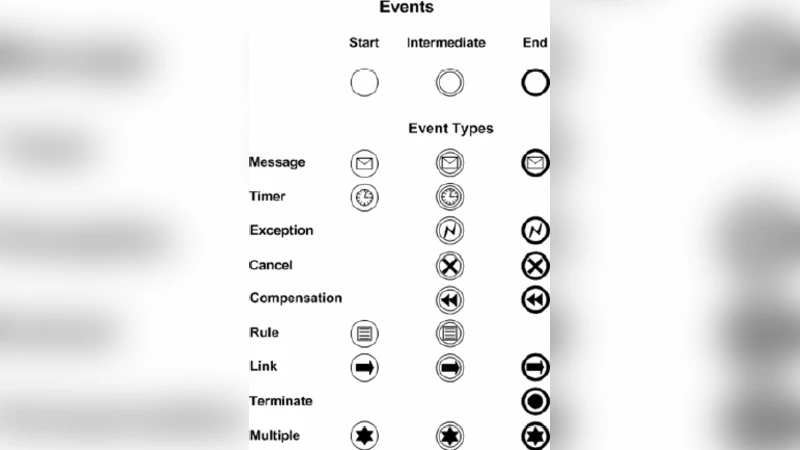
The core of the paper is a systematic breakdown of BPMN’s structural elements. Flow objects—Events, Activities, and Gateways—form the backbone of any diagram. Events mark the start, end, or intermediate points of a process and can be triggered by timers, messages, errors, and other stimuli. Activities represent work units and are further categorized into user tasks, service tasks, and sub‑processes, the latter enabling hierarchical decomposition of complex logic. Gateways control the direction of flow, with XOR, AND, and OR symbols providing exclusive, parallel, and inclusive branching respectively. Connecting objects—Sequence Flows, Message Flows, and Associations—link the flow objects, defining the default execution path, cross‑pool communication, and textual annotations. Pools and Lanes introduce organizational context, delineating the boundaries of participants, systems, or business units and clarifying how processes interact across these boundaries.
The authors then examine four principal pattern families that BPMN supports, illustrating how the notation captures common business scenarios. Sequential patterns depict simple linear execution, the most basic form of process flow. Parallel patterns use AND gateways to model tasks that can be performed concurrently, improving resource utilization and reducing overall cycle time. Conditional patterns employ XOR gateways with attached expressions to represent decision points and exception handling, making the logic of branching explicit. Looping patterns introduce cyclic behavior, allowing a set of activities to repeat until a defined condition is met—typical in review‑revise‑approve cycles or approval workflows. These patterns are mapped to real‑world examples such as order fulfillment, customer support, and compliance checks, demonstrating BPMN’s ability to model both straightforward and intricate processes.
A notable strength of BPMN highlighted in the paper is its extensibility. While the standard set of symbols covers a wide range of generic scenarios, practitioners can define custom tasks and events to address domain‑specific requirements. For instance, a financial institution might add a “Risk Assessment Event,” while a manufacturing firm could introduce a “Quality Inspection Sub‑process.” Such extensions preserve compatibility with the core specification while enriching the expressive power of the models.
The discussion also covers tooling and validation. A variety of commercial and open‑source BPMN editors provide drag‑and‑drop diagramming, automatic layout, simulation, and validation capabilities. Model validation is emphasized as a critical step to detect logical errors (e.g., dead‑ends, infinite loops) and violations of business rules before deployment. The paper outlines three validation approaches: formal verification using Petri‑net semantics, simulation‑based testing to observe runtime behavior, and runtime monitoring that checks conformance during execution.
In conclusion, the authors reaffirm BPMN’s role as a lingua franca for business process modeling, enabling diverse stakeholders to share a single, coherent view of a process. The notation’s standardized visual vocabulary, combined with its hierarchical structuring, pattern support, and extensibility, fosters effective collaboration and reduces miscommunication. The paper suggests future research directions, including tighter integration between BPMN models and execution engines, enhanced modeling of complex event processing, and the incorporation of AI‑driven process optimization techniques. These avenues aim to further elevate BPMN from a descriptive language to a proactive tool for continuous process improvement.
Comments & Academic Discussion
Loading comments...
Leave a Comment