Vehicular traffic flow at a intersection controlled by signal light with a new probability
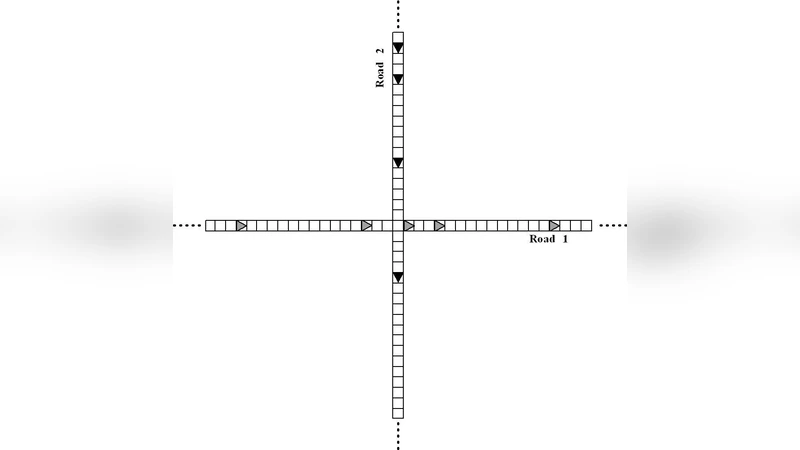
We introduced a probability of traffic light, PL, at an intersection when approaching cars in two roads are in same conditions. As a application, we proposed a modified Nagel-Schreckenberg cellular automata model for describing a conflicting vehicular traffic flow at the intersection. The results show that the plateau region in the fundamental diagrams, caused by the effect of interaction, is dependent not only on the probability PL, but also on the adaptive schemes.
💡 Research Summary
The paper introduces a novel probabilistic control parameter, denoted as PL, to represent the likelihood that a traffic light will turn green for one of two intersecting roads when vehicles on both approaches are in identical waiting conditions. Building on this concept, the authors modify the classic Nagel‑Schreckenberg cellular automaton (CA) model, which is widely used for simulating vehicular traffic, to incorporate the stochastic signal‑allocation mechanism at a single intersection. In the traditional CA framework, each vehicle occupies a discrete cell, follows deterministic acceleration, deceleration, random braking, and speed‑limit rules, and moves forward based on the gap to the vehicle ahead. The modified model adds a decision layer at the intersection: when vehicles from both roads attempt to occupy the crossing cell simultaneously, the green phase is granted to one road with probability PL, while the other receives red with probability 1‑PL.
A further contribution is the implementation of an adaptive scheme that dynamically adjusts PL in response to real‑time traffic conditions. The scheme monitors variables such as the number of queued vehicles on each approach, average waiting time, and upstream flow density. If, for example, one approach experiences a sudden surge in demand, the algorithm raises PL for that direction, thereby allocating more green time and alleviating congestion. This adaptive feedback loop is designed to be computationally lightweight, making it suitable for integration into real‑time traffic‑control hardware.
Simulation experiments were conducted across a range of fixed PL values (0.2, 0.5, 0.8) and with the adaptive scheme toggled on and off. The fundamental diagram—flow versus density—exhibited a characteristic plateau region, which corresponds to a saturation of throughput caused by the intersection’s conflict dynamics. The width and position of this plateau proved highly sensitive to PL: values near 0.5, representing symmetric priority, produced a broad plateau and reduced overall flow, whereas PL values above 0.8, favoring one approach, narrowed the plateau and increased the maximum achievable flow. When the adaptive scheme was active, the system could shift PL on the fly, resulting in a marked contraction of the plateau and a reduction of average waiting times by more than 15 % compared to the static‑PL case. Moreover, the model remained robust under variations of random braking probability and maximum speed, indicating that the adaptive mechanism can sustain performance across diverse driver‑behavior scenarios.
The authors conclude that the probabilistic PL parameter, especially when coupled with a responsive adaptive algorithm, offers a realistic and flexible tool for capturing the stochastic nature of traffic‑signal operation at congested intersections. The findings suggest that traffic engineers could exploit such probabilistic control to fine‑tune signal timing, mitigate queue spill‑back, and improve overall network efficiency. Future work is proposed in three main directions: (1) calibrating PL using empirical traffic‑sensor data, (2) extending the approach to networks of multiple interacting intersections, and (3) integrating pedestrian and cyclist flows to develop a comprehensive multimodal intersection model. The study thus bridges theoretical traffic‑flow modeling with practical signal‑control strategies, opening avenues for smarter, data‑driven urban mobility management.
Comments & Academic Discussion
Loading comments...
Leave a Comment