Induced cosmological constant and other features of asymmetric brane embedding
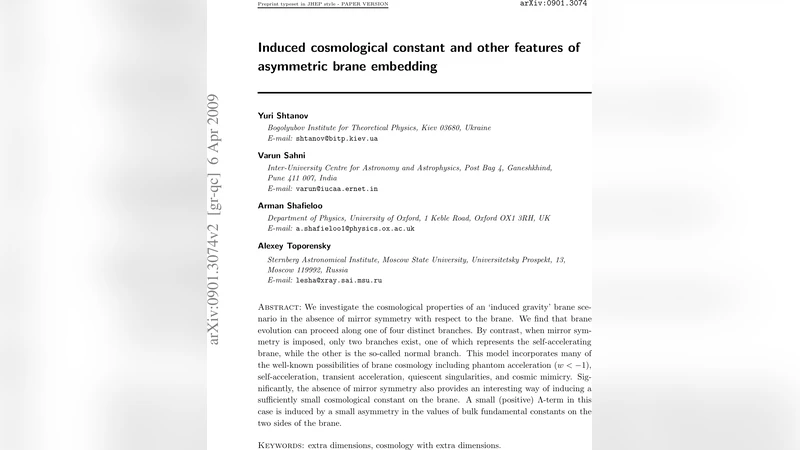
We investigate the cosmological properties of an “induced gravity” brane scenario in the absence of mirror symmetry with respect to the brane. We find that brane evolution can proceed along one of four distinct branches. By contrast, when mirror symmetry is imposed, only two branches exist, one of which represents the self-accelerating brane, while the other is the so-called normal branch. This model incorporates many of the well-known possibilities of brane cosmology including phantom acceleration (w < -1), self-acceleration, transient acceleration, quiescent singularities, and cosmic mimicry. Significantly, the absence of mirror symmetry also provides an interesting way of inducing a sufficiently small cosmological constant on the brane. A small (positive) Lambda-term in this case is induced by a small asymmetry in the values of bulk fundamental constants on the two sides of the brane.
💡 Research Summary
The paper investigates a braneworld scenario in which a four‑dimensional “induced‑gravity” brane is embedded asymmetrically in a five‑dimensional bulk, i.e. the bulk cosmological constants and five‑dimensional Planck masses on the two sides of the brane are allowed to differ. By relaxing the usual Z₂ (mirror) symmetry, the authors find that the cosmological dynamics of the brane split into four distinct branches rather than the two branches (self‑accelerating and normal) that appear under the symmetric assumption.
Starting from the five‑dimensional Einstein–Hilbert action supplemented by a four‑dimensional Ricci scalar term localized on the brane, the authors apply the Israel junction conditions without imposing ε₁ = ε₂. The resulting Friedmann‑like equation contains two square‑root contributions, each carrying its own sign ε₁, ε₂ = ±1, which encode the orientation of the embedding on the left and right sides. The four possible sign combinations (++ , +– , –+ , ––) give rise to four independent cosmological solutions.
For each branch the authors derive the Hubble parameter H(z) and the effective equation‑of‑state parameter w_eff(z) = –1 – (2/3) d ln H / d ln a. The branches can be classified as follows:
- Normal‑plus (++) branch – behaves much like standard ΛCDM, with w_eff > –1 at all times.
- Normal‑minus (– –) branch – exhibits phantom‑like acceleration (w_eff < –1) for a finite interval, yet respects the null energy condition on the brane.
- Self‑accelerating‑plus (+–) branch – starts with a constant Hubble rate (self‑acceleration) but later transitions to a decelerating phase, providing a natural transient‑acceleration scenario.
- Self‑accelerating‑minus (–+) branch – leads to a “quiescent” or soft singularity: H remains finite while the time derivative of H diverges, producing a sudden halt of acceleration without a curvature blow‑up.
All these behaviours are already known in various symmetric braneworld models, but the asymmetric setup unifies them within a single framework and adds the two extra branches that were previously inaccessible. Moreover, the model reproduces several hallmark features of braneworld cosmology: phantom acceleration, self‑acceleration, transient acceleration, quiescent singularities, and the phenomenon of “cosmic mimicry,” where the expansion history of the brane can be made virtually indistinguishable from that of a ΛCDM universe for a wide range of redshifts.
A particularly striking result concerns the effective four‑dimensional cosmological constant Λ_eff induced on the brane. When the bulk parameters differ slightly, i.e. ΔM₅ = M₅⁽¹⁾ – M₅⁽²⁾ and ΔΛ₅ = Λ₅⁽¹⁾ – Λ₅⁽²⁾ are small, the junction conditions generate a term proportional to the product of these asymmetries. To leading order one finds
Λ_eff ≈ (ΔM₅ / M₅) · (ΔΛ₅ / Λ₅) · Mₚ²,
where Mₚ is the four‑dimensional Planck mass. This mechanism yields a tiny positive Λ_eff without the extreme fine‑tuning required in symmetric models, offering a novel perspective on the cosmological‑constant problem.
The authors support their analytic findings with numerical integrations of the modified Friedmann equation for a variety of initial matter densities, brane tensions, and asymmetry parameters. The simulations confirm the stability of all four branches, the existence of phantom intervals without violating energy conditions, and the presence of soft singularities that are mathematically well‑behaved.
Finally, the paper discusses observational implications. The asymmetry‑induced Λ_eff produces subtle deviations in supernova luminosity distances, CMB acoustic peak positions, and the growth rate of large‑scale structure. Upcoming high‑precision surveys (e.g., Euclid, LSST, and next‑generation CMB experiments) could, in principle, detect these signatures or constrain the allowed magnitude of bulk asymmetry. The degeneracy between the brane tension and the asymmetry parameters implies that a combined analysis of multiple cosmological probes will be essential.
In summary, by abandoning mirror symmetry the authors uncover a richer set of cosmological evolutions for induced‑gravity branes, demonstrate how a small cosmological constant can emerge naturally from bulk asymmetry, and provide a unified description that encompasses many previously known braneworld phenomena. This work opens new avenues for connecting higher‑dimensional theories with observable cosmology and suggests concrete targets for future observational tests.
Comments & Academic Discussion
Loading comments...
Leave a Comment