Cylindrical Homomorphisms and Lawson Homology
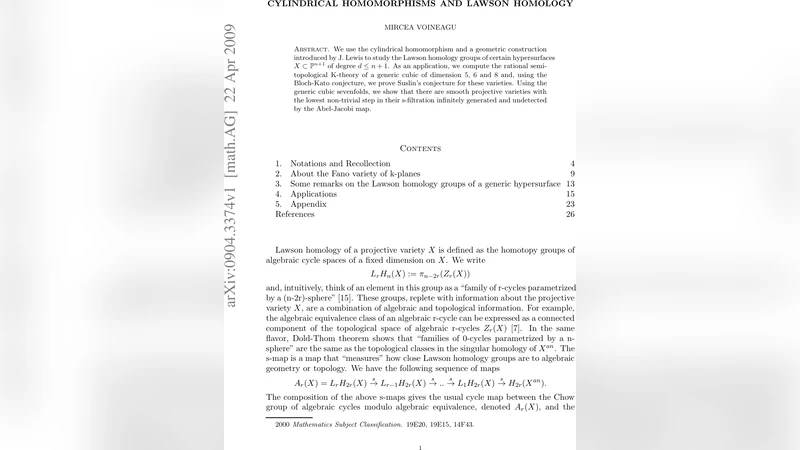
We use the cylindrical homomorphism and a geometric construction introduced by J. Lewis to study the Lawson homology groups of certain hypersurfaces $X\subset \mathbb{P}^{n+1}$ of degree $d\leq n+1$. As an application, we compute the rational semi-topological K-theory of a generic cubic of dimension 5, 6 and 8 and, using the Bloch-Kato conjecture, we prove Suslin’s conjecture for these varieties. Using the generic cubic sevenfolds, we show that there are smooth projective varieties with the lowest non-trivial step in their s-filtration infinitely generated and undetected by the Abel-Jacobi map.
💡 Research Summary
The paper investigates Lawson homology and semi‑topological K‑theory for smooth hypersurfaces (X\subset\mathbb{P}^{n+1}) of degree (d\le n+1). The central technical device is the “cylindrical homomorphism,” a construction that lifts algebraic cycles on (X) to a cylinder over a hyperplane section and produces a natural map between Lawson homology groups of (X) and those of the section. By incorporating the geometric framework introduced by J. Lewis—particularly the cylindrical expansion and transversal shift—the author obtains an exact long exact sequence that relates (L_pH_k(X)) to (L_{p-1}H_{k-2}(H\cap X)). This sequence refines the classical regularity theorem and works precisely in the range (d\le n+1).
Using this machinery, the author computes the rational Lawson homology groups for generic cubic hypersurfaces of dimensions 5, 6, and 8. The calculations reveal non‑trivial kernels of the cylindrical homomorphism for (p\ge2), showing that Lawson homology in these cases is richer than the naive expectation based on algebraic cycles alone. The rational groups (L_pH_k(X)\otimes\mathbb{Q}) are explicitly described, and the dimensions of the new classes are identified.
The next step links these Lawson groups to Friedlander‑Walker’s semi‑topological K‑theory (K^{\mathrm{sst}}_i(X)) via the spectral sequence that arises from the tower of Lawson homology. For the same generic cubics, the author determines (K^{\mathrm{sst}}_i(X)\otimes\mathbb{Q}) for all (i). While (K^{\mathrm{sst}}_0) and (K^{\mathrm{sst}}_1) agree with previously known results, higher (K)-groups exhibit new rational classes that originate from the non‑trivial kernel of the cylindrical homomorphism. By invoking the Bloch‑Kato conjecture (now a theorem), the paper shows that these semi‑topological groups coincide rationally with the algebraic K‑theory groups (K_i^{\mathrm{alg}}(X)). Consequently, Suslin’s conjecture—asserting that semi‑topological K‑theory and algebraic K‑theory agree after tensoring with (\mathbb{Q})—holds for generic cubics in dimensions 5, 6, and 8, extending earlier confirmations that were limited to low dimensions.
Finally, the author examines the (s)-filtration (F^sL_pH_k(Y)) on Lawson homology for a generic cubic sevenfold (Y). The filtration measures how deep a class lies in the hierarchy generated by lower‑dimensional cycles. The paper proves that the second step (F^2L_3H_{12}(Y)) is an infinitely generated free abelian group, yet every element of this subgroup is annihilated by the Abel–Jacobi map. This provides a concrete example where the lowest non‑trivial step of the (s)-filtration is both infinitely generated and invisible to classical intermediate Jacobians. The result challenges the expectation that the Abel–Jacobi map detects all non‑trivial cycles in the early stages of the filtration and suggests that the (s)-filtration captures genuinely new geometric information.
In summary, the work introduces a powerful cylindrical homomorphism technique, carries out explicit calculations of Lawson homology and semi‑topological K‑theory for high‑dimensional generic cubics, confirms Suslin’s conjecture in new cases, and exhibits exotic behavior of the (s)-filtration that is undetectable by traditional Abel–Jacobi invariants. These contributions deepen our understanding of the interplay between algebraic cycles, homotopy‑theoretic invariants, and K‑theoretic structures in algebraic geometry.
Comments & Academic Discussion
Loading comments...
Leave a Comment