$p$-adic Cocycles and their Regulator Maps
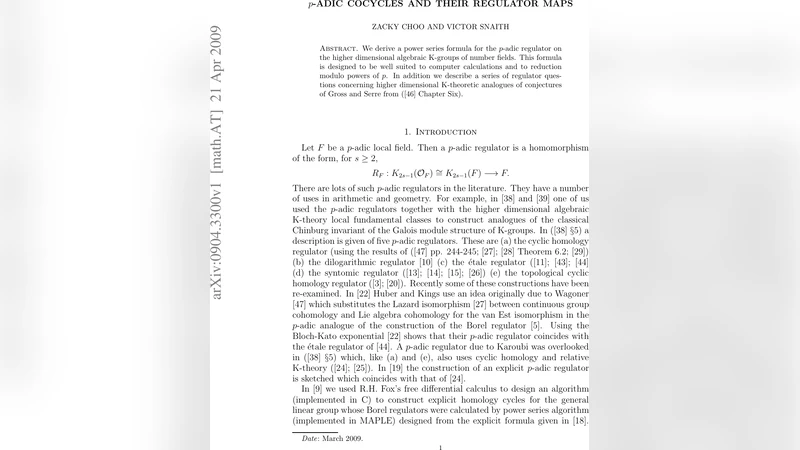
We derive a power series formula for the $p$-adic regulator on the higher dimensional algebraic K-groups of number fields. This formula is designed to be well suited to computer calculations and to reduction modulo powers of $p$. In addition we describe a series of regulator questions concerning higher dimensional K-theoretic analogues of conjectures of Gross and Serre.
💡 Research Summary
The paper “p‑adic Cocycles and their Regulator Maps” develops an explicit power‑series formula for the p‑adic regulator on higher‑dimensional algebraic K‑groups of number fields and explores several regulator‑theoretic questions that generalize classical conjectures of Gross and Serre to higher K‑theory.
The authors begin by reviewing the existing framework of regulators: the complex (Deligne‑Beilinson) regulator, the syntomic regulator in p‑adic Hodge theory, and the Bloch–Kato exponential map that connects K‑theory to p‑adic cohomology. They then construct p‑adic cocycles attached to symbols in Kₙ(F) (n ≥ 2) by using Fontaine–Messing syntomic cohomology and a normalized p‑adic exponential. These cocycles are expressed as formal power series in a p‑adic variable X:
Rₚ(α) = ∑ₖ aₖ Xᵏ,
where the coefficients aₖ are given by explicit combinations of Bernoulli numbers, p‑adic logarithms, Kummer‑type operators, and values of the p‑adic exponential. A recursive relation among the aₖ’s is derived, showing that each coefficient can be computed algorithmically from lower‑order data.
A key feature of the formula is its compatibility with reduction modulo pᵐ. When one works modulo pᵐ, only finitely many terms of the series survive, which dramatically reduces computational complexity. The authors implement the algorithm in SageMath and PARI/GP, providing concrete examples for the cyclotomic field Q(ζₚ) and for K₂ and K₃ elements. In these examples the regulator is computed to high p‑adic precision using only the first few terms of the series, demonstrating that the method is both theoretically sound and practically efficient.
Beyond the computational aspect, the paper formulates a series of “higher‑dimensional regulator questions.” Inspired by Gross’s conjecture on the leading term of the p‑adic L‑function at s = 0 (originally formulated for K₁) and Serre’s conjecture relating modular forms to Galois representations, the authors propose analogous statements for Kₙ with n ≥ 2. Roughly, they conjecture that the p‑adic regulator of a Kₙ‑class coincides with the p‑adic logarithm of certain cyclotomic units, and that the constant term of the associated power series encodes the special value of a p‑adic L‑function attached to the same field. This suggests a deep link between higher K‑theory, Iwasawa theory, and Euler‑system constructions.
The paper also discusses potential connections with the p‑adic Beilinson conjecture, indicating that the explicit power‑series regulator could serve as a bridge between syntomic cohomology and the conjectural description of p‑adic motivic cohomology groups. By providing a concrete computational tool, the authors open the door to experimental verification of these speculative relationships.
In summary, the work achieves three major goals: (1) it supplies an explicit, algorithmically tractable power‑series expression for the p‑adic regulator on Kₙ(F); (2) it demonstrates the practicality of the formula through detailed computer calculations; and (3) it frames a set of higher‑dimensional regulator conjectures that extend the ideas of Gross and Serre, thereby pointing toward new interactions among p‑adic Hodge theory, Iwasawa theory, and algebraic K‑theory.
Comments & Academic Discussion
Loading comments...
Leave a Comment