Combinatorial and model-theoretical principles related to regularity of ultrafilters and compactness of topological spaces. VI
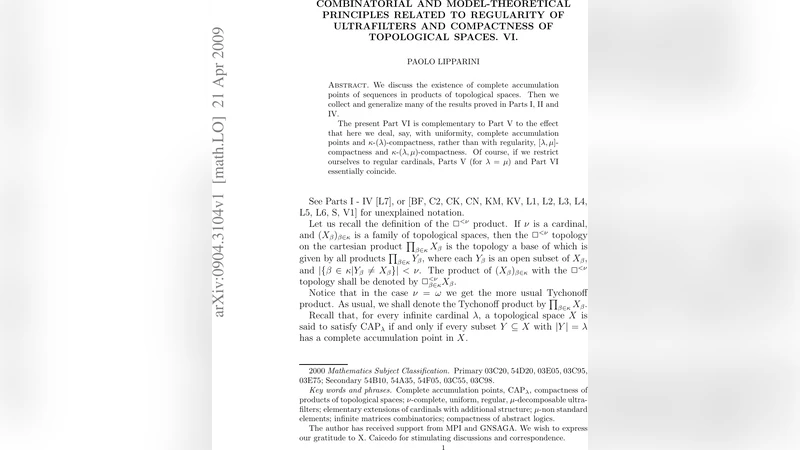
We discuss the existence of complete accumulation points of sequences in products of topological spaces. Then we collect and generalize many of the results proved in Parts I, II and IV. The present Part VI is complementary to Part V to the effect that here we deal, say, with uniformity, complete accumulation points and $ \kappa $-$(\lambda)$-compactness, rather than with regularity, $[ \lambda, \mu ]$-compactness and $ \kappa $-$ (\lambda, \mu)$-compactness. Of course, if we restrict ourselves to regular cardinals, Parts V (for $ \lambda = \mu$) and Part VI essentially coincide.
💡 Research Summary
This paper investigates the existence of complete accumulation points for sequences in arbitrary products of topological spaces and uses this notion to develop a unified framework linking ultrafilter uniformity with a new compactness concept, called κ‑(λ)‑compactness. The authors begin by revisiting the classical definitions of ultrafilter regularity, κ‑completeness, and κ‑uniformity, then refine these notions into λ‑completeness and λ‑uniformity, allowing a finer analysis of cardinal parameters.
A complete accumulation point of a set S⊆X is defined as a point x∈X such that every open neighbourhood of x meets S in a subset of the same cardinality as S. This generalizes the usual accumulation point and becomes especially powerful when dealing with κ‑length sequences (xα)α<κ: if each neighbourhood contains κ many terms, the sequence possesses a complete accumulation point.
The central compactness notion introduced, κ‑(λ)‑compactness, requires that every open cover of a space X has a subcover of size <λ. When λ is regular, this coincides with the familiar
Comments & Academic Discussion
Loading comments...
Leave a Comment