On the vanishing of homology for modules of finite complete intersection dimension
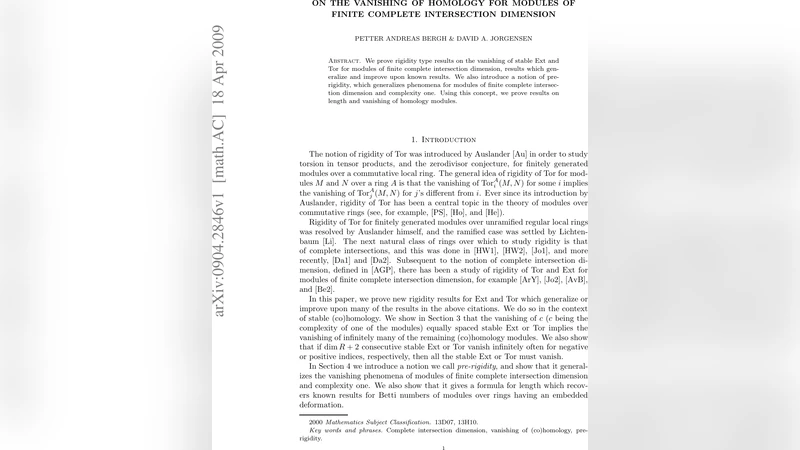
We prove rigidity type results on the vanishing of stable (co)homology for modules of finite complete intersection dimension, results which generalize and improve upon known results. We also introduce a notion of pre-rigidity, which generalizes phenomena for modules of finite complete intersection dimension and complexity one. Using this concept, we prove results on length and vanishing of homology modules.
💡 Research Summary
The paper investigates the vanishing behavior of stable (co)homology for modules whose complete intersection (CI) dimension is finite. Classical rigidity theorems state that over a local complete intersection ring, if a pair of finitely generated modules (M) and (N) have vanishing (\operatorname{Tor}) (or (\operatorname{Ext})) in a consecutive range of degrees, then all higher (or lower) (\operatorname{Tor}) (resp. (\operatorname{Ext})) groups vanish. However, those results typically require additional hypotheses such as bounded complexity or that the modules themselves have finite CI‑dimension and small complexity.
The authors remove the complexity restriction by introducing a new notion called pre‑rigidity. A module (M) is said to be pre‑rigid of order (n) with respect to a regular sequence (\mathbf{x}=x_{1},\dots ,x_{c}) if, after tensoring a suitable minimal free resolution of (M) with any module (N), the homology at degree (n) becomes zero (or the corresponding stable Tor group vanishes). This condition abstracts the “one‑step vanishing” phenomenon observed for modules of complexity one and extends it to all modules of finite CI‑dimension, regardless of their complexity.
Using the periodicity of minimal free resolutions over complete intersection rings, the authors prove that pre‑rigidity forces a full rigidity phenomenon: if (\widehat{\operatorname{Tor}}^{R}{t}(M,N)=0) for some integer (t) and (M) is pre‑rigid of order (n\le t), then (\widehat{\operatorname{Tor}}^{R}{i}(M,N)=0) for every (i\ge t). An analogous statement holds for stable Ext. Consequently, the classical “vanishing on a stretch ⇒ vanishing everywhere” principle now applies to a much larger class of modules.
Beyond the qualitative vanishing results, the paper derives quantitative information about the lengths of the stable homology modules. When pre‑rigidity is present, the lengths (\operatorname{length}{R}\widehat{\operatorname{Tor}}^{R}{i}(M,N)) stabilize for all (i) beyond the pre‑rigidity order, and the stable length can be expressed in terms of the depth of the ring and the depth of the module (M). This furnishes a precise measure of how the homological size of (M) interacts with the ambient ring.
The authors illustrate the theory with explicit examples on low‑dimensional complete intersection rings such as (k
Comments & Academic Discussion
Loading comments...
Leave a Comment