Decomposition width - a new width parameter for matroids
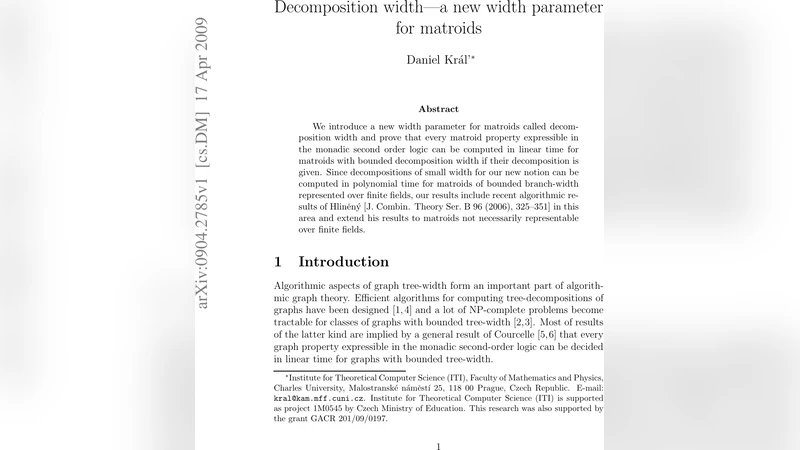
We introduce a new width parameter for matroids called decomposition width and prove that every matroid property expressible in the monadic second order logic can be computed in linear time for matroids with bounded decomposition width if their decomposition is given. Since decompositions of small width for our new notion can be computed in polynomial time for matroids of bounded branch-width represented over finite fields, our results include recent algorithmic results of Hlineny [J. Combin. Theory Ser. B 96 (2006), 325-351] in this area and extend his results to matroids not necessarily representable over finite fields.
💡 Research Summary
The paper introduces a novel width parameter for matroids called decomposition width and demonstrates its powerful algorithmic consequences. After reviewing existing width measures—branch‑width and tree‑width—the authors define a decomposition of a matroid as a rooted tree where each node is annotated with a label that encodes the pattern of independent sets in the sub‑matroid represented by that node. The decomposition width of a matroid is the smallest integer k such that there exists a decomposition in which every node carries at most k distinct labels. This notion can be seen as a matroid‑specific analogue of tree‑width: the labels play the role of states in a finite‑state automaton, and the transition rules between parent and children correspond to the matroid operations (restriction, contraction, direct sum, etc.).
The central technical result is that, given a decomposition of bounded width k, any property of the matroid that can be expressed in monadic second‑order logic (MSO) can be evaluated in linear time with respect to the size of the ground set. The authors achieve this by a bottom‑up dynamic programming scheme on the decomposition tree. Because the number of possible label configurations at each node is bounded by a function of k (independent of the ground set size), the DP table at each node has constant size, and the total work is proportional to the number of nodes, i.e., O(n). Consequently, model‑checking for MSO on matroids with bounded decomposition width becomes fixed‑parameter tractable with the parameter k, and the dependence on n is linear.
A crucial question is whether such decompositions can be found efficiently. The paper shows that for matroids representable over a finite field 𝔽_q, if the branch‑width is bounded by a constant b, then a decomposition of width k = f(b, q) can be constructed in polynomial time. The construction starts from a branch‑decomposition, computes for each sub‑matroid the set of possible label patterns, and then compresses these patterns to keep the number of labels bounded. This reduction relies on the fact that over a finite field the number of distinct linear subspaces of bounded dimension is itself bounded, allowing a uniform bound on the label set. Importantly, the algorithm does not depend on the specific field beyond its finiteness, and the same approach works for any matroid that admits a bounded‑branch‑width representation.
By establishing these two results, the authors generalize the celebrated theorem of Hliněný (JCTB 2006), which proved linear‑time MSO model‑checking for finite‑field representable matroids of bounded branch‑width. Hliněný’s theorem required the matroid to be representable over a fixed finite field; the new decomposition‑width framework removes this restriction entirely. Consequently, the linear‑time MSO algorithm now applies to all matroids—representable or not—provided a bounded‑width decomposition is supplied. This opens the door to efficient algorithmic treatment of many combinatorial structures that were previously out of reach, such as non‑representable transversal matroids, certain gammoids, and abstract matroids arising in optimization problems.
The paper also discusses practical implications. Since the DP tables are of constant size, the memory footprint is modest, and the algorithm is highly parallelizable (each subtree can be processed independently). Moreover, bounded decomposition width implies a strong structural regularity: the matroid can be assembled from a fixed library of “atomic” pieces using a bounded set of composition rules. This insight suggests that other combinatorial problems—e.g., matroid intersection, matroid parity, or network coding design—might admit similarly efficient algorithms when restricted to low‑width instances.
In the concluding sections, the authors outline future research directions: (1) developing approximation or heuristic methods for finding low‑decomposition‑width trees in general matroids; (2) extending the framework to other logical formalisms such as counting MSO or fixed‑point logics; (3) investigating the relationship between decomposition width and other matroid invariants (e.g., connectivity, girth); and (4) applying the theory to concrete domains like coding theory, where matroids model linear codes, and efficient MSO evaluation could lead to new decoding algorithms.
Overall, the work provides a unified, field‑independent algorithmic paradigm for matroids, showing that bounded decomposition width is a robust structural parameter that yields linear‑time solvability for a broad class of logical queries, thereby significantly extending the scope of tractable matroid algorithms.
Comments & Academic Discussion
Loading comments...
Leave a Comment