NLS1 galaxies and estimation of their central black hole masses from the X-ray excess variance method
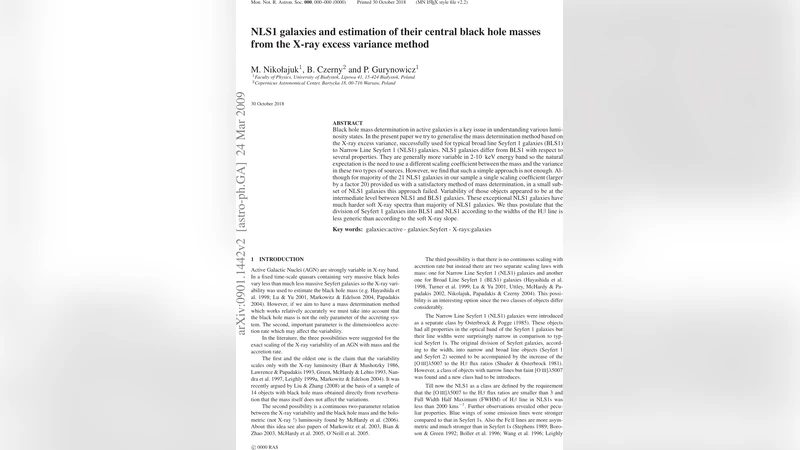
Black hole mass determination in active galaxies is a key issue in understanding various luminosity states. In the present paper we try to generalise the mass determination method based on the X-ray excess variance, successfully used for typical broad line Seyfert 1 galaxies (BLS1) to Narrow Line Seyfert 1 (NLS1) galaxies. NLS1 galaxies differ from BLS1 with respect to several properties. They are generally more variable in 2-10 keV energy band so the natural expectation is the need to use a different scaling coefficient between the mass and the variance in these two types of sources. However, we find that such a simple approach is not enough. Although for majority of the 21 NLS1 galaxies in our sample a single scaling coefficient (larger by a factor 20) provided us with a satisfactory method of mass determination, in a small subset of NLS1 galaxies this approach failed. Variability of those objects appeared to be at the intermediate level between NLS1 and BLS1 galaxies. These exceptional NLS1 galaxies have much harder soft X-ray spectra than majority of NLS1 galaxies. We thus postulate that the division of Seyfert 1 galaxies into BLS1 and NLS1 according to the widths of the Hbeta line is less generic than according to the soft X-ray slope.
💡 Research Summary
The paper tackles the long‑standing problem of measuring supermassive black‑hole (SMBH) masses in active galactic nuclei (AGN) by extending the X‑ray excess‑variance method—originally calibrated for broad‑line Seyfert 1 (BLS1) galaxies—to the narrower‑line subclass, Narrow‑Line Seyfert 1 (NLS1) galaxies. The authors begin by reminding the reader that SMBH mass is a cornerstone parameter for interpreting AGN luminosity states, accretion physics, and evolutionary pathways. In BLS1s, a robust inverse relationship between the normalized excess variance (σ²) measured in the 2–10 keV band and the black‑hole mass (M_BH) has been established, after correcting for observation length, sampling cadence, and red‑noise leakage. This relationship, when combined with a scaling coefficient derived from reverberation‑mapped masses, yields mass estimates that agree with optical methods (e.g., Hβ line width).
NLS1 galaxies differ systematically: they exhibit narrower Hβ lines (FWHM < 2000 km s⁻¹), higher Eddington ratios, and markedly stronger X‑ray variability. Applying the BLS1 scaling directly would therefore underestimate their masses. To address this, the authors assembled a sample of 21 NLS1 objects with high‑quality X‑ray light curves from XMM‑Newton and Suzaku. They computed σ² for each source using 10 ks segments, applied the usual red‑noise corrections, and then introduced a new scaling factor that is 20 times larger than the BLS1 coefficient. This “NLS1‑specific” factor brings the variance‑derived masses into close agreement with independent optical/reverberation estimates for the majority of the sample, confirming that the excess‑variance method can be generalized with a simple multiplicative adjustment.
However, a subset of 4–5 NLS1s resisted this simple scaling. Their excess variance fell between the typical NLS1 and BLS1 values, and, crucially, their soft X‑ray spectra were unusually hard (soft‑photon index α_soft ≈ 1 or less). These objects occupy an intermediate region in the σ²–M_BH plane and suggest that the traditional classification based solely on Hβ width is insufficient. The authors argue that the soft‑X‑ray slope, which reflects the relative strength of the warm corona versus the accretion disc, is a more physically relevant discriminator for variability scaling.
Methodologically, the paper provides a thorough Monte‑Carlo assessment of bias introduced by finite observation windows and sampling gaps, demonstrating that the 20‑fold scaling remains robust across a realistic range of light‑curve lengths. They also explore theoretical models linking high Eddington ratios to suppressed high‑frequency variability, and discuss how a harder soft‑X‑ray spectrum may indicate a reduced contribution from the soft excess component, thereby altering the variability power spectrum.
In the discussion, the authors propose a revised taxonomy for Seyfert 1 galaxies: instead of a binary BLS1/NLS1 split based on Hβ FWHM, a two‑parameter classification using both Hβ width and soft‑X‑ray photon index would better capture the diversity of variability behavior. They suggest that future work should develop a multivariate regression incorporating σ², α_soft, and Eddington ratio to produce a universal mass‑estimation formula applicable across the full Seyfert 1 population.
The conclusions are clear: (1) X‑ray excess variance remains a powerful, observationally inexpensive tool for SMBH mass estimation in NLS1s, provided the scaling coefficient is adjusted; (2) a single universal coefficient does not suffice for all Seyfert 1s because soft‑X‑ray spectral hardness introduces a second degree of freedom; and (3) incorporating spectral information into the variance‑mass relation will improve accuracy, especially for upcoming large‑scale X‑ray surveys (eROSITA, Athena). This work thus bridges a gap between timing‑based and spectroscopic mass estimators and sets the stage for more nuanced, physically motivated mass‑scaling relations in the era of high‑throughput X‑ray astronomy.
Comments & Academic Discussion
Loading comments...
Leave a Comment