Mesoscopic phases of dipolar ensembles with polar molecules and Rydberg atoms
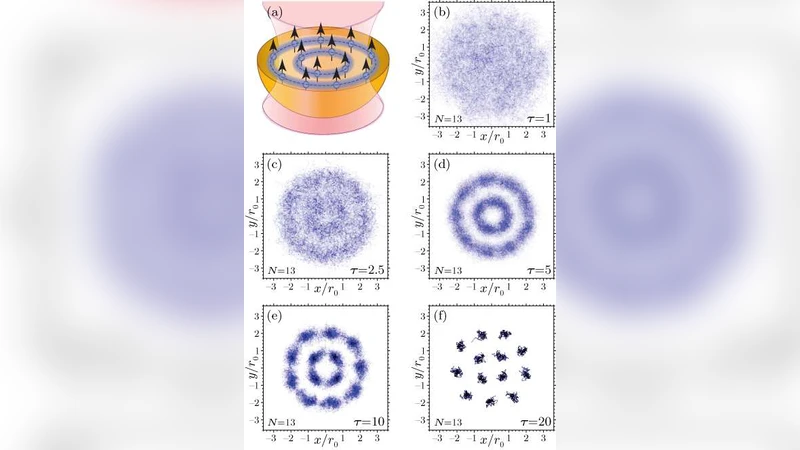
We discuss the realization of mesoscopic phases of dipolar gases relevant to current experiments with cold polar molecules and Rydberg atoms confined to two dimensions. We predict the existence of superfluid clusters, mesoscopic supersolids, and crystals for a small number of trapped particles, with no counterpart in the homogeneous situation. For certain strengths of the dipole-dipole interactions, the stabilization of purely {\it non-classical crystals} by quantum fluctuations is possible. We propose a magnification scheme to detect the spatial structure of these crystalline phases.
💡 Research Summary
The paper investigates the emergence of novel mesoscopic quantum phases in two‑dimensional ensembles of dipolar particles realized with ultracold polar molecules and Rydberg atoms. While the bulk (thermodynamic‑limit) behavior of dipolar gases is known to support superfluid, supersolid, and crystalline phases, the authors show that when the number of particles is limited to a few‑tens, confinement and finite‑size effects give rise to qualitatively new states that have no counterpart in the homogeneous system.
Using a combination of variational Monte‑Carlo and path‑integral quantum Monte‑Carlo simulations, the authors model the particles as point dipoles interacting via the (V_{dd}(r)=d^{2}/r^{3}) potential and confined by a 2‑D harmonic trap of frequency (\omega). The key dimensionless control parameter is the dipolar interaction strength (D = d^{2}/(a_{\mathrm{ho}}^{3}\hbar\omega)), where (a_{\mathrm{ho}}=\sqrt{\hbar/(m\omega)}) is the harmonic oscillator length. By scanning (D) for particle numbers (N) ranging from 5 to 30, they map out a phase diagram that contains three distinct regimes.
-
Superfluid clusters – For weak dipolar interactions the particles form compact clusters inside the trap. Despite the spatial localization, quantum exchange cycles remain abundant, leading to a finite superfluid fraction. The one‑body density matrix exhibits long‑range off‑diagonal order, while the pair‑correlation function shows only short‑range peaks.
-
Mesoscopic supersolids – At intermediate (D) the particles begin to arrange themselves into regular polygonal or hexagonal patterns, but the finite particle number prevents a perfect lattice. Defects and edge‑induced distortions coexist with persistent exchange cycles, producing a state that simultaneously displays crystalline density modulation and a non‑zero superfluid response. The static structure factor (S(k)) displays Bragg peaks superimposed on a low‑(k) superfluid plateau, a hallmark of supersolidity in a mesoscopic setting.
-
Crystalline phases and non‑classical crystals – For strong dipolar coupling the system approaches a classical crystal where particles occupy the minima of the dipolar plus trap potential. Remarkably, when quantum zero‑point fluctuations are comparable to the lattice spacing (which occurs for certain “magic” particle numbers such as 5, 7, 11, 19), the simulations reveal a different ordering: particles are displaced from the classical lattice sites and the resulting structure possesses a symmetry that is not present in the classical ground state. This “pure non‑classical crystal” is stabilized by quantum fluctuations that lower the energy of the fluctuating configuration below that of the static lattice. The authors identify this phenomenon as quantum‑fluctuation‑induced stabilization.
To make these predictions experimentally accessible, the authors propose a magnification protocol. After preparing the dipolar ensemble in the trap, the confinement is switched off abruptly and the particles are accelerated by a pulsed electric field or an optical lattice. The rapid expansion maps the initial inter‑particle distances onto a much larger spatial scale while preserving their relative ordering. High‑resolution absorption or fluorescence imaging can then resolve the amplified pattern, allowing direct observation of the cluster, supersolid, or non‑classical crystal geometry. The scheme leverages existing quantum‑gas microscope technology and requires only modest modifications to current polar‑molecule or Rydberg‑atom setups.
In summary, the work demonstrates that mesoscopic dipolar systems host a rich set of phases—superfluid clusters, mesoscopic supersolids, and fluctuation‑stabilized non‑classical crystals—that are absent in the bulk limit. By providing both a detailed theoretical phase diagram and a concrete detection strategy, the paper opens a realistic pathway for experimentalists to explore these exotic states, with implications for quantum simulation of long‑range interacting models, the design of novel quantum materials, and the study of quantum phase transitions in finite‑size systems.
Comments & Academic Discussion
Loading comments...
Leave a Comment