Solar wind and motion of dust grains
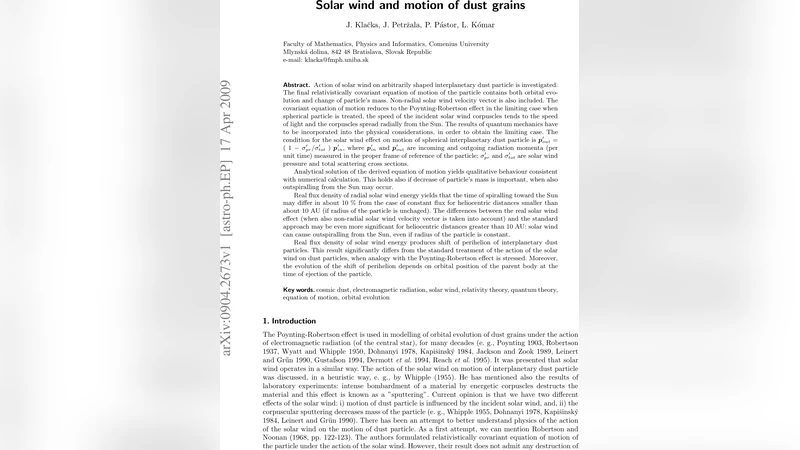
Action of solar wind on arbitrarily shaped interplanetary dust particle is investigated. The final relativistically covariant equation of motion of the particle contains both orbital evolution and change of particle’s mass. Non-radial solar wind velocity vector is also included. The covariant equation of motion reduces to the Poynting-Robertson effect in the limiting case when spherical particle is treated, the speed of the incident solar wind corpuscles tends to the speed of light and the corpuscles spread radially from the Sun. The results of quantum mechanics have to be incorporated into the physical considerations, in order to obtain the limiting case. The condition for the solar wind effect on motion of spherical interplanetary dust particle is $\vec{p}’{out}$ $=$ (1 $-$ $\sigma’{pr} / \sigma’{tot}$) $\vec{p}’{in}$, where $\vec{p}’{in}$ and $\vec{p}’{out}$ are incoming and outgoing radiation momenta (per unit time) measured in the proper frame of reference of the particle; $\sigma’{pr}$ and $\sigma’{tot}$ are solar wind pressure and total scattering cross sections. Real flux density of solar wind energy produces shift of perihelion of interplanetary dust particles. This result significantly differs from the standard treatment of the action of the solar wind on dust particles, when analogy with the Poynting-Robertson effect is stressed. Moreover, the evolution of the shift of perihelion depends on orbital position of the parent body at the time of ejection of the particle.
💡 Research Summary
The paper presents a comprehensive relativistically covariant formulation of the dynamics of arbitrarily shaped interplanetary dust particles (IDPs) under the action of the solar wind. Unlike the traditional treatment that simply draws an analogy with the Poynting‑Robertson (P‑R) effect, the authors derive an equation of motion that simultaneously accounts for (i) the change of the particle’s orbital elements, (ii) the secular variation of the particle’s mass, and (iii) the possibility that the solar‑wind velocity vector is not purely radial.
The cornerstone of the derivation is the momentum balance in the particle’s proper frame. The incoming solar‑wind momentum per unit time, (\vec p’{\rm in}), and the outgoing momentum, (\vec p’{\rm out}), are related by
\
Comments & Academic Discussion
Loading comments...
Leave a Comment