The application Breit-Wigner form with radiative corrections to the resonance fitting
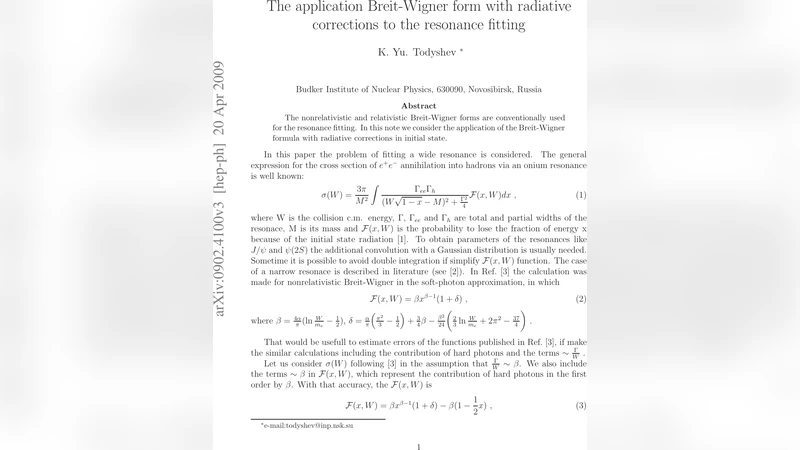
The nonrelativistic and relativistic Breit-Wigner forms are conventionally used for the resonance fitting. In this note we consider the application of the Breit-Wigner formula with radiative corrections in initial state.
💡 Research Summary
The paper addresses a long‑standing limitation in resonance analysis for electron‑positron colliders: the standard Breit‑Wigner (BW) line‑shape, whether in its non‑relativistic or relativistic formulation, does not account for the energy loss caused by initial‑state radiation (ISR). In high‑precision measurements near narrow resonances such as J/ψ, ψ(2S), or the Υ family, ISR can shift the effective center‑of‑mass energy and produce a pronounced asymmetric tail on the low‑energy side of the peak. Ignoring this effect leads to biased estimates of the resonance mass, total width, and leptonic partial width, as well as inflated χ² values in fits.
To remedy this, the authors incorporate the well‑established Kuraev‑Fadin radiator function W(s,x) into the BW formalism. The radiator describes the probability density for the fraction x of the beam energy carried away by radiated photons. The observable cross‑section is then expressed as a convolution:
σ_obs(s) = ∫₀^{x_max} W(s,x) σ_BW(s(1−x)) dx,
where σ_BW(s) is the conventional BW cross‑section (non‑relativistic: σ_BW(s)=12πΓ_eΓ/
Comments & Academic Discussion
Loading comments...
Leave a Comment