On the Proof Complexity of Deep Inference
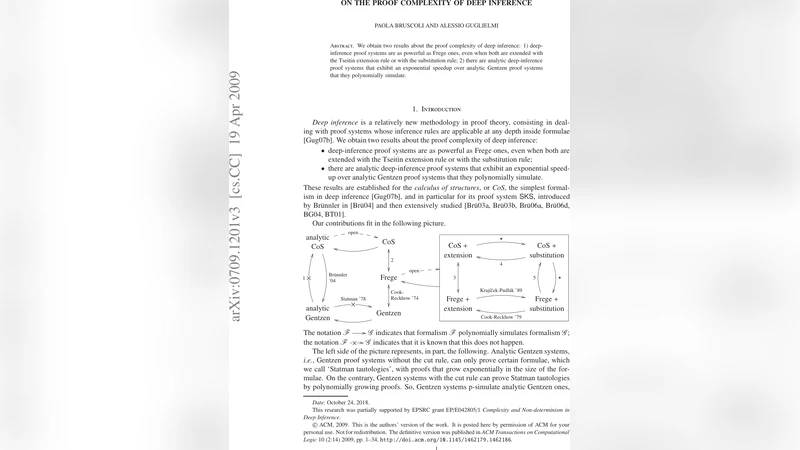
We obtain two results about the proof complexity of deep inference: 1) deep-inference proof systems are as powerful as Frege ones, even when both are extended with the Tseitin extension rule or with the substitution rule; 2) there are analytic deep-inference proof systems that exhibit an exponential speed-up over analytic Gentzen proof systems that they polynomially simulate.
💡 Research Summary
The paper investigates the proof‑complexity landscape of deep inference (DI) systems and establishes two major results that position DI as a powerful alternative to traditional proof systems. The first result shows that DI proof systems are polynomially equivalent to Frege systems even when both are extended with the Tseitin extension rule or with the substitution rule. To achieve this, the authors formalize DI with its characteristic deep‑rule application mechanisms—such as deep associativity, deep distributivity, and rule propagation—and construct explicit translation procedures between DI derivations and Frege derivations. The translation from Frege to DI decomposes each Frege inference into a bounded sequence of local DI steps that operate at arbitrary depths inside formulas, while the reverse translation simulates DI’s deep steps by a polynomial‑size Frege proof that carefully manages the introduction of new variables and definitions required by the extension rule. The handling of substitution is analogous: DI’s ability to apply substitutions locally at any depth is shown to be simulable by a series of bounded Frege substitution steps, preserving proof size up to a polynomial factor. Consequently, the paper proves that the addition of powerful extension mechanisms does not break the equivalence; DI remains as expressive as the strongest known propositional proof system.
The second result concerns analytic (cut‑free) fragments. Analytic DI systems are defined to forbid cuts and to restrict each inference to sub‑formulas, just as analytic Gentzen (sequent) systems do. The authors identify a family of propositional formulas—negative pyramidal formulas—that are easy for DI but hard for analytic Gentzen. In a Gentzen setting, proving such a formula forces a cascade of new sub‑derivations at each level of the pyramid, leading to a proof size that grows exponentially in the height of the pyramid. By contrast, DI can rearrange the structure of a formula at any depth in a single inference step, and it can propagate transformations simultaneously across many levels. The paper constructs an O(n)‑size DI proof for a pyramid of height n, while establishing a lower bound of 2^{Ω(n)} for any analytic Gentzen proof of the same formula. This exponential separation demonstrates that analytic DI enjoys a genuine speed‑up over analytic Gentzen, even though the latter polynomially simulates the former in the unrestricted (non‑analytic) setting.
The paper is organized as follows. Section 1 reviews background on proof complexity, Frege systems, Gentzen sequent calculi, and the deep‑inference framework. Section 2 introduces the extended Frege and DI systems, defines the Tseitin extension and substitution rules, and presents the polynomial‑simulation constructions. The key technical tools are a “proof‑graph” representation that tracks variable dependencies and a systematic rule‑propagation algorithm that keeps the size blow‑up polynomial. Section 3 focuses on analytic fragments. After formalizing analytic DI and analytic Gentzen, the authors define the negative pyramidal formulas and prove the exponential lower bound for Gentzen using a combinatorial argument based on proof‑width and the pigeon‑hole principle. They then exhibit the compact DI derivation, highlighting the role of deep rule application and simultaneous transformation. Section 4 discusses the implications of these findings: DI’s equivalence to Frege suggests that deep inference can serve as a universal proof‑theoretic framework, while the analytic speed‑up points to potential advantages in automated theorem proving and proof compression. The authors also outline open questions, such as whether similar separations exist for other analytic systems (e.g., resolution) and how DI might be integrated into practical proof assistants. In summary, the paper establishes that deep inference is both as strong as the most powerful propositional proof systems when extensions are allowed, and strictly more efficient than analytic Gentzen in certain cases, thereby enriching our understanding of the hierarchy of proof systems.
Comments & Academic Discussion
Loading comments...
Leave a Comment