A new supersymmetric equation is proposed for the Sawada-Kotera equation. The integrability of this equation is shown by the existence of Lax representation and infinite conserved quantities and a recursion operator.
Deep Dive into A supersymmetric Sawada-Kotera equation.
A new supersymmetric equation is proposed for the Sawada-Kotera equation. The integrability of this equation is shown by the existence of Lax representation and infinite conserved quantities and a recursion operator.
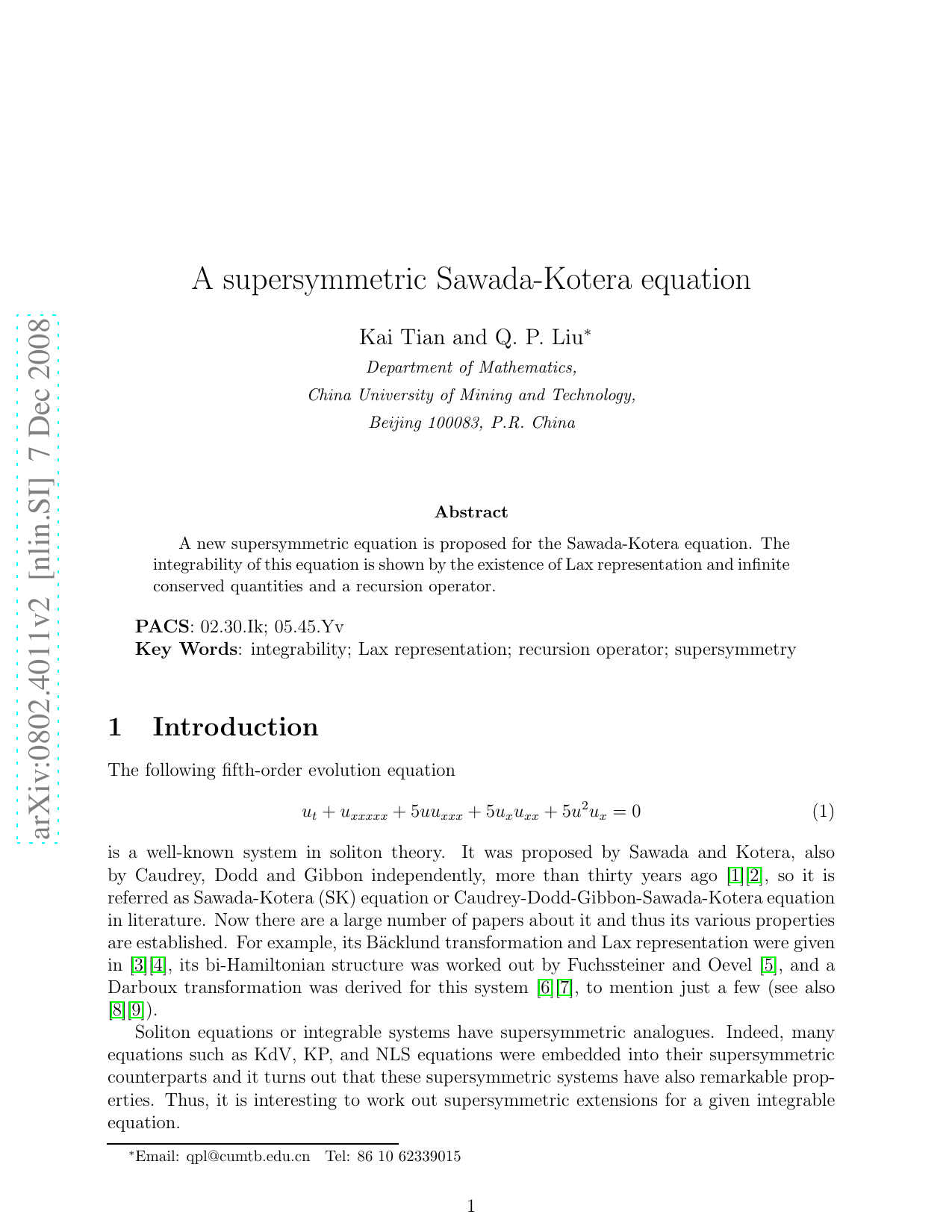
The following fifth-order evolution equation
is a well-known system in soliton theory. It was proposed by Sawada and Kotera, also by Caudrey, Dodd and Gibbon independently, more than thirty years ago [1][2], so it is referred as Sawada-Kotera (SK) equation or Caudrey-Dodd-Gibbon-Sawada-Kotera equation in literature. Now there are a large number of papers about it and thus its various properties are established. For example, its Bäcklund transformation and Lax representation were given in [3][4], its bi-Hamiltonian structure was worked out by Fuchssteiner and Oevel [5], and a Darboux transformation was derived for this system [6][7], to mention just a few (see also [8][9]). Soliton equations or integrable systems have supersymmetric analogues. Indeed, many equations such as KdV, KP, and NLS equations were embedded into their supersymmetric counterparts and it turns out that these supersymmetric systems have also remarkable properties. Thus, it is interesting to work out supersymmetric extensions for a given integrable equation.
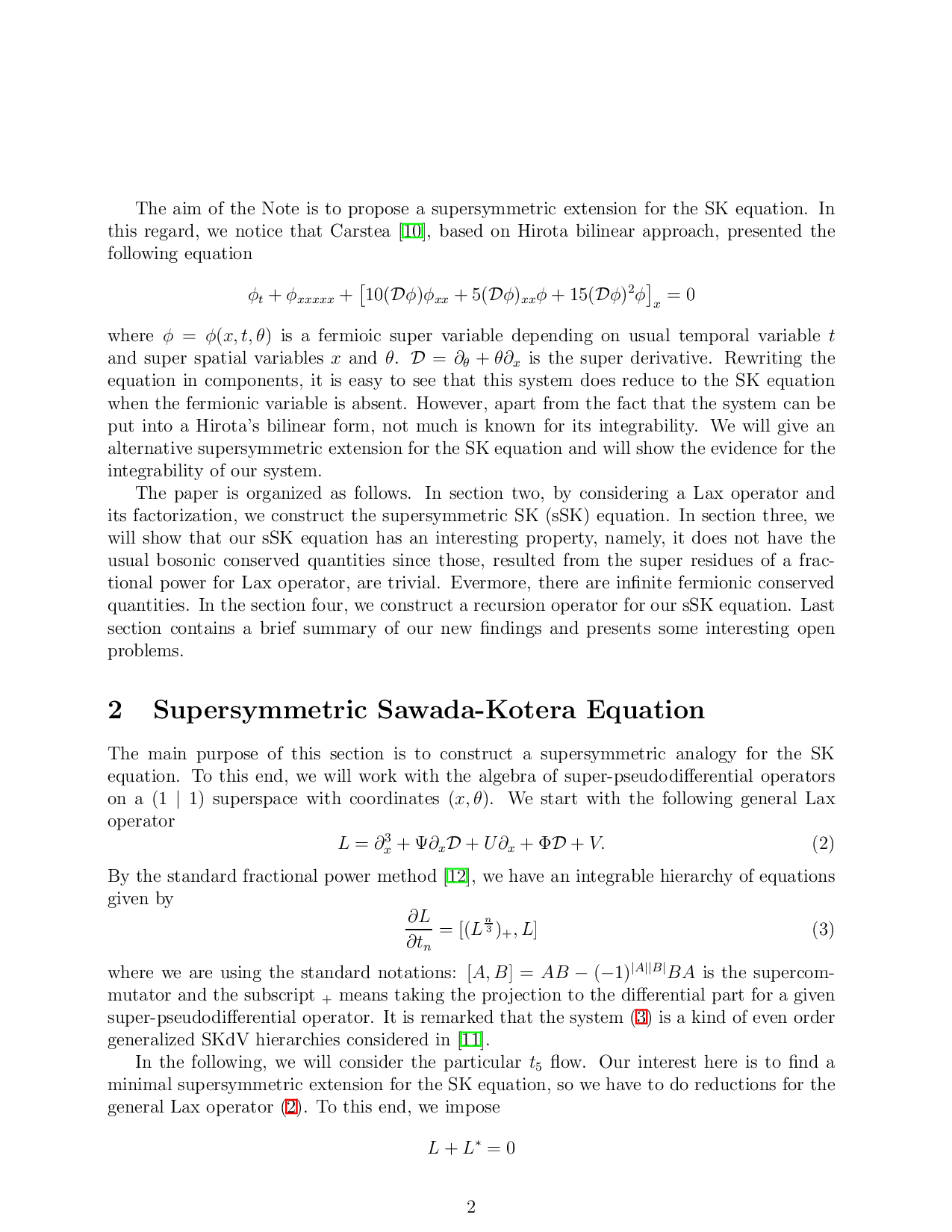
The aim of the Note is to propose a supersymmetric extension for the SK equation. In this regard, we notice that Carstea [10], based on Hirota bilinear approach, presented the following equation
where φ = φ(x, t, θ) is a fermioic super variable depending on usual temporal variable t and super spatial variables x and θ. D = ∂ θ + θ∂ x is the super derivative. Rewriting the equation in components, it is easy to see that this system does reduce to the SK equation when the fermionic variable is absent. However, apart from the fact that the system can be put into a Hirota’s bilinear form, not much is known for its integrability. We will give an alternative supersymmetric extension for the SK equation and will show the evidence for the integrability of our system.
The paper is organized as follows. In section two, by considering a Lax operator and its factorization, we construct the supersymmetric SK (sSK) equation. In section three, we will show that our sSK equation has an interesting property, namely, it does not have the usual bosonic conserved quantities since those, resulted from the super residues of a fractional power for Lax operator, are trivial. Evermore, there are infinite fermionic conserved quantities. In the section four, we construct a recursion operator for our sSK equation. Last section contains a brief summary of our new findings and presents some interesting open problems.
The main purpose of this section is to construct a supersymmetric analogy for the SK equation. To this end, we will work with the algebra of super-pseudodifferential operators on a (1 | 1) superspace with coordinates (x, θ). We start with the following general Lax operator
By the standard fractional power method [12], we have an integrable hierarchy of equations given by
where we are using the standard notations: [A, B] = AB -(-1) |A||B| BA is the supercommutator and the subscript + means taking the projection to the differential part for a given super-pseudodifferential operator. It is remarked that the system (3) is a kind of even order generalized SKdV hierarchies considered in [11].
In the following, we will consider the particular t 5 flow. Our interest here is to find a minimal supersymmetric extension for the SK equation, so we have to do reductions for the general Lax operator (2). To this end, we impose
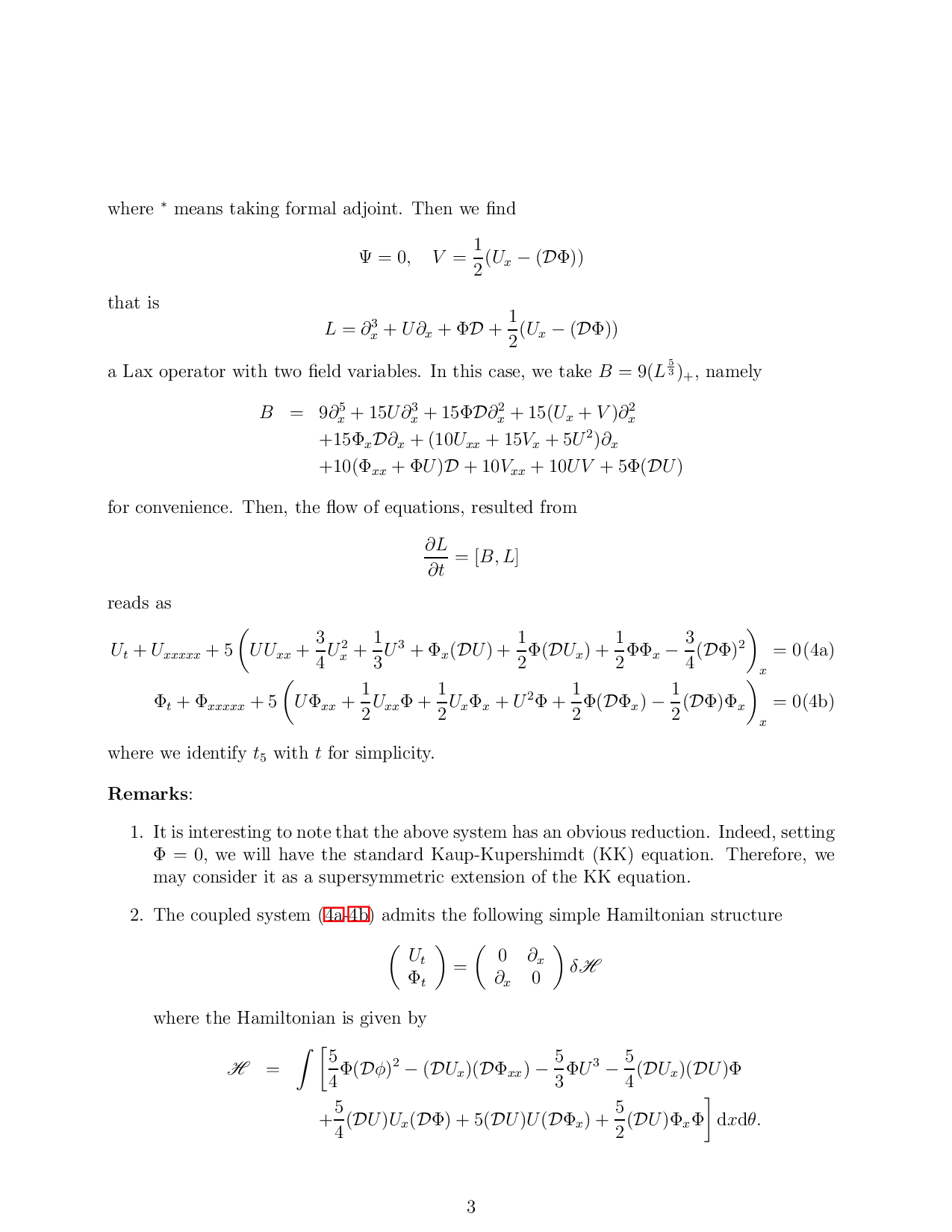
where * means taking formal adjoint. Then we find
that is
a Lax operator with two field variables. In this case, we take B = 9(L
3 ) + , namely
for convenience. Then, the flow of equations, resulted from
reads as
where we identify t 5 with t for simplicity.
It is interesting to note that the above system has an obvious reduction. Indeed, setting Φ = 0, we will have the standard Kaup-Kupershimdt (KK) equation. Therefore, we may consider it as a supersymmetric extension of the KK equation.
The coupled system (4a-4b) admits the following simple Hamiltonian structure
where the Hamiltonian is given by
At this point, it is not clear how this system (4a-4b) is related to the SK equation. To find a supersymmetric SK equation from it, we now consider the factorization of the Lax operator in the following way
which gives us a Miura-type transformation
and the modified system corresponding to this factorization is given by
Although this modification does indeed have a complicated form, the remarkable fact is that it allows a simple reduction. What we need to do is simply putting W to zero, namely
In this case, we have
this equation is our supersymmetric SK equation. To see the connection with the original SK equation (1), we let φ = θu(x, t) + ξ(x, t) and write the equation ( 6) out in components
It is now obvious that the system reduces to the SK equation when ξ = 0. Therefore, our system (6) does qualify as a supersymmetric SK equation.
Our system ( 6) is integrable in the sense that it has a Lax representation. In fact, the factorization (5) implies that the reduced Lax
…(Full text truncated)…
This content is AI-processed based on ArXiv data.