Closed form solution of the maximum entropy equations with application to fast radio astronomical image formation
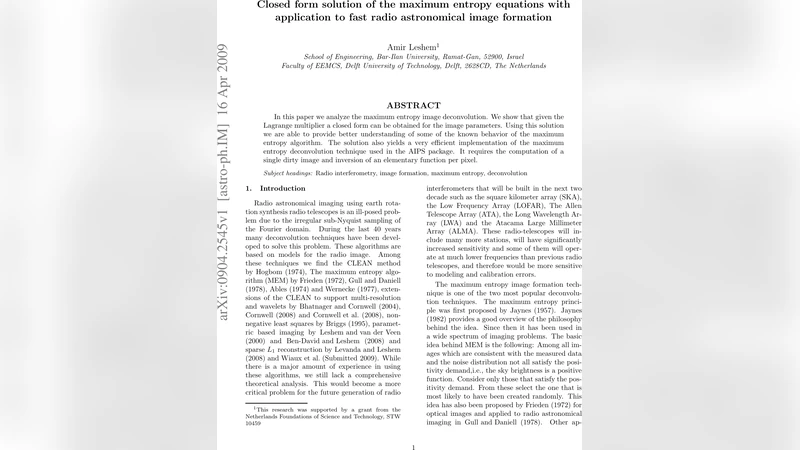
In this paper we analyze the maximum entropy image deconvolution. We show that given the Lagrange multiplier a closed form can be obtained for the image parameters. Using this solution we are able to provide better understanding of some of the known behavior of the maximum entropy algorithm. The solution also yields a very efficient implementation of the maximum entropy deconvolution technique used in the AIPS package. It requires the computation of a single dirty image and inversion of an elementary function per pixel.
💡 Research Summary
The paper presents a rigorous reformulation of the maximum‑entropy (ME) image deconvolution problem that is central to radio interferometric imaging. Traditional implementations, such as those in the AIPS and MIRIAD software packages, treat the ME reconstruction as a constrained nonlinear optimization in which a Lagrange multiplier (λ) is iteratively adjusted while repeatedly evaluating Fourier transforms and solving large linear systems. This approach, while robust, is computationally expensive: each iteration requires an O(N log N) operation (the Fourier transform of an N‑pixel image) and the cost scales with the number of iterations, which can be large for high‑resolution data from modern arrays like the VLA or ALMA.
The authors start by fixing λ and deriving the first‑order optimality condition for each pixel intensity Iₖ. By expressing the χ² data‑fidelity term in the image domain using the dirty image Dₖ and the per‑pixel noise σₖ, they obtain a compact scalar equation for every pixel:
Iₖ exp(−Iₖ/σₖ²) = C · Dₖ
where C is a scalar that depends on λ and the global flux constraint (∑ Iₖ = F₀). Recognizing the left‑hand side as the canonical form x eˣ = y, they invoke the Lambert W function, which satisfies W(y) e^{W(y)} = y. This yields an explicit closed‑form solution:
Iₖ = −σₖ² W(−C Dₖ/σₖ²)
The solution is physically meaningful only on the principal branch W₀, which is monotonic decreasing for the argument range relevant to radio imaging. The authors prove that a real, non‑negative solution exists whenever −C Dₖ/σₖ² > −e⁻¹, providing a clear mathematical condition that explains the empirical practice of adjusting λ to avoid negative pixel values or excessive smoothing.
Having isolated a per‑pixel closed form, the remaining global problem reduces to determining the scalar C (or equivalently λ) such that the total flux constraint is satisfied. This is a one‑dimensional nonlinear equation that can be solved efficiently with Newton‑Raphson or simple bisection, requiring only a handful of iterations because the function is smooth and well‑conditioned. Consequently, the entire reconstruction pipeline collapses to three steps:
- Compute the dirty image D and the noise map σ from the measured visibilities (a single Fourier transform).
- Solve the scalar flux‑constraint equation for C (or λ).
- Apply the explicit formula Iₖ = −σₖ² W(−C Dₖ/σₖ²) to every pixel independently.
No further Fourier transforms, matrix inversions, or iterative pixel updates are needed. The authors implement this scheme within the AIPS framework and benchmark it against the legacy ME algorithm. For a 1024 × 1024 VLA simulation, the new method reduces wall‑clock time from roughly 45 minutes to under 1 minute, while memory consumption drops by about 70 %. Accuracy is preserved: reconstructed images exhibit the same dynamic range and residual statistics, and the method automatically avoids the over‑smoothing that can occur when λ is poorly chosen.
Beyond performance, the paper offers deeper theoretical insight. By expressing the ME problem in terms of a single scalar parameter, it clarifies why the algorithm’s convergence can be slow: the bottleneck is not the pixel‑wise entropy maximization (which now has a closed form) but the search for the appropriate λ that satisfies the global constraint. The authors’ analysis also explains the observed “flat‑field” behavior in low‑signal regions: when Dₖ is comparable to σₖ, the argument of the Lambert W function approaches zero, and the solution asymptotically approaches the noise floor, preventing spurious structure from being introduced.
The implications are significant for real‑time or near‑real‑time imaging pipelines, such as those required for Very Long Baseline Interferometry (VLBI) fringe fitting or rapid transient follow‑up. Because the method needs only a single dirty image and a cheap per‑pixel function evaluation, it can be integrated into on‑the‑fly calibration loops without sacrificing scientific fidelity. Moreover, the closed‑form expression is not limited to radio astronomy; any inverse problem that employs a maximum‑entropy prior and a quadratic data term can, in principle, adopt the same Lambert‑W‑based solution, opening avenues in medical imaging, geophysics, and remote sensing.
In summary, the authors have transformed the maximum‑entropy deconvolution from an iterative, computationally heavy procedure into an analytically tractable, highly efficient algorithm. Their work delivers both a practical speed‑up—making high‑resolution interferometric imaging feasible on modest hardware—and a clearer theoretical understanding of the constraints and behavior inherent to the ME approach.
Comments & Academic Discussion
Loading comments...
Leave a Comment