A mathematical study of the hematopoiesis process with applications to chronic myelogenous leukemia
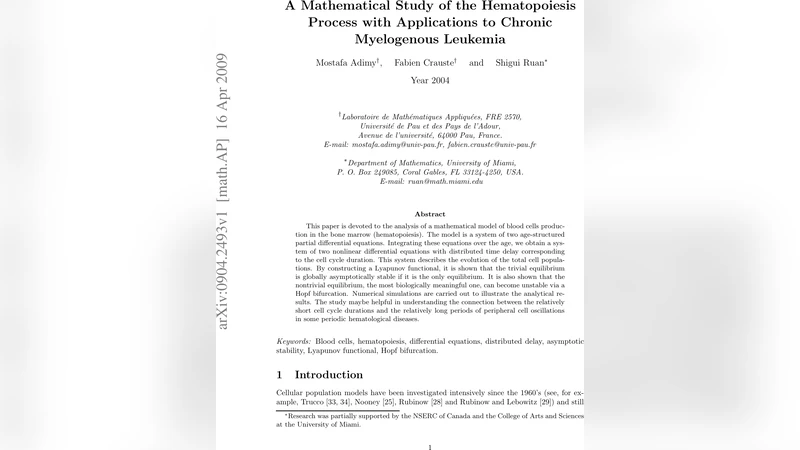
This paper is devoted to the analysis of a mathematical model of blood cells production in the bone marrow (hematopoiesis). The model is a system of two age-structured partial differential equations. Integrating these equations over the age, we obtain a system of two nonlinear differential equations with distributed time delay corresponding to the cell cycle duration. This system describes the evolution of the total cell populations. By constructing a Lyapunov functional, it is shown that the trivial equilibrium is globally asymptotically stable if it is the only equilibrium. It is also shown that the nontrivial equilibrium, the most biologically meaningful one, can become unstable via a Hopf bifurcation. Numerical simulations are carried out to illustrate the analytical results. The study maybe helpful in understanding the connection between the relatively short cell cycle durations and the relatively long periods of peripheral cell oscillations in some periodic hematological diseases.
💡 Research Summary
The paper presents a rigorous mathematical investigation of hematopoiesis—the production of blood cells in the bone marrow—and explores its relevance to chronic myelogenous leukemia (CML), a disease characterized by periodic oscillations in peripheral blood counts. The authors begin by formulating a pair of age‑structured partial differential equations (PDEs) that describe the dynamics of two cell compartments: immature progenitor cells and mature blood cells. Each PDE accounts for the progression of cell age, proliferation, differentiation, and death, and incorporates a probability distribution for the duration of the cell‑cycle rather than a fixed delay.
By integrating the PDEs over the age variable, the model is reduced to a system of two nonlinear ordinary differential equations (ODEs) with a distributed time delay. The delay kernel, denoted K(s), captures the variability of the cell‑cycle length and appears inside convolution integrals such as ∫₀^τ K(s) x(t−s) ds, where x(t) denotes the total number of immature cells. Nonlinear terms model feedback mechanisms (e.g., growth‑factor inhibition) that regulate proliferation and apoptosis.
The authors first analyze the trivial equilibrium (x = y = 0). They construct a Lyapunov functional V(x, y) = x² + y² and prove that its derivative along trajectories satisfies dV/dt ≤ 0, with equality only at the origin. Consequently, if the trivial equilibrium is the unique steady state, it is globally asymptotically stable. This result mathematically formalizes the biological intuition that a completely non‑functional marrow cannot spontaneously regenerate.
Next, the non‑trivial equilibrium—where both cell populations are positive—is examined. Linearizing the delayed system around this steady state yields a characteristic equation containing the Laplace transform of the kernel K(s). By varying biologically relevant parameters (average cell‑cycle time, variance of the distribution, strength of feedback inhibition, death rates), the authors show that a pair of complex conjugate eigenvalues can cross the imaginary axis, giving rise to a Hopf bifurcation. Using center‑manifold reduction and normal‑form calculations, they demonstrate that the bifurcation is supercritical, leading to a stable limit cycle for parameter values beyond the critical threshold.
Numerical simulations are performed with parameter values drawn from clinical observations: typical cell‑cycle durations of 24–48 hours and peripheral oscillation periods ranging from weeks to months. Simulations confirm that even when the intrinsic cell‑cycle delay is short, a sufficiently broad distribution (large variance) can generate long‑period oscillations through the Hopf mechanism. The simulated time series reproduce the hallmark “short internal cycle → long external oscillation” pattern observed in periodic hematological disorders. Sensitivity analyses reveal that weakening growth‑factor inhibition amplifies oscillation amplitude, while increasing apoptosis rates suppresses the limit cycle, highlighting potential therapeutic targets.
The study contributes several novel insights. First, it bridges age‑structured PDE modeling with distributed‑delay ODE analysis, providing a more realistic representation of cell‑cycle heterogeneity. Second, the global stability proof for the zero equilibrium via a Lyapunov functional adds a rigorous foundation often missing in earlier works that rely on linearization alone. Third, the identification of a Hopf bifurcation as the mechanism behind CML‑related periodicity offers a clear mathematical explanation for the discrepancy between short cell‑cycle times and long peripheral oscillation periods. Fourth, the numerical validation against realistic parameter ranges strengthens the model’s applicability to clinical scenarios and suggests that modulating feedback strength could be a viable strategy to control pathological oscillations.
Finally, the authors acknowledge limitations: the current framework includes only two cell compartments and a single delay kernel, neglecting spatial effects, multiple lineage interactions, and immune system feedback. They propose extending the model to incorporate additional cell types (e.g., stem cells, endothelial cells), spatial diffusion, and stochastic fluctuations. Such extensions could enhance predictive power, enable patient‑specific parameter fitting, and ultimately guide the design of personalized treatment protocols for CML and other periodic hematological diseases.
Comments & Academic Discussion
Loading comments...
Leave a Comment