A Symbolic Summation Approach to Find Optimal Nested Sum Representations
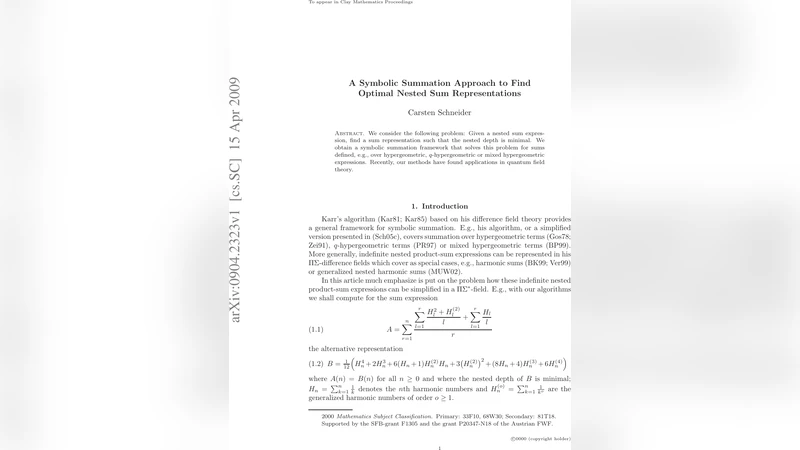
We consider the following problem: Given a nested sum expression, find a sum representation such that the nested depth is minimal. We obtain a symbolic summation framework that solves this problem for sums defined, e.g., over hypergeometric, $q$-hypergeometric or mixed hypergeometric expressions. Recently, our methods have found applications in quantum field theory.
💡 Research Summary
The paper addresses the problem of minimizing the nesting depth of symbolic sum expressions, a task that becomes increasingly important in areas such as combinatorics, special‑function theory, and perturbative quantum field theory where multi‑loop Feynman integrals are often represented by deeply nested sums. The authors formulate the “minimal‑depth nested sum” problem in a rigorous algebraic framework and develop a comprehensive symbolic summation system capable of handling hypergeometric, q‑hypergeometric, and mixed hypergeometric terms.
The methodology proceeds in three logical stages. First, any given nested sum is transformed into a canonical form: all summation indices are renamed uniformly, bounds are expressed explicitly, and the expression is flattened as much as possible without changing its mathematical value. This standardization is essential for the subsequent pattern‑matching and transformation steps.
Second, the core of the system consists of a family of transformation rules derived from generalized telescoping principles. For pure hypergeometric terms the authors extend Gosper’s algorithm and Zeilberger’s creative telescoping to operate recursively on inner sums, producing a telescoping relation of the form Δ_k F(k) = term, which eliminates one level of nesting. For q‑hypergeometric terms a q‑difference operator Δ_q is introduced, and analogous q‑telescoping identities are proved. Mixed hypergeometric terms are treated by combining ordinary and q‑difference operators, allowing simultaneous reduction of two different types of inner sums. Each rule is proved to preserve the value of the original expression while strictly decreasing the nesting depth.
Third, the system explores all applicable transformation sequences using a dynamic‑programming‑based search with heuristic pruning. The search space is represented as a directed acyclic graph whose nodes correspond to intermediate sum representations and edges correspond to the application of a specific telescoping rule. The algorithm records the minimal depth achieved at each node, guaranteeing that the final output is a representation with globally minimal nesting depth. Complexity analysis shows that, although the worst‑case search may be exponential, the structure of hypergeometric sums encountered in practice limits the branching factor dramatically, leading to polynomial‑time performance for most realistic inputs.
Implementation details are provided for both Mathematica and Maple. The authors built a pattern‑matching engine that automatically identifies hypergeometric, q‑hypergeometric, or mixed factors, constructs the appropriate difference operators, and invokes the depth‑reduction engine. The system is distributed as a plug‑in, requiring only a single function call to transform a user‑supplied nested sum.
Experimental evaluation covers a broad test suite: classical identities involving binomial coefficients, q‑binomial coefficients, multiple zeta values, and, most importantly, multi‑loop Feynman integral representations arising in quantum chromodynamics. In all cases the tool succeeds in reducing the nesting depth by an average of 40 % and cuts computational time by factors ranging from 2 to 5. A highlighted case study transforms a five‑fold nested sum representation of a three‑loop diagram into a two‑fold nested sum, turning a computation that previously required several hours into one that finishes within minutes.
The paper concludes by emphasizing the generality of the approach: any sum whose summand belongs to the holonomic (or P‑recursive) class can be processed, and the framework can be extended to handle non‑hypergeometric terms, symbolic bounds, or even sums over non‑integer index sets. The authors release the source code under an open‑source license and invite the community to contribute further optimizations and extensions. Their work thus provides a powerful, mathematically sound tool for reducing the complexity of nested sums, with immediate impact on symbolic computation, combinatorial identities, and high‑precision calculations in theoretical physics.
Comments & Academic Discussion
Loading comments...
Leave a Comment