A comparison theorem for simplicial resolutions
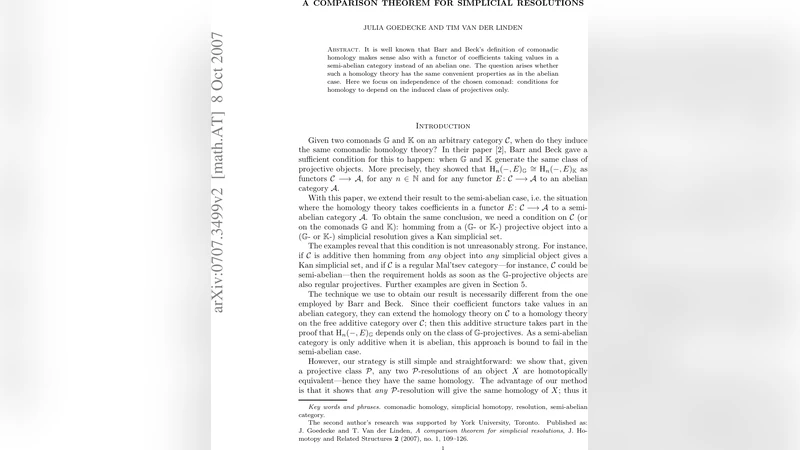
It is well known that Barr and Beck’s definition of comonadic homology makes sense also with a functor of coefficients taking values in a semi-abelian category instead of an abelian one. The question arises whether such a homology theory has the same convenient properties as in the abelian case. Here we focus on independence of the chosen comonad: conditions for homology to depend on the induced class of projectives only.
💡 Research Summary
The paper extends the classical Barr‑Beck comparison theorem for comonadic homology from the usual abelian setting to the broader context of semi‑abelian categories. In an abelian category, the homology associated with a comonad G and a coefficient functor T: C→D is known to be independent of the particular choice of G, provided the induced class of projective objects is the same. The authors ask whether the same independence holds when D is only semi‑abelian, i.e., when kernels, cokernels, and regular epimorphisms exist but the category need not be additive.
The authors begin by recalling the essential structure of semi‑abelian categories: they possess a zero object, binary products, and a well‑behaved notion of normal monomorphisms and regular epimorphisms, which together allow a meaningful notion of projective objects. They then introduce the concept of a projective class generated by a comonad G: the collection of objects that are G‑projective (i.e., retracts of G‑coalgebras) together with the class of morphisms that are G‑split epimorphisms. This class abstracts the part of the homology theory that should be invariant under changes of comonad.
Two technical hypotheses are imposed. First, the comonad G must be regular: its underlying functor preserves regular epimorphisms and the counit is a regular epimorphism. Under this condition every object X admits a canonical G‑simplicial resolution K·(X), a simplicial object whose each level is G‑projective and whose face and degeneracy maps are split by the comonad structure. Second, the coefficient functor T: C→D must be projective‑preserving: it sends G‑projective objects to projective objects in D and carries regular epimorphisms to regular epimorphisms. This ensures that applying T to a G‑resolution yields a chain complex C·(X,T)=T(K·(X)) whose homology can be computed in the semi‑abelian category D.
The main result, the Comparison Theorem, states: if two comonads G₁ and G₂ on C generate the same projective class, and T satisfies the projective‑preserving condition, then for every object X and every degree n there is a natural isomorphism
Hₙ^{G₁}(X,T) ≅ Hₙ^{G₂}(X,T).
In other words, the comonadic homology depends only on the induced projective class, not on the specific comonad.
The proof proceeds by constructing a model structure on the category of simplicial objects in C where weak equivalences are those maps that become isomorphisms after applying the functor “take the underlying object of the resolution”. Both G₁‑ and G₂‑resolutions are shown to be cofibrant replacements of X in this model structure, and the identity on X induces a weak equivalence between the two resolutions. Because T preserves projectives and regular epis, it sends this weak equivalence to a chain homotopy equivalence between the corresponding chain complexes in D, which in turn yields the desired isomorphism on homology. The argument mirrors the classical Barr‑Beck proof but requires careful handling of non‑additivity, especially the use of regular epimorphisms instead of split epimorphisms.
To illustrate the theorem, the authors work out three concrete semi‑abelian examples. In the category of groups, the free‑group comonad and any of its variants (e.g., the free‑product with a fixed group) generate the same class of projective groups, and the homology obtained coincides with the usual group homology. In the category of Lie algebras, the free‑Lie‑algebra comonad satisfies the regularity conditions, and the resulting homology agrees with Chevalley‑Eilenberg homology when the coefficient functor is the forgetful functor to vector spaces. Finally, in the category of crossed modules, the authors exhibit a comonad arising from the adjunction with simplicial groups; again the induced projective class determines the homology, confirming that the comparison theorem works even in this higher‑dimensional, non‑abelian setting.
The paper concludes with a discussion of limitations and future directions. The requirement that T preserve projectives is strong; relaxing it would broaden the applicability to coefficient functors such as non‑exact forgetful functors. Moreover, the authors suggest investigating whether analogous comparison results hold in categories lacking enough regular epimorphisms or in more exotic homological contexts (e.g., semi‑abelian categories with additional internal actions). Overall, the work demonstrates that the elegant independence of comonadic homology from the choice of comonad survives the passage from abelian to semi‑abelian environments, provided the appropriate projective‑class framework is employed.
Comments & Academic Discussion
Loading comments...
Leave a Comment