As radio spectrum usage paradigm moving from the traditional command and control allocation scheme to the open spectrum allocation scheme, wireless networks meet new opportunities and challenges. In this article we introduce the concept of cognitive wireless mesh (CogMesh) networks and address the unique problem in such a network. CogMesh is a self-organized distributed network architecture combining cognitive technologies with the mesh structure in order to provide a uniform service platform over a wide range of networks. It is based on dynamic spectrum access (DSA) and featured by self-organization, self-configuration and self-healing. The unique problem in CogMesh is the common control channel problem, which is caused by the opportunistic spectrum sharing nature of secondary users (SU) in the network. More precisely, since the channels of SUs are fluctuating according to the radio environment, it is difficult to find always available global common control channels. This puts a significant challenge on the network design. We develop the control cloud based control channel selection and cluster based network formation techniques to tackle this problem. Moreover, we show in this article that the swarm intelligence is a good candidate to deal with the control channel problem in CogMesh. Since the study of cognitive wireless networks (CWN) is still in its early phase, the ideas provided in this article act as a catalyst to inspire new solutions in this field.
Deep Dive into Cloud Networking Formation in CogMesh Environment.
As radio spectrum usage paradigm moving from the traditional command and control allocation scheme to the open spectrum allocation scheme, wireless networks meet new opportunities and challenges. In this article we introduce the concept of cognitive wireless mesh (CogMesh) networks and address the unique problem in such a network. CogMesh is a self-organized distributed network architecture combining cognitive technologies with the mesh structure in order to provide a uniform service platform over a wide range of networks. It is based on dynamic spectrum access (DSA) and featured by self-organization, self-configuration and self-healing. The unique problem in CogMesh is the common control channel problem, which is caused by the opportunistic spectrum sharing nature of secondary users (SU) in the network. More precisely, since the channels of SUs are fluctuating according to the radio environment, it is difficult to find always available global common control channels. This puts a signi
Radio spectrum usage is undergoing a paradigm shift from the traditional command and control allocation to the DSA [1]. Cognitive radio (CR) is a promising approach to achieve open spectrum sharing flexibly and efficiently [2]. The research on CR has already penetrated into different types of wireless networks, and covered almost every aspect in wireless communications [3]. Following the CR, the concept of CWN comes out with the emphasis on the network-wide cognition and adaptation [4]- [5].
Although a CWN may not rely on CR technologies solely, it is a common assumption that CWNs are CR based to some extent and use DSA as the spectrum access scheme. We follow this assumption in the article. In a DSA based network the SUs of the spectrum opportunistically access the spectrum based on the activities of the primary users (PU) as well as the radio environment. The definitions of PU and SU can be found in [3]. For the deep understanding of DSA, please refer to the survey of [6].
In this article, starting from our previous related work [7], [8], we first introduce the concept of CogMesh, which is defined as a self-organized distributed network architecture combining cognitive technologies with the mesh structure in T. Chen and M. Katz are with VTT, Finland. H. Zhang is with Zhejiang University, China. order to provide a uniform service platform over a wide range of networks. A network based on this architecture is featured by self-organization, self-configuration and selfhealing. It shows similarities with wireless ad hoc networks on the aspects of distributivity and self-organization. However, a CogMesh network is more flexible on spectrum, energy and network resource usage, therefore being superior to wireless ad hoc networks on performance and resource efficiency. We call the environment where CogMesh networks are operated the CogMesh environment.
Considering that at present the study on CWNs is still on its early phase, it is interesting to show readers the unique problems in the CogMesh environment and potential solutions. We identify the control channel as one of the main challenges in CogMesh. Indeed, in the CogMesh environment, because SUs opportunistically share spectrum with PUs, the network cannot rely on a global common control channel for coordination. This is different from conventional wireless networks where the common control channels are usually assumed.
In this article, we will analyze the common control channel problem in CogMesh and propose feasible solutions. For a distributed network it is desirable that the nodes share a common control channel in order to provide reliable and efficient communications, and reduce the control overhead. We first propose a control cloud concept for the control channel selection. A control cloud is a group of connected SUs that share a common control channel. Furthermore, one can find some similarities between CogMesh networks and the collective behavior of social insects. From such an analogy, we introduce the swarm intelligence mechanism into CogMesh and use distributed algorithms to form the control clouds as large as possible. A larger control cloud means more nodes sharing the same control channel. Then, based on the control clouds, a cluster based network formation scheme is employed to further consolidate the spectrum management. The main advantage of the swarm intelligence based control channel selection and cluster based network formation is their adaptability to the radio and network environment change, which is important for CWNs.
In the remainder of the article, we will first introduce the concept of CogMesh, and discuss its differences with conventional wireless networks. Then we will describe the control channel problem in CogMesh, and provide our solutions. A wireless MAC protocol tailored for CogMesh will be given to explain how the network discovery and cluster formation are performed. We also give the simulation results illustrating the behavior of the proposed solutions. Finally, we draw the conclusion.
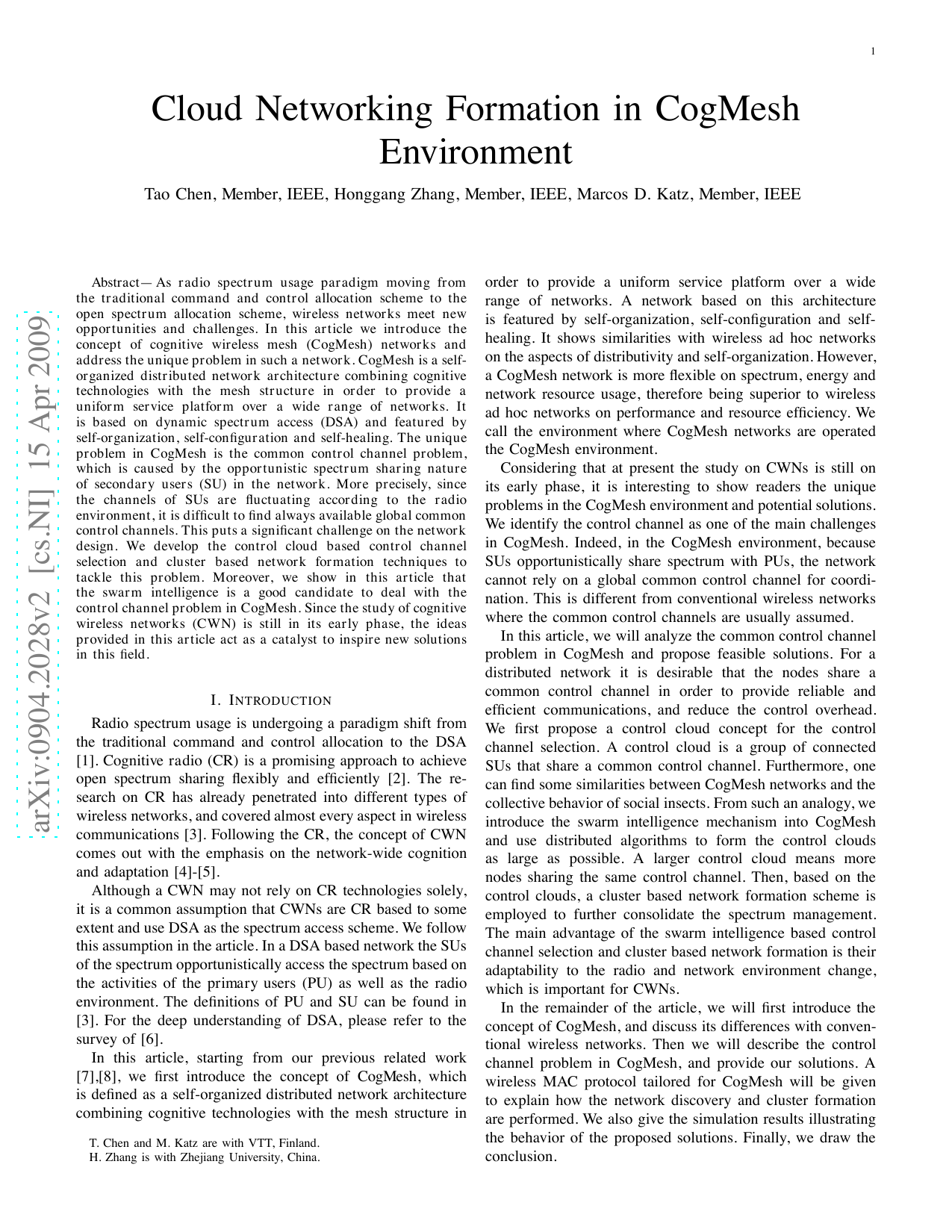
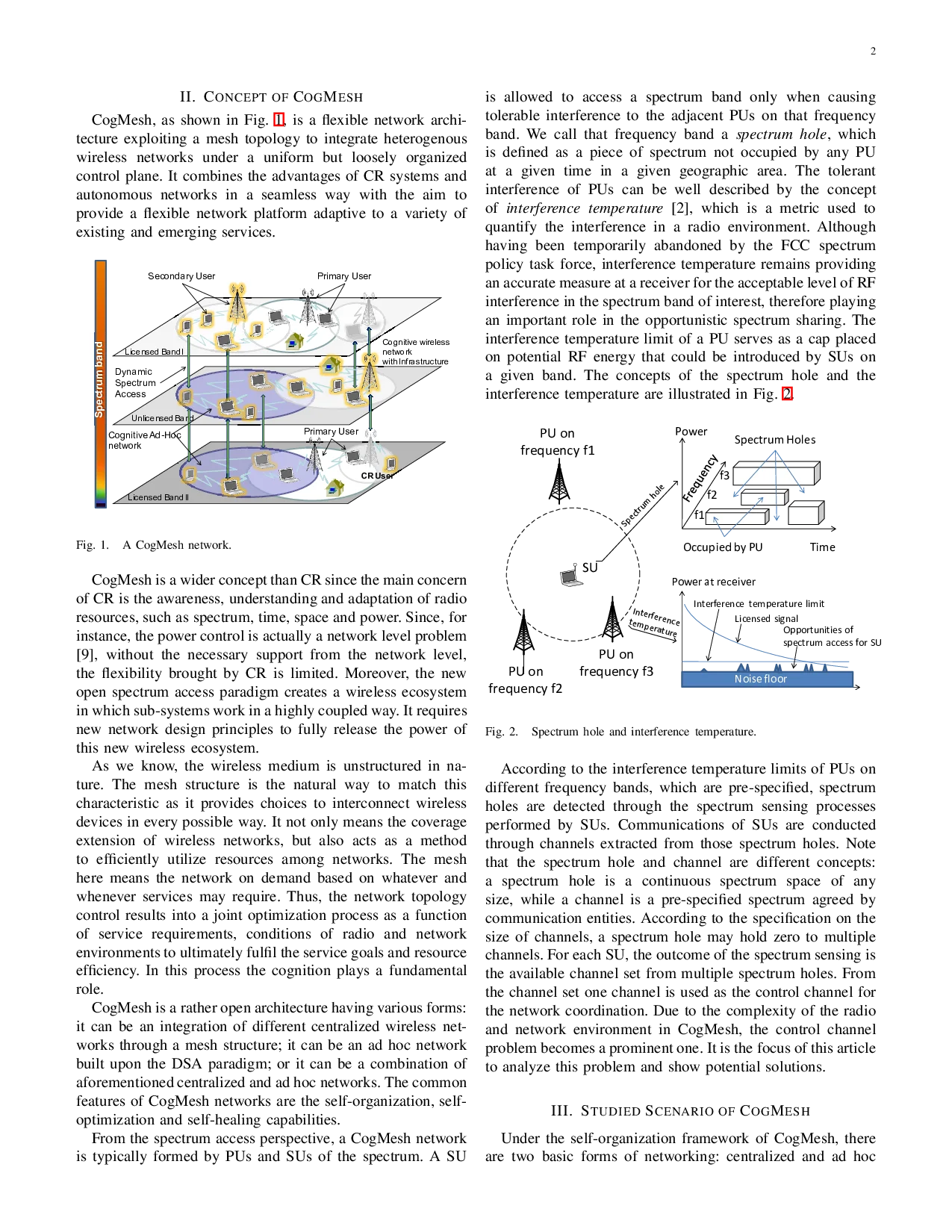
CogMesh, as shown in Fig. 1, is a flexible network architecture exploiting a mesh topology to integrate heterogenous wireless networks under a uniform but loosely organized control plane. It combines the advantages of CR systems and autonomous networks in a seamless way with the aim to provide a flexible network platform adaptive to a variety of existing and emerging services. CogMesh is a wider concept than CR since the main concern of CR is the awareness, understanding and adaptation of radio resources, such as spectrum, time, space and power. Since, for instance, the power control is actually a network level problem [9], without the necessary support from the network level, the flexibility brought by CR is limited. Moreover, the new open spectrum access paradigm creates a wireless ecosystem in which sub-systems work in a highly coupled way. It requires new network design principles to fully release the power of this new wireless ecos
…(Full text truncated)…
This content is AI-processed based on ArXiv data.