Closures in Formal Languages and Kuratowskis Theorem
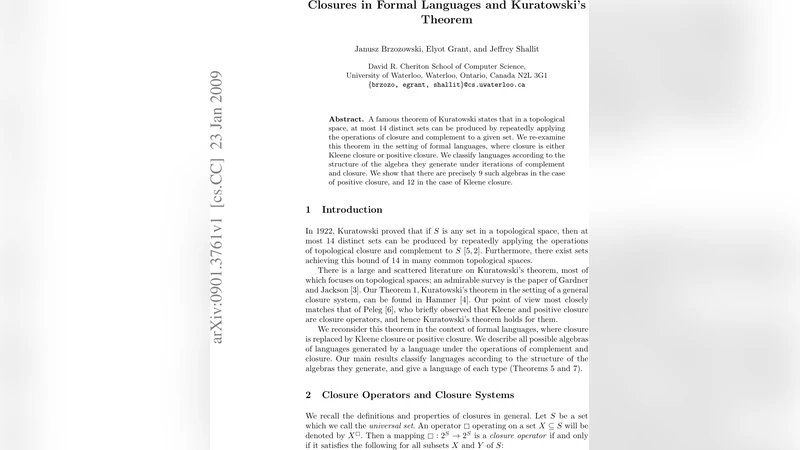
A famous theorem of Kuratowski states that in a topological space, at most 14 distinct sets can be produced by repeatedly applying the operations of closure and complement to a given set. We re-examine this theorem in the setting of formal languages, where closure is either Kleene closure or positive closure. We classify languages according to the structure of the algebra they generate under iterations of complement and closure. We show that there are precisely 9 such algebras in the case of positive closure, and 12 in the case of Kleene closure.
💡 Research Summary
The paper revisits Kuratowski’s classic theorem—originally formulated for topological spaces, where at most fourteen distinct sets can be obtained by repeatedly applying closure and complement—to the domain of formal languages. In this setting, the authors replace the topological closure operator with two language‑theoretic counterparts: positive closure (L⁺), which consists of all non‑empty concatenations of strings from a language L, and Kleene closure (L*), which adds the empty word ε to L⁺. Complement is defined with respect to the full free monoid Σ* (the set of all strings over the alphabet Σ).
The central research question is: given an arbitrary language L, what algebraic structure emerges when we iteratively apply complement and either positive or Kleene closure in any order? More precisely, how many distinct algebras—closed under these operations—can be generated? To answer this, the authors adopt a systematic, graph‑theoretic approach. They construct a directed graph whose nodes represent the current language after a sequence of operations, and whose edges correspond to applying one of the three possible operations (complement, positive closure, Kleene closure). By exploring all reachable nodes from the initial language, they obtain a finite transition system because each operation can only produce a limited set of distinct languages.
A crucial step is the identification of equivalence among nodes. Two nodes are merged when they denote the same language, and pairs of nodes that are exact complements of each other are treated symmetrically, allowing the graph to be reduced without loss of information. After this reduction, each connected component corresponds to a distinct algebra generated by the operations. The authors then classify these components up to isomorphism, which yields the count of fundamentally different algebras.
For positive closure, the presence of ε is prohibited, which restricts how complement interacts with subsequent closures. In particular, after taking a complement, applying positive closure never re‑introduces ε, so the “empty language” ∅ and the “universal language” Σ* cannot be interchanged through the closure‑complement cycle. This limitation dramatically reduces the branching possibilities in the transition graph. The authors prove that exactly nine non‑isomorphic algebras can arise under positive closure. Each algebra contains a specific number of distinct languages, ranging from as few as two (the trivial algebra generated by a language that is already closed under both operations) up to the full fourteen in the most expressive cases.
When Kleene closure is used, ε is always present in L*. Consequently, after a complement, applying Kleene closure may either preserve ε (if ε was already in the complement) or introduce it anew. This subtle difference creates additional branches in the transition graph, leading to three extra algebras that do not appear in the positive‑closure scenario. The authors therefore establish that precisely twelve distinct algebras can be generated when Kleene closure is allowed.
To illustrate the theory, the paper supplies concrete language examples for each algebraic class. Simple regular languages such as a⁺b⁺ generate relatively small algebras (e.g., five distinct languages), whereas the universal language (a|b)* yields the maximal fourteen‑element algebra. Languages that consist solely of ε or that are already closed under both operations serve as representatives of the minimal algebras. These examples demonstrate how properties like regularity, infiniteness, and the inclusion of ε directly influence the size and shape of the generated algebra.
Beyond the combinatorial classification, the authors discuss several implications for theoretical computer science. The fact that only a bounded number of distinct languages can arise from arbitrary sequences of complement and closure suggests opportunities for optimization in automata theory and regular‑expression processing. For instance, algorithms that need to compute the complement of a regular language followed by closure can be designed to stop early once a previously encountered language is reached, guaranteeing termination after at most fourteen steps. Moreover, the algebraic perspective offers a new metric for measuring language complexity: the number of distinct elements in the closure‑complement algebra can serve as an indicator of how “rich” a language’s structure is.
The paper also hints at future research directions. One avenue is extending the analysis to other language operators, such as homomorphism, inverse homomorphism, or intersection, and investigating whether similar finite bounds exist. Another promising line is exploring the impact of these algebras on decision problems, e.g., whether membership in a particular algebra class can be decided efficiently, or how the classification interacts with language hierarchy levels (regular, context‑free, etc.).
In summary, the authors successfully transplant Kuratowski’s theorem into formal language theory, establishing that positive closure yields nine distinct algebras while Kleene closure yields twelve. Their rigorous graph‑based methodology, coupled with illustrative examples and discussion of practical consequences, provides a clear and comprehensive contribution to the understanding of language operations and their algebraic closures.
Comments & Academic Discussion
Loading comments...
Leave a Comment