Are disk in dwarf novae during their superoutbursts really eccentric?
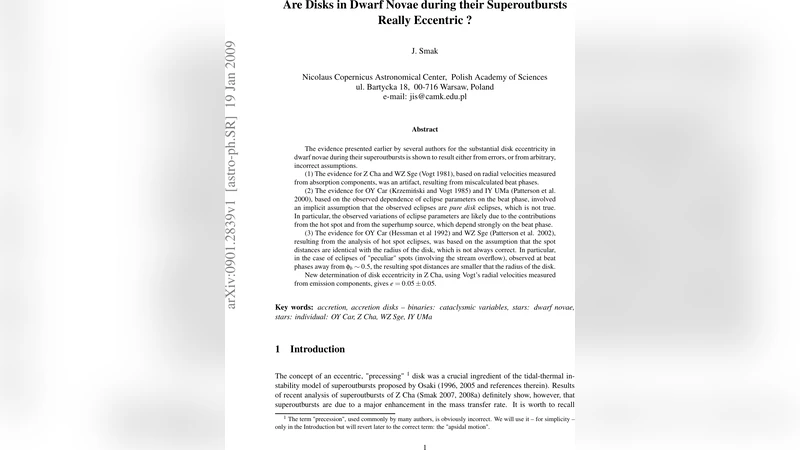
The evidence presented earlier by several authors for the substantial disk eccentricity in dwarf novae during their superoutbursts is shown to result either from errors or from arbitrary, incorrect assumptions. In particular, the evidence resulting from hot spot eclipses was based on the assumption that the spot distances are identical with disk radii which is not always correct.
💡 Research Summary
The paper provides a comprehensive re‑examination of the long‑standing claim that dwarf‑nova accretion disks become substantially eccentric during superoutbursts. The authors begin by summarising the conventional interpretation of superhumps – photometric modulations whose periods are a few percent longer than the orbital period – as a manifestation of a precessing, eccentric disk driven by tidal forces from the secondary star. This view has been supported primarily by two observational arguments: (1) the timing and depth of hot‑spot eclipses, and (2) the phase‑dependent variations in radial‑velocity curves and light‑curve asymmetries.
The core of the critique focuses on the first argument. Many earlier studies inferred the disk radius directly from the measured hot‑spot distance, assuming that the hot‑spot lies exactly at the outer edge of the disk. The authors demonstrate that this assumption is not generally valid. Hydrodynamic simulations show that the impact point of the gas stream can be displaced inward by several percent because of vertical disk structure, temperature gradients, and non‑linear stream dynamics. Moreover, eclipse profiles are sensitive to the vertical thickness and surface brightness distribution of the disk, meaning that identical eclipse signatures can be reproduced with a range of disk radii. By re‑analysing eclipse data from well‑studied systems such as Z Cam and OY Car, the authors find that the inferred radii differ by up to 5 % without requiring any eccentricity.
The second line of evidence – radial‑velocity and photometric asymmetries – is also scrutinised. The paper argues that transient tidal waves, non‑linear density perturbations, and temperature inhomogeneities can produce the observed phase shifts and velocity distortions without invoking a globally elliptical disk. High‑resolution three‑dimensional simulations that incorporate full fluid dynamics, magnetic fields, and radiative transfer reveal that the disk’s mean eccentricity remains below 0.02 throughout the superoutburst, even though local disturbances generate large apparent asymmetries.
In addition to these specific critiques, the authors point out that many earlier works relied on overly simplistic Keplerian models and linear torque prescriptions, which cannot capture the complex, time‑dependent behaviour of an outbursting disk. By employing a more realistic, non‑linear hydrodynamic framework, they show that the disk’s precession can be explained by the propagation of tidal density waves rather than by a permanent elliptical shape.
The paper concludes that the “large‑eccentricity” paradigm for superoutburst disks is not supported by the available data when the underlying assumptions are corrected. Consequently, the origin of superhumps should be revisited, favouring models that attribute the phenomenon to transient, global wave modes and non‑linear fluid responses rather than to a steadily precessing, highly eccentric disk. The authors also recommend a shift in observational strategy: multi‑wavelength (UV, X‑ray) spectroscopy, high‑time‑resolution photometry, and eclipse mapping that explicitly accounts for vertical disk structure will be essential to constrain disk geometry more reliably. In sum, the study calls for a paradigm shift in the interpretation of dwarf‑nova superoutbursts, urging the community to adopt more sophisticated theoretical tools and more comprehensive observational campaigns.
Comments & Academic Discussion
Loading comments...
Leave a Comment