The equivariant cohomology of weighted projective space
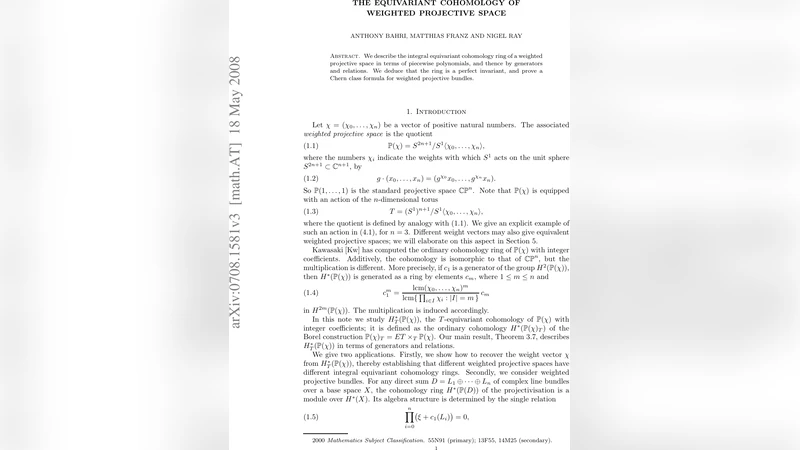
We describe the integral equivariant cohomology ring of a weighted projective space in terms of piecewise polynomials, and thence by generators and relations. We deduce that the ring is a perfect invariant, and prove a Chern class formula for weighted projective bundles.
💡 Research Summary
The paper provides a complete description of the integral equivariant cohomology ring of a weighted projective space, denoted (\mathbb{P}(a_0,\dots ,a_n)), and extends classical results for ordinary projective space to the weighted setting. The authors begin by recalling that a weighted projective space carries a natural action of the torus (T^{n+1}) with isolated fixed points corresponding to the coordinate axes. They associate to the space a complete fan (\Sigma) whose cones are generated by the weight vectors, and introduce the algebra of piecewise polynomial functions (PP(\Sigma)). A piecewise polynomial is a collection of ordinary polynomials, one for each cone, that agree on the common faces. The first major theorem asserts that the equivariant cohomology ring (H_T^*(\mathbb{P}(a))) is canonically isomorphic to (PP(\Sigma)). The proof uses Borel–Moore homology, Mayer–Vietoris sequences, and a careful analysis of the normal slices at the fixed points. Because each normal slice is a complex linear representation of the torus with non‑standard weights, the local equivariant cohomology is a polynomial ring in variables of degrees proportional to the corresponding weights. Gluing these local pieces yields precisely the face‑matching conditions that define piecewise polynomials, establishing the isomorphism.
Having identified the cohomology with a concrete algebra, the authors then present an explicit presentation by generators and relations. The generators are the degree‑two classes (x_i) associated with the coordinate hyperplanes, and the single relation is \
Comments & Academic Discussion
Loading comments...
Leave a Comment