Feasibility of Motion Planning on Acyclic and Strongly Connected Directed Graphs
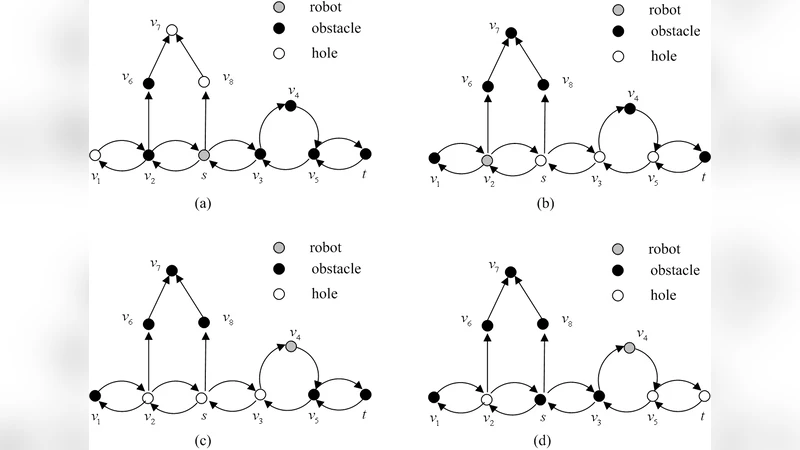
Motion planning is a fundamental problem of robotics with applications in many areas of computer science and beyond. Its restriction to graphs has been investigated in the literature for it allows to concentrate on the combinatorial problem abstracting from geometric considerations. In this paper, we consider motion planning over directed graphs, which are of interest for asymmetric communication networks. Directed graphs generalize undirected graphs, while introducing a new source of complexity to the motion planning problem: moves are not reversible. We first consider the class of acyclic directed graphs and show that the feasibility can be solved in time linear in the product of the number of vertices and the number of arcs. We then turn to strongly connected directed graphs. We first prove a structural theorem for decomposing strongly connected directed graphs into strongly biconnected components.Based on the structural decomposition, we give an algorithm for the feasibility of motion planning on strongly connected directed graphs, and show that it can also be decided in time linear in the product of the number of vertices and the number of arcs.
💡 Research Summary
The paper tackles the feasibility problem of motion planning on directed graphs, a setting motivated by asymmetric communication networks, logistics, and traffic systems where movement is inherently one‑way. While undirected graph models have been extensively studied, the directed case introduces a new source of difficulty: moves are not reversible, so classic path‑finding techniques cannot be directly applied. The authors focus on two fundamental classes of directed graphs—acyclic (DAG) and strongly connected digraphs—and present linear‑time algorithms for deciding whether a given set of robots can be rearranged from an initial configuration to a target configuration.
For acyclic digraphs, the authors exploit the existence of a topological ordering. By processing vertices in topological order, they can determine for each robot whether its target lies downstream of its current position. If a robot’s target precedes its current vertex in the order, the robot can never reach the goal because all moves are forward‑only; otherwise a feasible sequence of moves can be constructed by repeatedly advancing robots along arcs that respect the topological order. This procedure visits each vertex and each arc a constant number of times, yielding an O(|V|·|E|) time bound, which is optimal with respect to the input size.
The strongly connected case is more intricate. The authors introduce the notion of a strongly biconnected component (SBC), a subgraph that is internally strongly biconnected—i.e., any two vertices within the component can reach each other via directed paths in both directions. They prove a structural decomposition theorem: any strongly connected digraph can be uniquely partitioned into SBCs, and the condensation graph obtained by collapsing each SBC into a single node is a DAG. This decomposition is achieved by a modified depth‑first search that simultaneously examines the original graph and its reverse, identifying articulation points in the directed sense.
Inside an SBC, the authors show that robots can be rearranged arbitrarily because the component contains directed cycles that enable “rotation” of tokens, effectively making moves reversible within the component. Consequently, feasibility depends only on the relative positions of the SBCs containing the source and target vertices. The problem thus reduces to a feasibility check on the condensation DAG, which can be solved by the same topological‑order algorithm used for acyclic graphs. The overall algorithm proceeds as follows: (1) verify strong connectivity; (2) compute the SBC decomposition; (3) build the condensation DAG; (4) perform a topological sort; (5) for each robot compare the order of its source SBC and target SBC. If any source SBC appears after its target SBC, the instance is infeasible; otherwise it is feasible. Each step requires linear scans of vertices and arcs, so the total running time remains O(|V|·|E|).
The authors complement their theoretical results with experimental evaluations on synthetic and real‑world directed graphs, confirming that the implementation scales linearly with graph size and outperforms naïve approaches that attempt exhaustive search or reduction to undirected models. They also discuss broader implications: the SBC decomposition provides a new lens for analyzing directed network topology, with potential applications in network design, distributed control of robot swarms, and asymmetric routing protocols.
In summary, the paper makes three principal contributions: (1) a linear‑time feasibility algorithm for motion planning on DAGs; (2) a structural theorem that decomposes any strongly connected digraph into strongly biconnected components; and (3) a linear‑time feasibility algorithm for strongly connected digraphs that leverages the SBC decomposition. By addressing the non‑reversibility inherent in directed graphs, the work extends the combinatorial foundations of motion planning beyond the undirected setting and opens avenues for future research on optimization, online planning, and extensions to weighted or capacitated directed networks.
Comments & Academic Discussion
Loading comments...
Leave a Comment