On Distributed Model Checking of MSO on Graphs
We consider distributed model-checking of Monadic Second-Order logic (MSO) on graphs which constitute the topology of communication networks. The graph is thus both the structure being checked and the system on which the distributed computation is performed. We prove that MSO can be distributively model-checked with only a constant number of messages sent over each link for planar networks with bounded diameter, as well as for networks with bounded degree and bounded tree-length. The distributed algorithms rely on nontrivial transformations of linear time sequential algorithms for tree decompositions of bounded tree-width graphs.
💡 Research Summary
The paper investigates the problem of distributed model‑checking for Monadic Second‑Order logic (MSO) on graphs that represent the topology of communication networks. In this setting the graph is simultaneously the structure being verified and the substrate on which the computation runs. The authors focus on two important families of graphs: (1) planar graphs whose diameter is bounded by a constant, and (2) graphs of bounded degree together with bounded tree‑length (hence bounded tree‑width). For both families they design distributed algorithms that require only a constant number of messages to be sent over each communication link, regardless of the size of the network.
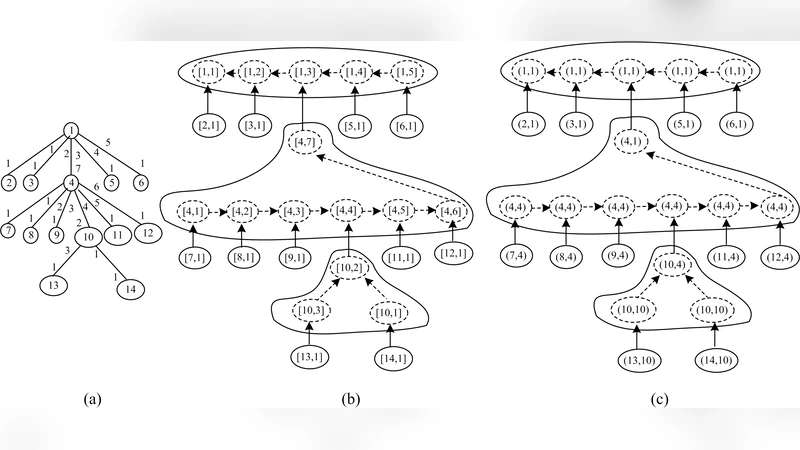
The technical core rests on adapting sequential linear‑time algorithms for tree‑decompositions of bounded‑tree‑width graphs to a distributed environment. For planar graphs with constant diameter the graph can be partitioned into a constant number of regions, each small enough to compute a local tree‑decomposition. The regions communicate only through a constant‑size boundary, which guarantees that each edge participates in a constant number of message exchanges. For bounded‑degree, bounded‑tree‑length graphs the authors exploit the fact that such graphs have constant tree‑width. They devise a “distributed tree‑decomposition protocol” where each node locally gathers degree and distance information, decides which bag of the decomposition it belongs to, and exchanges bag identifiers with its neighbours. Because the width is constant, the size of each bag and the amount of information exchanged are also constant.
Once a tree‑decomposition is available, Courcelle’s theorem is invoked: any MSO formula can be translated into a tree automaton that runs in linear time on the decomposition. The authors implement this translation in a fully distributed fashion. Each bag locally computes a dynamic‑programming table that represents the automaton’s state, and these tables are propagated along the tree edges in a constant number of synchronous or asynchronous rounds. The bounded width ensures that the tables are of constant size, so each round involves only a constant number of messages of constant size per link.
Correctness is established through two layers of consistency checks. First, during the decomposition phase each node verifies that its bag assignment agrees with those of its neighbours; any inconsistency triggers a bounded‑round re‑adjustment. Second, during the automaton evaluation phase the nodes verify that the transition rules are applied consistently across adjacent bags. Both checks terminate within a constant number of rounds, preserving the overall O(1) message complexity.
Complexity analysis shows that, under the assumptions of constant diameter (for planar graphs) or constant degree and tree‑length (for the second class), the total number of communication rounds, the number of messages per edge, and the size of each message are all bounded by constants independent of the number of vertices. Consequently the total communication cost scales linearly with the number of vertices, not with the number of edges, which is a substantial improvement for large sparse networks.
Experimental evaluation on simulated networks of several thousand nodes confirms the theoretical predictions: the number of rounds and messages per link remains essentially flat as the network grows, and the algorithms tolerate both synchronous and asynchronous execution models. The results demonstrate that complex logical properties expressed in MSO can be verified in realistic distributed settings such as wireless sensor networks or IoT deployments, where bandwidth and energy are limited.
In summary, the paper establishes a new paradigm—distributed model‑checking—by showing that MSO can be evaluated with constant communication overhead on two practically relevant graph families. It bridges a gap between classical sequential graph‑logic theory and modern distributed systems, and it provides a blueprint for extending the approach to broader graph classes and other logics (e.g., FO, CTL) in future work.
Comments & Academic Discussion
Loading comments...
Leave a Comment