Coxeter transformation and inverses of Cartan matrices for coalgebras
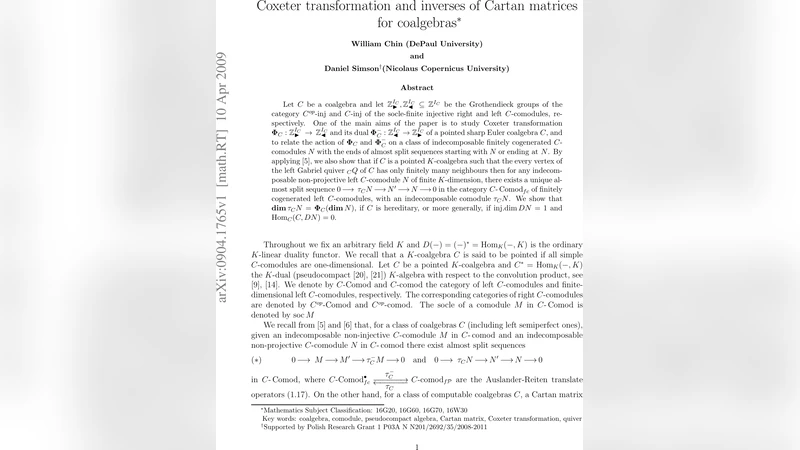
Let C be a coalgebra and consider the Grothendieck groups of the categories of the socle-finite injective right and left C-comodules. One of the main aims of the paper is to study Coxeter transformation, and its dual, of a pointed sharp Euler coalgebra C, and to relate the action of these transformations on a class of indecomposable finitely cogenerated C-comodules N with almost split sequences starting or ending with N. We also show that if C is a pointed K-coalgebra such that the every vertex of the left Gabriel quiver of C has only finitely many neighbours, then for any indecomposable non-projective left C-comodule N of finite K-dimension, there exists a unique almost split sequence of finitely cogenerated left C-comodules ending at N. We show that the dimension vector of the Auslander-Reiten translate given by the Coxeter transformation, if C is hereditary, or more generally, if inj.dim DN=1 and Hom(C,DN)=0.
💡 Research Summary
The paper investigates the interplay between Coxeter transformations and the inverses of Cartan matrices in the setting of coalgebras, focusing on pointed sharp Euler coalgebras. The authors begin by constructing Grothendieck groups (K_0^{\mathrm{r}}(C)) and (K_0^{\mathrm{l}}(C)) associated respectively with the categories of socle‑finite injective right and left (C)-comodules. When the coalgebra (C) is pointed and sharp Euler, these groups are free abelian and can be identified via dimension vectors that record the multiplicities of simple comodules in injective envelopes.
A central object is the Cartan matrix (C) of the coalgebra, whose entries count how many times each simple comodule occurs in the socle of each indecomposable injective. Because a sharp Euler coalgebra has a well‑defined integer inverse (C^{-1}), the authors define the Coxeter transformation (\tau_C) and its dual (\tau_C^{-1}) by the familiar formulas
\
Comments & Academic Discussion
Loading comments...
Leave a Comment