Online Scheduling of Bounded Length Jobs to Maximize Throughput
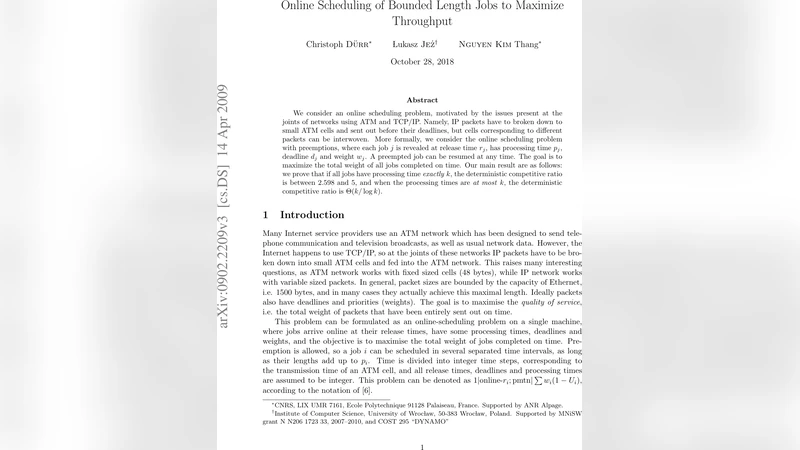
We consider an online scheduling problem, motivated by the issues present at the joints of networks using ATM and TCP/IP. Namely, IP packets have to broken down to small ATM cells and sent out before their deadlines, but cells corresponding to different packets can be interwoven. More formally, we consider the online scheduling problem with preemptions, where each job j is revealed at release time r_j, has processing time p_j, deadline d_j and weight w_j. A preempted job can be resumed at any time. The goal is to maximize the total weight of all jobs completed on time. Our main result are as follows: we prove that if all jobs have processing time exactly k, the deterministic competitive ratio is between 2.598 and 5, and when the processing times are at most k, the deterministic competitive ratio is Theta(k/log k).
💡 Research Summary
The paper addresses a preemptive online scheduling problem motivated by the need to transmit IP packets as ATM cells before their deadlines. Each job j arrives at release time r_j, has a processing time p_j, a deadline d_j, and a weight w_j. A preempted job may be resumed arbitrarily, and the objective is to maximize the total weight of jobs completed on time.
The authors focus on two settings. First, when every job’s processing time is exactly k. In this uniform‑length case they prove that any deterministic online algorithm has a competitive ratio bounded between 2.598 (lower bound) and 5 (upper bound). The lower bound is obtained by constructing an adversarial input sequence that forces any algorithm to lose at least a factor of 2.598 relative to an optimal offline scheduler. The upper bound is achieved by a deterministic policy that orders jobs by a weighted‑density criterion (weight divided by processing time) combined with earliest‑deadline‑first tie‑breaking; a potential‑function analysis shows that this policy never exceeds five times the optimal offline profit.
Second, they consider the more general bounded‑length case where each p_j ≤ k. Here the diversity of job lengths introduces additional difficulty. The authors design an algorithm that groups jobs by length class and, within each class, selects jobs according to the same weighted‑density rule. By carefully balancing the contributions of different classes and using a logarithmic partition of the length interval, they prove that the algorithm’s competitive ratio is Θ(k / log k). A matching lower‑bound construction shows that no deterministic algorithm can achieve a better asymptotic factor, establishing the tightness of the result.
These findings improve upon prior work, which only gave coarse bounds (e.g., O(k) for bounded lengths) or non‑tight constants for the uniform‑length case. The paper’s technical contributions include: (1) a precise competitive‑ratio interval for the uniform‑length problem; (2) a Θ(k / log k) tight bound for bounded‑length jobs; and (3) a novel analytical framework that combines potential‑function techniques with weighted‑density selection, which may be applicable to other online optimization problems.
Overall, the work provides both a rigorous theoretical understanding of online scheduling under realistic network constraints and practical algorithmic guidance for designing cell‑scheduling policies in ATM/TCP‑IP environments.
Comments & Academic Discussion
Loading comments...
Leave a Comment